

More news on this day
China’s largest air hubs are facing a fresh wave of severe flight disruptions, with cascading delays and cancellations stranding travelers, unsettling holiday traffic forecasts and amplifying existing pressure on global aviation networks.
Get the latest news straight to your inbox!
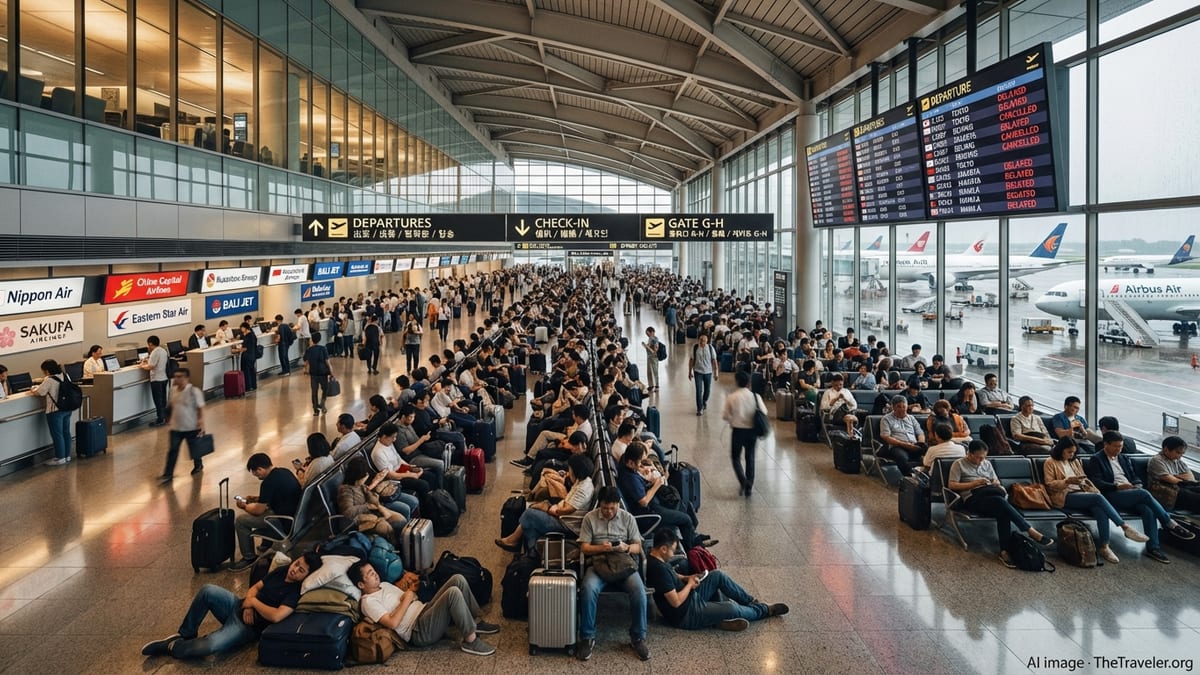
Major Hubs Struggle As Disruptions Cascade Nationwide
Recent operational data and media reports point to mounting disruption across China’s biggest airports, including Beijing’s dual hubs, Shanghai Pudong and Hongqiao, and Guangzhou Baiyun. Flight tracking snapshots from late March and early April 2026 show unusually high delay and cancellation rates on core domestic trunk routes linking these cities, indicating that congestion is no longer confined to isolated regional weather events but has spread into the country’s primary aviation corridors.
Published coverage of a March disruption affecting six airports across China described how knock-on delays originating at Shanghai Pudong quickly propagated through the network, with downstream effects recorded in Guangzhou, Beijing, Chengdu and Shenzhen. These patterns align with long observed vulnerabilities in China’s hub-and-spoke system, where tight aircraft turnarounds and high runway utilization leave limited buffer when weather, airspace constraints or schedule compression push demand beyond capacity.
Industry-facing statistics compiled in early April highlight just how acute the situation has become on selected city pairs. One recent dataset tracking China Eastern flights showed cancellation rates exceeding 70 percent on the busy Shanghai to Guangzhou corridor over a defined period, along with extremely elevated disruption on other Beijing and Shanghai services. While such numbers are often tied to a specific cluster of days, they underscore the degree to which even flagship routes have become susceptible to operational shocks.
Travel demand is adding further strain. According to state media, immigration authorities expect cross-border traffic through major international airports in Shanghai, Guangzhou, Beijing, Chengdu and Shenzhen to surge during the upcoming Qingming Festival holiday from April 4 to 6, with daily crossings projected to exceed 2.3 million. That forecast was issued before the most recent wave of disruptions, raising questions about how efficiently carriers and airport operators will be able to absorb the holiday rush.
Weather, Airspace Bottlenecks and Network Design All Play a Role
Multiple factors appear to be converging behind the latest snarl, rather than a single, clearly defined trigger. China’s civil aviation system frequently contends with springtime weather hazards, from coastal thunderstorms to northern sandstorms, any of which can sharply reduce airport operating capacity for hours at a time. In past years, high winds and sandstorms around Beijing have led to the cancellation of hundreds of flights in a single day, illustrating how quickly conditions can deteriorate across a large metropolitan airspace.
Air traffic management constraints represent a second, persistent challenge. Chinese and international research on “metroplex” terminal areas, including work using Shanghai’s twin-airport system as a case study, has highlighted the chronic tension between rapid aviation growth and finite runway and terminal maneuvering capacity. Even incremental increases in scheduled movements can push delay metrics sharply higher if they are not matched by more efficient sequencing and routing of arrivals and departures.
Network design further amplifies these vulnerabilities. Reports on the March 18 disruption detail how delays at one or two hub airports translated into widespread schedule breakdowns as aircraft and crews failed to arrive in position for subsequent legs. Tight turnaround windows, designed to maximize aircraft utilization, leave little margin for recovery when an inbound flight arrives significantly behind schedule. Once cancellations begin to ripple through the system, stranded planes and displaced passengers can take days to clear.
Rising operational costs and capacity shifts in the wider region may be compounding the squeeze. Industry analysis shows that air freight rates out of China to Europe and North America have climbed sharply since late February 2026, driven by geopolitical disruptions that have reduced global cargo capacity and pushed up fuel prices. As airlines adjust aircraft deployment and schedules in response, passenger networks can experience additional instability, particularly on long-haul routes that interline through Chinese hubs.
Holiday Travelers Face Heightened Risk of Disruption
The timing of the latest operational turbulence is particularly sensitive for travelers planning to cross China or fly abroad during the Qingming Festival. Official projections call for international passenger flows through major Chinese airports to rise more than 10 percent compared with the same period last year, led by Shanghai Pudong, which is expected to handle close to 95,000 inbound and outbound trips per day during the three-day break.
For passengers, the combination of heavier traffic and already-stressed schedules translates into a higher probability of last-minute changes. Recent disruption reports note that thousands of travelers remained in terminals for extended periods as airlines worked through backlogs of delayed and canceled flights at key nodes in the network. Given China’s dense domestic route map, a missed connection at a hub such as Shanghai or Guangzhou can affect not only same-day travel but also onward regional and international itineraries.
Travel observers indicate that Chinese civil aviation rules generally entitle passengers on canceled flights to rebooking or refunds, though timelines and procedures can vary by carrier and the underlying cause of disruption. Where weather or air-traffic restrictions are involved, compensation policies may be more limited, placing a premium on proactive planning. Some consumer-focused advisories now recommend that passengers with time-sensitive plans build in longer connection windows, consider earlier departures, or schedule key trips outside forecast peak travel days when possible.
Online booking and flight-tracking platforms show continuing volatility on routes that rely heavily on the country’s largest hubs, suggesting that conditions may remain unpredictable through the holiday period. Travelers connecting through Beijing, Shanghai, Guangzhou, Shenzhen or Chengdu are being encouraged by industry commentators to monitor flight status closely in the days before departure and to have backup plans in case of extended delays.
Global Ripple Effects Felt on Asia and Long Haul Routes
China’s aviation system sits at the crossroads of many regional and intercontinental networks, so severe disruption at major hubs can quickly spread beyond the country’s borders. Recent coverage of Asia-wide delays in late March described how more than two thousand flights were affected across the region in a single day, with Chinese carriers and airports featuring heavily in delay statistics. When flights into and out of Shanghai or Beijing operate off-schedule, downstream impacts are often recorded at airports in Japan, Southeast Asia and the Middle East.
These ripple effects reach further on long haul services linking China with Europe and North America. Travel and aviation data providers tracking the recovery of transpacific and Eurasian routes have documented uneven performance in recent months, in part because carriers are still rebuilding capacity while contending with new cost and routing pressures. Any fresh wave of disruptions at Chinese hubs can force last-minute aircraft swaps, diversions or cancellations on flights scheduled to connect through those airports.
While some airlines have introduced more conservative scheduling and added recovery buffers since the pandemic years, the concentrated nature of China’s hub system means that major operational shocks remain difficult to isolate. As networks continue to grow and holiday peaks intensify, analysts suggest that sustained improvements in air traffic management efficiency and greater schedule resilience will be needed to prevent episodic disruption from becoming a recurring feature of travel through the country’s key air gateways.