

More news on this day
Travelers passing through Cairo International Airport are facing extensive disruption after a wave of operational problems led to 143 flight delays and 32 cancellations, affecting services operated by EgyptAir, Emirates, Flynas and other regional and international carriers on key routes linking Cairo with Dubai, Beirut and Jeddah.
Get the latest news straight to your inbox!
Major Hub Under Strain as Disruptions Mount
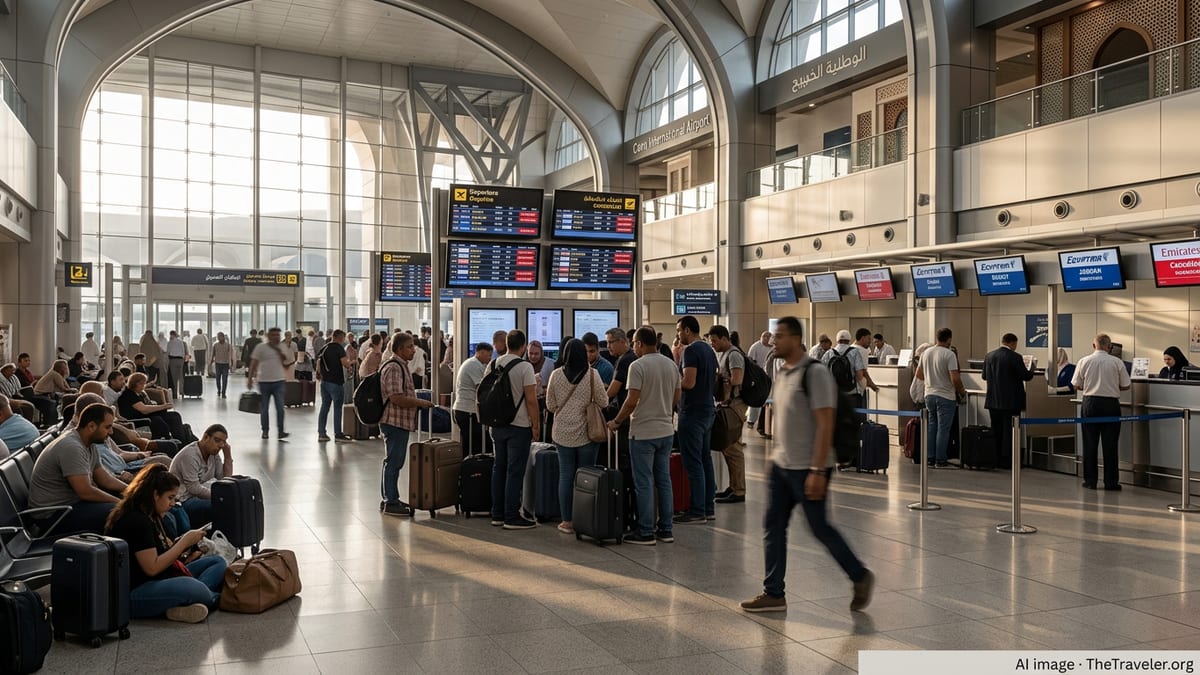
Cairo International Airport, one of the Middle East and North Africa region’s busiest hubs, has been operating under heavy strain as knock-on delays and cancellations ripple across its daily schedule. Publicly available flight-tracking data and media reports indicate that the airport has recorded 143 delayed departures and arrivals alongside 32 outright cancellations over a compressed period, with regional trunk routes among the most affected.
The pattern of disruption has not been limited to a single airline or time window, suggesting that a mix of factors is at play, from upstream delays on incoming aircraft to congestion in crowded air corridors and tight turnaround times on the ground. The result has been extended waits for passengers in departure halls and transfer zones, as well as disrupted connections for travelers relying on Cairo as a gateway between Africa, the Middle East and Europe.
Although Cairo International frequently manages high traffic volumes, the scale of the current disruption has highlighted how quickly operations can become imbalanced when several carriers encounter schedule pressures at the same time. Once banks of flights are pushed back by even short intervals, airport-wide congestion can build, leading to further holds on the taxiways and additional delays to subsequent rotations.
Reports from passenger forums and aviation tracking platforms describe departure boards in certain terminals showing clusters of services marked as delayed by more than an hour, interspersed with cancellations on both regional and long-haul routes. Travelers with tight onward connections in other hubs have been especially vulnerable, facing missed flights and last-minute itinerary changes.
EgyptAir, Emirates, Flynas and Others Hit on Key Routes
Egypt’s flag carrier EgyptAir has been among the airlines most visibly affected, as it operates a dense network through Cairo that relies on short ground times and finely tuned connectivity. When inbound aircraft arrive late or airspace congestion slows arrivals, that wave of disruption can quickly cascade through the carrier’s departure bank, leaving aircraft and crews out of position for later flights.
Emirates, which connects Cairo to its global hub in Dubai, has also seen select services impacted, complicating travel plans for passengers using Dubai for onward connections to Europe, North America and Asia. Changes to flight timings on this route can reverberate across entire itineraries, particularly for travelers on tightly scheduled long-haul journeys.
Saudi low-cost carrier Flynas and other regional airlines operating high-frequency services between Cairo, Jeddah and other Saudi cities have similarly faced schedule pressure. These routes serve a large volume of religious pilgrims, migrant workers and business travelers, and even moderate delays can strain airport processing capacities at both ends of the journey as passenger flows bunch into narrower time windows.
Beirut has also appeared among the cities most affected by the disruption pattern, with select flights between the Lebanese capital and Cairo encountering extended delays or cancellation. For passengers relying on Cairo as a transfer point from Beirut toward the Gulf or Africa, such irregularities have increased the risk of missed connections and extended layovers.
Passengers Confront Long Waits, Missed Connections and Uncertain Plans
For travelers on the ground in Cairo, the operational disruption has translated into long waits at departure gates and transit counters, as well as uncertainty over when or whether their flights will depart. Accounts shared on public travel forums describe passengers monitoring airport screens and airline apps for rolling updates, sometimes seeing their estimated departure times repeatedly pushed back across the day.
Those traveling on multi-leg itineraries have faced particular challenges. Even a delay of 60 to 90 minutes on a regional sector between Cairo and Dubai, Beirut or Jeddah can be enough to jeopardize a long-haul onward flight, requiring rebooking and, in some cases, overnight stays. Families and solo travelers alike have reported the stress of having to rearrange hotel bookings, ground transport and connecting flights while already in transit.
At terminal level, crowded seating areas, extended queues at airline service desks and pressure on food and beverage outlets are common secondary effects when large numbers of flights depart significantly behind schedule. Travelers have reported seeking out quieter corners of the terminal or airline lounges where possible, while others remain close to their assigned gates to avoid missing any sudden changes to boarding calls or gate assignments.
Accessibility and special-assistance needs can become more difficult to manage in such conditions. Elderly passengers, those traveling with small children and individuals with reduced mobility may require additional support when waits extend for hours, particularly if boarding times keep shifting or involve last-minute gate changes within the same terminal.
Operational and Regional Factors Behind the Disruption
While no single root cause has been identified in public reporting, several operational and regional factors likely underpin the scale of disruption visible at Cairo International. Airspace congestion on busy corridors linking North Africa, the Levant and the Gulf can create holding patterns and arrival delays that ripple through airport schedules, particularly at times of day when multiple carriers are funneling flights into the same hubs.
Aircraft and crew rotations are also highly sensitive to earlier delays. If an inbound aircraft arrives late from a previous sector, ground handling teams have less time to complete essential checks, cleaning, refueling and boarding. This can force successive departure banks to run behind schedule, especially for carriers structured around hub-and-spoke operations such as EgyptAir and Emirates.
In parallel, seasonal peaks in travel demand on routes to Dubai, Beirut and Jeddah may be increasing pressure on both airport infrastructure and airline resources. Religious travel periods, regional events and shifting demand patterns can all contribute to sudden surges in passenger numbers, testing the resilience of baggage systems, security checkpoints and immigration desks when flights do not depart as originally planned.
Weather and regional operational constraints can further complicate recovery from disruption, even when conditions over Cairo itself are stable. When upstream flights encounter challenging weather or scheduling restrictions at other airports, aircraft may arrive out of slot or not at all, forcing last-minute cancellations if suitable alternatives are unavailable.
What Travelers Can Do If Flying Through Cairo Now
In light of the current pattern of delays and cancellations, publicly available guidance from airlines and consumer travel resources generally emphasizes proactive monitoring and flexible planning. Passengers scheduled to travel through Cairo in the coming days are widely advised to check their flight status frequently via airline apps or airport information services, particularly in the 24 hours before departure and again on the day of travel.
For those connecting through Cairo on itineraries involving Dubai, Beirut or Jeddah, leaving additional buffer time between flights can reduce the risk of missed onward connections. When booking new trips, selecting slightly longer layovers rather than minimum connection times may provide greater protection against moderate delays on the first leg.
Travelers already at the airport who encounter significant delays or cancellations can often explore same-day alternatives, including rerouting through other regional hubs where capacity is available. Publicly available information indicates that some carriers are offering rebooking options in the event of disrupted services, although the precise terms vary by ticket type, routing and the cause of delay.
Given the fluid nature of the situation, experts who comment publicly on air travel disruptions generally recommend that passengers keep documentation of delay times, boarding passes and any additional expenses incurred. Such records can be useful when seeking compensation or reimbursement under applicable airline policies or consumer protection frameworks, once operations have stabilized and full details of each disruption are available.