

More news on this day
Thousands of passengers across Australia and New Zealand are facing severe disruption as nearly 100 flights are cancelled and more than 1,100 delayed across major hubs in both countries, with services operated by Jetstar, Qantas, Virgin Australia, Air New Zealand and several other carriers affected.
Get the latest news straight to your inbox!
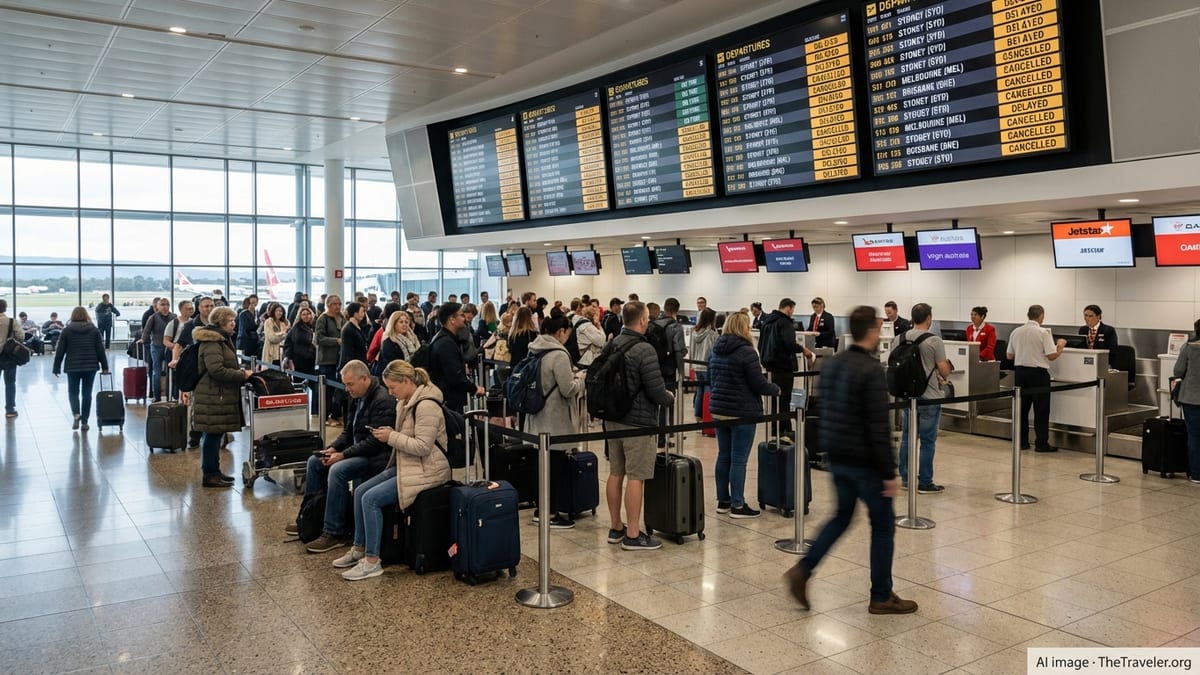
Wide-Scale Disruptions Across Trans-Tasman Network
Publicly available flight-tracking and airport operations data indicate a combined tally of 97 cancellations and 1,127 delays across key airports including Melbourne, Sydney, Auckland and Wellington, alongside secondary hubs such as Brisbane, Adelaide, Christchurch and Queenstown. The impact is being felt most acutely on the busy trans-Tasman and domestic trunk routes where high passenger volumes leave little slack in schedules.
The disruptions are affecting short-haul domestic services as well as medium-haul international connections, resulting in missed onward flights for many travellers. Reports from airline status boards and aviation data providers show a rolling pattern of delays building through the day, with early operational issues compounding as aircraft and crew struggle to return to planned rotations.
Carriers most visibly affected include Jetstar, Qantas, Virgin Australia and Air New Zealand, which collectively operate a large share of services between Australia and New Zealand and on domestic routes within each country. A mix of regional and international airlines using the same airports are also recorded as experiencing knock-on delays, particularly on services timed to connect with trans-Tasman flights.
In several instances, flights that did operate departed significantly behind schedule, which in turn contributed to late arrivals and missed curfews, especially at airports with strict overnight operating limits. This has further constrained airlines’ ability to recover normal schedules before the next day’s peak periods.
Impact on Travellers: Long Queues, Lost Holidays and Missed Events
Across Melbourne, Sydney, Auckland and Wellington, passenger terminals have seen periods of heavy congestion as travellers contend with rolling cancellations and delays. Social media posts and local broadcast coverage describe long queues at check-in and service desks, crowded departure halls and difficulties securing timely information on revised departure times.
For many travellers, the disruption is not limited to a few hours’ delay. With popular leisure and business routes already heavily booked, re-accommodation options are limited, particularly for larger groups and those needing to connect with long-haul services to Asia, North America and Europe. Some passengers have reportedly faced overnight stays in transit cities, additional accommodation costs and the loss of prepaid holiday arrangements and events.
Families travelling with children and older passengers appear especially affected by extended waits and last-minute schedule changes. In some cases highlighted in local media, travellers have been rebooked via complex multi-stop routings in order to reach their destinations, increasing total travel times by many hours.
Travel insurers and consumer advisory groups in both countries are reminding passengers to keep documentation of additional expenses such as hotels, meals and ground transport, as these may be necessary for any later claims under policy terms or applicable consumer protection frameworks.
Operational Pressures and Weather Complications
Aviation analysts note that the current wave of cancellations and delays reflects a combination of factors rather than a single underlying cause. Publicly available information points to a mix of adverse weather conditions, air traffic management constraints and airline operational challenges including aircraft availability and crew rostering.
Weather-related disruption, particularly low cloud and strong winds on both sides of the Tasman, has periodically reduced runway capacity at key airports, forcing temporary schedule reductions and diversions. When combined with already tight turnarounds for many low-cost and full-service carriers, even short interruptions can reverberate across the day’s operations.
Industry observers also highlight that several airlines in the region continue to operate with limited spare aircraft and lean staffing levels after years of restructuring and demand swings. This leaves carriers with less flexibility to recover quickly from unexpected technical issues, crew sickness or late inbound flights, increasing the likelihood that isolated problems escalate into network-wide delays.
Data from government on-time performance statistics in recent months has already pointed to elevated cancellation and delay rates on some of the busiest domestic routes in Australia and New Zealand. The latest disruptions appear to be amplifying those existing trends, particularly on corridors such as Sydney to Melbourne and Auckland to Wellington.
Consumer Rights and What Stranded Passengers Can Do
The scale of disruption has renewed attention on passenger rights frameworks in both countries. Consumer advocacy organisations and travel law specialists have been reiterating that travellers affected by cancellations and significant delays may be entitled to assistance or compensation, depending on the cause of disruption, the airline involved and the jurisdiction under which the ticket was sold.
In New Zealand, publicly available guidance from regulators outlines specific obligations for airlines when flights are cancelled or significantly delayed for reasons within a carrier’s control, such as maintenance or staffing issues. These can include providing meals, accommodation and alternative transport arrangements within defined limits. Weather-related disruptions are often treated differently, with more limited entitlements.
Australia has a different framework, relying more heavily on individual airline conditions of carriage and general consumer law. Published coverage notes that major carriers operating domestic and trans-Tasman services have varying policies on meal vouchers, hotel stays and rebooking options when flights are cancelled or heavily delayed. Passengers are encouraged to review airline policies and retain receipts for out-of-pocket costs that might later be recoverable.
Travel experts recommend that stranded passengers make use of airline mobile apps and online tools where possible to rebook seats or track schedule changes, as physical service counters can quickly become overwhelmed during major disruptions. At the same time, they advise checking the status of connecting flights and accommodation bookings proactively, rather than waiting until arrival at a transit point.
Outlook for Schedules in the Coming Days
While airlines are working to stabilise their operations, the volume of aircraft and crew displaced by the latest wave of cancellations and delays means that some residual disruption is likely to persist into coming days. Published industry commentary suggests that recovering normal patterns on busy trans-Tasman and domestic routes can take several schedule cycles, particularly when aircraft are out of position or maintenance slots need to be rescheduled.
Airlines are expected to prioritise core business and leisure routes between major centres such as Melbourne, Sydney, Brisbane, Auckland, Wellington and Christchurch in order to restore connectivity for the greatest number of passengers. However, this can result in thinner schedules and occasional cancellations on less frequent regional services as operators concentrate resources on trunk corridors.
Passengers with upcoming travel are being urged, through airline advisories and local media reports, to monitor flight statuses closely before heading to the airport, arrive earlier than usual for check-in and security, and keep contingency plans in mind for possible schedule changes. Flexible tickets, where available, and comprehensive travel insurance may offer additional protection for those with time-sensitive commitments.
The latest round of disruption underscores the continued fragility of airline schedules across Australia and New Zealand, where high demand and operational constraints leave little margin for error. For travellers, it serves as a reminder to build extra time into itineraries and to be prepared for rapidly shifting circumstances at some of the region’s busiest airports.