

More news on this day
Hundreds of travellers were left stranded across Brazil after a fresh wave of flight delays and cancellations at São Paulo–Congonhas, São Paulo–Guarulhos and Porto Alegre’s Salgado Filho airports disrupted schedules for LATAM, GOL, Azul, VOEPASS and other carriers, with at least 76 services delayed and 23 cancelled according to early operational tallies on Sunday.
Get the latest news straight to your inbox!
Major Hubs in São Paulo and Porto Alegre Hit Simultaneously
Operational data and local media coverage indicate that the disruption unfolded across Brazil’s busiest domestic corridors, centering on São Paulo–Congonhas (CGH), São Paulo–Guarulhos (GRU) and Salgado Filho International Airport (POA) in Porto Alegre. The three hubs form critical links in Brazil’s aviation network, funnelling passengers between the country’s south and southeast regions.
Reports show that a combined total of 76 flights were delayed and 23 cancelled across these and other affected airports over the course of the day, leaving departure boards dominated by warnings of hold‑ups and last‑minute schedule changes. The majority of the affected services were short‑haul domestic routes, intensifying crowding in terminal departure lounges as passengers waited for new departure times.
Publicly available tracking information suggests that knock‑on effects extended beyond São Paulo and Porto Alegre, as aircraft and crews scheduled to operate subsequent legs were held out of position. Secondary airports that depend on connections through these hubs, particularly in the south and southeast, reported scattered delays through the afternoon and evening as airlines attempted to restore normal operations.
LATAM, GOL, Azul and Regional Operators Among Those Affected
Brazil’s three largest carriers, LATAM, GOL and Azul, were among the airlines most heavily impacted. Their dense networks at Congonhas and Guarulhos meant that even limited airfield or airspace constraints quickly cascaded across multiple rotations, stranding passengers on both origin and connecting flights. Some services operated with multi‑hour delays, while others were scrubbed entirely as the operating window narrowed.
Regional operator VOEPASS, along with smaller and codeshare partners, also appeared in disrupted schedules, particularly on feeder routes into major hubs. While VOEPASS has faced separate regulatory and financial challenges in recent years, its inclusion among the airlines listed in disruption reports underscores the vulnerability of thinner regional services when major hubs experience irregular operations.
Information published by consumer channels showed that some travellers were reprotected onto later flights or rerouted through alternative airports, but capacity constraints limited options on busy domestic routes. Passengers on multi‑segment itineraries involving São Paulo or Porto Alegre often faced missed connections and unplanned overnight stays, especially when onward flights departed from different airports within the metropolitan area.
Operational Pressures Expose Fragility of Brazil’s Domestic Network
Analysts following Brazilian aviation note that congestion at Congonhas and Guarulhos, combined with variable weather and tight aircraft utilisation patterns, can quickly expose fragilities in domestic schedules. When multiple hubs are affected on the same day, small timing disruptions can compound into widespread delays, mirroring the pattern seen in this latest incident.
Publicly available airport statistics show that Congonhas and Guarulhos rank among the country’s busiest airports by passenger volume, handling a high proportion of Brazil’s business and connecting traffic. Salgado Filho in Porto Alegre, while smaller, acts as a key gateway for the south, funnelling travellers to São Paulo and beyond. Any constraints on runway capacity, ramp operations or air traffic flow at these locations tend to ripple outward across the network.
Observers point out that Brazil’s aviation sector has been rebuilding capacity after several years of volatility, including pandemic‑related reductions and airline restructurings. As demand returns and new routes are added, operational buffers can become thinner, leaving less room for recovery when irregular operations strike, particularly during busy weekends and holiday peaks.
Travellers Face Long Queues, Rebookings and Uncertain Timelines
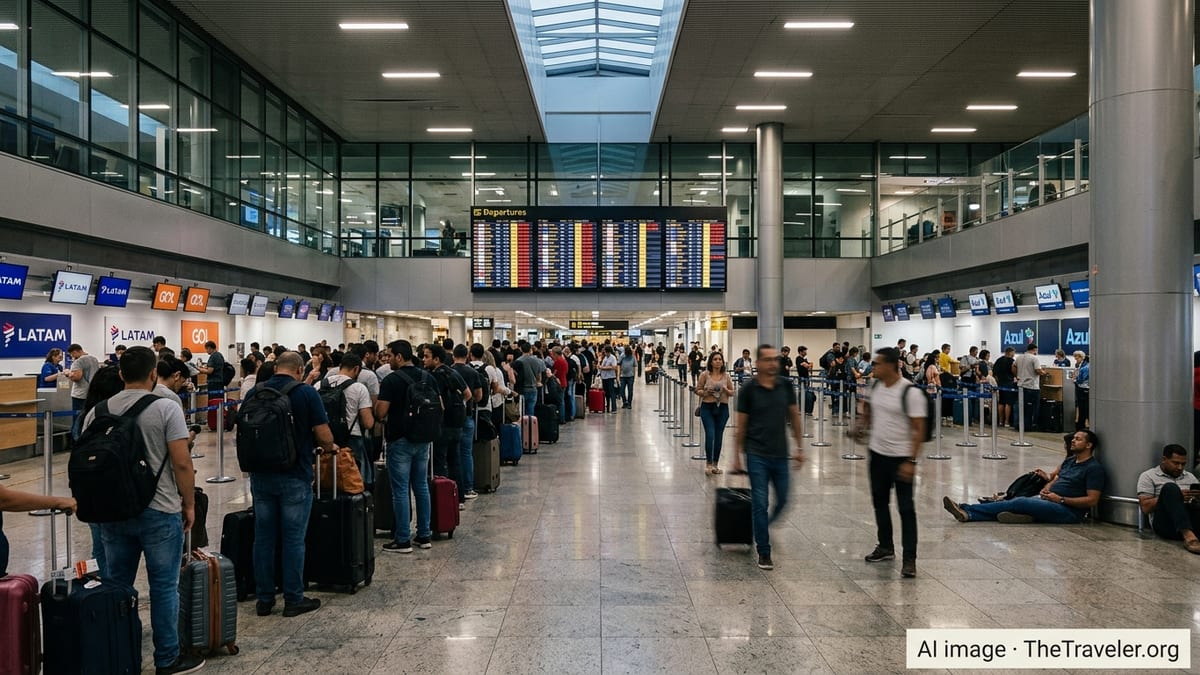
Social media posts and consumer helpline forums on Sunday showed images of crowded check‑in halls and gate areas at Congonhas, Guarulhos and Salgado Filho, with travellers lining up to seek rebooking options or clarification on revised departure times. Many reported extended waits at service desks as airline staff attempted to process a surge of last‑minute itinerary changes.
Publicly shared itineraries suggest that travellers on tight connections, especially those transferring between Guarulhos and Congonhas or continuing to late‑evening departures, were among the hardest hit. Missed onward flights often meant unplanned overnight stays in São Paulo or Porto Alegre, with passengers attempting to secure hotel vouchers or reimbursements in line with Brazil’s passenger‑rights framework.
Some accounts described families and international visitors struggling with language barriers and limited information on the cause and expected duration of the disruption. Others indicated that digital tools such as airline apps and messaging channels helped some travellers secure alternative flights without joining physical queues, although platform overload and inconsistent updates remained a concern for many.
Airlines Work to Stabilise Schedules as Investigations Continue
By late evening, operational dashboards indicated a gradual reduction in the number of active delays as airlines worked to reposition aircraft and crews. However, aviation analysts warned that residual disruptions could continue into subsequent days, as early‑morning rotations rely on aircraft that may not have reached their planned overnight bases.
Regulatory and meteorological data released publicly will be closely examined in the coming days to clarify the combination of factors behind the irregular operations, including potential weather impacts, airspace constraints, infrastructure issues or technical incidents. Industry observers consistently highlight that major hubs such as Congonhas, Guarulhos and Salgado Filho operate with limited margin for disruption, increasing the importance of coordinated planning between airlines, airport operators and air navigation services.
For affected travellers, consumer advocates recommend closely monitoring booking channels, accepting earlier rebooking options when offered and allowing additional time for cross‑airport transfers in metropolitan São Paulo. As Brazil’s domestic network continues to grow in complexity and volume, episodes like this latest disruption underscore the importance of contingency planning for both carriers and passengers on the country’s busiest routes.