

More news on this day
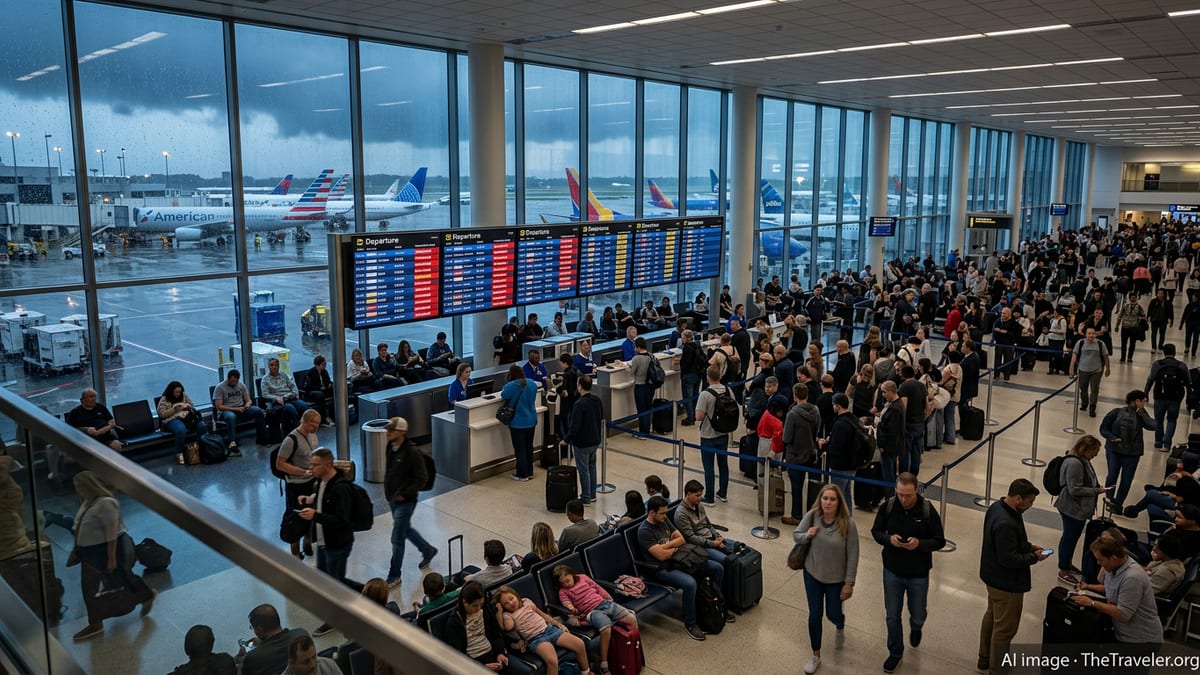
More than 4,000 U.S. flights were canceled and over 9,000 delayed on Monday as powerful storm systems disrupted operations at major hubs including Miami, Chicago, Houston, Charlotte and Boston, creating widespread travel turmoil for passengers across the country.
Get the latest news straight to your inbox!
Storm Systems Stall Major Airline Networks
Publicly available tracking data shows that a series of fast-moving storm fronts, bringing high winds, heavy rain and embedded thunderstorms, pushed across large swaths of the South, Midwest and East Coast, overwhelming the tightly choreographed U.S. airline network. The impact has been felt most acutely at high-volume hubs where even brief ground stops and runway flow restrictions can cascade into nationwide disruption.
American, Delta, Southwest, United, JetBlue and several smaller carriers have all reported elevated cancellation and delay rates, with some hubs seeing large portions of their schedules affected at peak times. Aviation data dashboards indicate that cancellations climbed into the thousands by midday while delay counts rose steadily through the afternoon as storms repeatedly re-formed over key corridors.
Operational planners have been juggling rolling thunderstorms in the Southeast, low ceilings and wind at Midwestern airports, and a zone of unsettled weather along the Northeast coast. As aircraft and crews fell out of position, airlines began preemptively trimming schedules and consolidating flights in an effort to stabilize operations for later in the week.
The disruption has been compounded by the interconnected nature of hub-and-spoke routing. Aircraft that began the day in relatively calm regions have still been pulled into the storm’s orbit as downstream legs into Chicago, Houston, Charlotte or Boston encountered ground stops or lengthy arrival metering programs.
Miami, Chicago and Houston Bear the Brunt
Miami International has emerged as one of the hardest-hit gateways, with strong winds and convective cells offshore periodically slowing arrivals and departures. Tracking sites show elevated delay averages for both inbound and outbound flights, affecting not only domestic routes but also connections to Latin America and the Caribbean. Airlines with a heavy Miami footprint have faced difficult choices about which routes to operate, which to consolidate and which to cancel outright.
In Chicago, passengers at O’Hare have described hours-long waits as wind and passing storms forced changes in runway configurations and limited the rate at which flights could safely take off and land. Social media posts from travelers reference departure boards dominated by delayed and canceled flights, with some airlines scrubbing entire waves of regional departures as conditions worsened.
Houston’s primary international hub has also experienced significant disruption as bands of severe weather moved across Texas. High winds and lightning in the vicinity of the airfield intermittently halted ramp activity, slowing the loading and unloading of aircraft and forcing crews to temporarily stand down for safety. These pauses, even when brief, have contributed to mounting knock-on delays across afternoon and evening banks of flights.
Data from recent storm events suggests that when multiple high-volume hubs such as Miami, Chicago and Houston are constrained simultaneously, the U.S. system has limited flexibility to absorb shocks. Flights that might typically be rerouted through alternate airports instead encounter congestion at those backups, amplifying the disruption.
Charlotte, Boston and Other Hubs Struggle to Recover
Further along the East Coast, Charlotte and Boston have faced their own operational challenges as the same weather pattern sweeps northeast. Charlotte, a crucial connecting point for passengers traveling along the Eastern Seaboard and into smaller regional markets, has seen morning and midday departures particularly affected. When early flights are delayed or canceled, later connections often lack available seats, leaving travelers with limited same-day alternatives.
Boston Logan has contended with low clouds, gusty coastal winds and passing showers, conditions that can force wider spacing between aircraft on approach and departure. Publicly available coverage of similar recent storms shows that Boston’s coastal location and runway layout often make it vulnerable to weather-related flow restrictions, and Monday’s pattern has again exposed those sensitivities.
Secondary hubs and large focus cities have not been spared. Reports highlight issues at airports such as Atlanta, New York-area fields, Washington National and others experiencing temporary ground delays ordered by traffic managers as cells of severe weather drift through their approach corridors. Each localized slowdown sends ripples through the broader schedule as crews and aircraft miss carefully planned connection windows.
Regional airports that depend heavily on feed from these hubs have in turn seen flights arrive late or not at all. Travelers at smaller fields report early-morning cancellations tied to aircraft that never departed the previous night’s storm-affected stations, illustrating how quickly hub disruptions propagate outward.
Airlines Deploy Contingency Measures and Schedule Cuts
To cope with the mounting impact, airlines have implemented a range of standard severe-weather responses. Public advisories detail flexible rebooking waivers for affected cities, encouraging passengers with nonessential travel to shift itineraries to later days. Some carriers have pulled down schedules in advance for the hardest-hit periods, cancelling selected flights early rather than allowing rolling delays to accumulate throughout the day.
Operationally, crews have been repositioned where possible, and larger aircraft substituted on some routes to accommodate displaced passengers from multiple canceled flights. On key trunk routes serving hubs like Miami, Chicago, Houston and Boston, widebody jets that might normally operate long-haul international services have in some cases been reassigned to high-demand domestic legs to help clear backlogs more quickly.
However, limitations on crew duty time, the finite availability of spare aircraft and the need to maintain safety margins in deteriorating weather have constrained how aggressively airlines can respond. Even when storms move out of a region, residual disruptions often linger into the next day as aircraft and crew rotations are rebuilt and maintenance schedules catch up.
Travel industry analysts note that severe-weather playbooks have become more sophisticated in recent years, with carriers relying on improved forecasting and data-driven models to decide when to pre-cancel and when to hold flights. Nonetheless, the scale of Monday’s multi-hub disruption underscores the difficulty of fully insulating passengers from the effects of widespread storms.
What Passengers Are Experiencing on the Ground
For travelers, the operational complexity translates into hours of uncertainty at crowded terminals. Passengers at affected hubs report repeated gate changes, creeping departure times and long lines at customer service counters as they seek new routing options. Families and business travelers alike have described missed connections, overnight stays in unexpected cities and the challenge of finding hotel rooms near airports already straining under the surge in stranded guests.
In many cases, travelers have turned to airline mobile apps and text alerts as their primary source of real-time information, monitoring shifting departure estimates and rebooking options. When storms affect multiple hubs at once, available seats on alternate flights tend to disappear quickly, pushing some rebookings several days into the future, particularly on popular business and leisure routes.
Airport operations teams have also come under pressure to manage longer dwell times in gate areas and security zones. With passengers remaining in terminals for extended periods, concessionaires and lounges have seen heavy demand, while ground transportation services report surges as some travelers abandon air plans in favor of driving to their destinations.
As storm systems gradually move away from the nation’s busiest air corridors, focus is shifting to how quickly airlines can restore normal operations. Experience from recent large-scale weather disruptions suggests that even after skies clear, full recovery can take several days, especially when cancellations exceed several thousand flights in a single day and delays run into the high four-figure range.