

More news on this day
Travelers across Europe faced another day of disruption on April 6 as severe spring weather, congestion and ongoing airspace complications converged to delay and divert flights, with Athens International Airport among the hubs reporting significant operational strain.
Get the latest news straight to your inbox!
Storm Systems Combine With a Fragile European Network
Reports from aviation data providers and European transport coverage indicate that a series of slow-moving storm systems over the first week of April has brought heavy rain, low cloud and gusty winds to several key air corridors, amplifying existing pressure on air traffic control capacity. While disruptions are scattered across the continent, they are clustering around major hubs where traffic density is highest and margins for delay are already slim at the start of the busy spring travel season.
Weather-sensitive airports in Western and Central Europe have seen waves of delays ripple through their schedules as thunderstorms and reduced visibility trigger spacing requirements between arrivals and departures. Once ground delay programs are imposed at one or two major hubs, knock-on effects are felt hundreds of miles away as aircraft and crews miss connections and rotations, effectively exporting disruption along the network.
Industry trend reports from Eurocontrol and regional punctuality studies have repeatedly highlighted that adverse weather is no longer a rare shock but a recurring driver of minutes lost across European airspace. The latest disturbance is unfolding against that backdrop of chronic congestion, with airlines operating tight timetables on near-full fleets, leaving limited resilience when storms and strong winds coincide with peak holiday flows.
Operational summaries published over the weekend suggest that while outright cancellations have been contained at many airports, the number of late arrivals and missed slots has surged. This has forced carriers to trim frequencies, consolidate services and reassign aircraft at short notice, contributing to longer queues at check-in and security as passengers seek rebooking options.
Athens Airport Feels the Strain After a Winter of Airspace Scares
At Athens International Airport, publicly available flight boards on April 6 showed a modest number of outright cancellations but a much larger wave of delayed departures and arrivals, particularly on intra-European routes connecting Greece with northern hubs. Travel-focused outlets tracking the situation reported dozens of services running behind schedule, with some short-haul sectors leaving more than an hour late as aircraft arrived out of sequence from weather-affected airports further west.
The current round of delays comes only weeks after Greece’s airspace was thrust into the spotlight by a serious communications failure affecting the Athens Flight Information Region in early January. At that time, air traffic controllers were forced to fall back on contingency procedures, and Greece briefly halted or heavily constrained movements, leaving thousands of passengers stranded across Europe while aircraft held or diverted to alternate airports.
Discussion papers and union statements released since that incident have drawn attention to concerns over the robustness of navigation and communications systems supporting Greek airspace. Operational data from punctuality reports already noted recurrent flow restrictions linked to air traffic control capacity at Athens prior to the January episode, suggesting that the system was under stress even before the latest round of spring weather disruption.
As a result, this week’s delays at Athens are unfolding in a context where both the physical infrastructure and the management of airspace are under scrutiny. For travelers, the distinction between weather-related disruption and issues linked to outdated systems or staffing constraints is often academic, but it is likely to matter later for any compensation claims under European passenger-rights rules.
Middle East Airspace Crisis Rewrites Flight Paths to and from Greece
Beneath the immediate weather problems lies a deeper structural challenge: the ongoing conflict in the Middle East and the associated closure or restriction of key airspace corridors. Eurocontrol’s latest trend analysis points to a marked reduction in flights between Europe and parts of the Gulf and wider region, with Greece counted among the markets showing a significant drop in routes as carriers reroute or suspend services.
Coverage in Greek and regional business media notes that Athens, which had become a convenient gateway between Europe and the eastern Mediterranean, has been particularly exposed to these shifts. Routes that once overflew conflict-affected areas now follow longer, more northerly or southerly tracks, increasing flight times and fuel burn. In parallel, some direct links have been thinned out or paused altogether, reducing the connectivity that helped support Greece’s growing year-round tourism and business travel segments.
The resulting pattern is a patchwork of new and adjusted services. Some Gulf and regional carriers are adding or reshaping flights to Athens in an effort to preserve links around the temporarily closed Bahrain airspace and other restricted zones, while European airlines weigh the economics of sustaining longer routings. For passengers, this can translate into schedule changes at short notice and a greater dependence on a handful of key hubs that still offer viable connections between Greece, the Middle East and onward long-haul destinations.
These shifting flows also have practical consequences during periods of bad weather. When a storm or air traffic control restriction hits one of the remaining major transfer points, there are fewer alternative paths available to reroute aircraft without encroaching on closed or sensitive airspace. That reality is contributing to the cascading nature of the current disruption, where a localized thunderstorm in one region can be felt in delay statistics at airports as far away as Athens.
Passengers Confront Long Queues, Uncertain Rights and Patchy Information
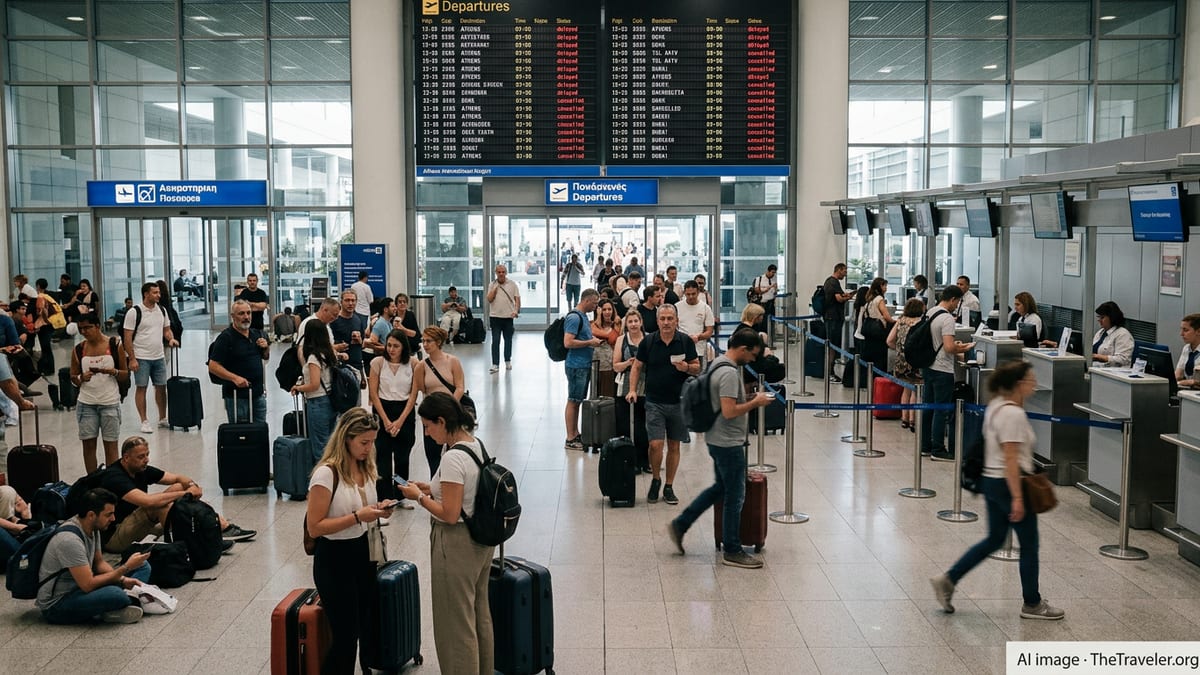
On the ground, the impact of the latest disruptions is visible in crowded departure halls and lengthening customer-service lines at airports across Europe. Social media posts and traveler reports from Athens and other hubs describe passengers waiting for updated departure times and guidance on rebooking, particularly on multi-leg itineraries where a delayed European feeder flight can jeopardize a long-haul connection.
Consumer-advocacy groups and specialized air passenger rights platforms are using the current turmoil to remind travelers of their entitlements under EU261. Passengers facing cancellations or long delays that are not exclusively the result of extraordinary circumstances, such as uncontrollable weather or sudden airspace closures linked to security concerns, may be eligible for financial compensation in addition to rerouting or refunds. However, the mixed causes in the present situation make the picture more complex.
Legal commentators note that when disruptions stem from a blend of severe weather, chronic capacity limitations and earlier operational decisions, the line between what is considered “extraordinary” and what falls under normal airline responsibility becomes blurred. For example, an initial weather delay can trigger crew-duty timeouts or expose weaknesses in scheduling and de-icing capacity, raising questions about how much of the eventual disruption truly lies beyond a carrier’s control.
For travelers caught in the middle, the most immediate concern is often access to clear, timely information. Public guidance from airports and airlines continues to emphasize checking official flight-status tools and mobile apps before heading to the airport, as well as monitoring email and text alerts for last-minute gate changes. In Athens and other affected hubs, passengers are being advised to allow extra time for check-in and security, and to be prepared for potential overnight stays in case knock-on delays extend into the following day.
Outlook for Greece’s Crucial Spring and Summer Travel Season
The latest flare-up of disruptions comes at a sensitive time for Greece, which relies heavily on aviation to support its tourism-driven economy. With Easter travel underway and the peak summer season approaching, airlines and airport operators are under pressure to demonstrate that the country’s gateways, including Athens, can absorb high volumes of traffic despite both weather volatility and regional geopolitical tension.
Eurocontrol’s forward-looking assessments for 2026 foresee continued growth in European flight numbers, but also warn that congestion and weather-related delay minutes are likely to remain elevated without significant investment in air traffic management and digital systems. For Greece, which has already experienced a high-profile airspace incident this year, the case for accelerating modernization of communications and control infrastructure is gaining prominence in public debate.
Tourism analysts point out that travelers have become more sensitive to reliability when choosing routes and carriers, especially after repeated episodes of large-scale disruption in recent years. If Athens and other Greek airports are perceived as vulnerable to recurring bouts of chaos, some visitors may opt for alternative gateways in neighboring countries, even when Greece remains their final destination.
In the short term, the focus remains on stabilizing schedules once the current weather patterns ease. Airlines serving Greece are expected to gradually restore regular timetables, but experience from previous disruption events suggests that residual delays can persist for several days as aircraft and crews return to their planned rotations. For passengers planning to pass through Athens or other European hubs in the coming week, the advice from travel experts is clear: build in extra buffer time, keep a close eye on flight status, and be prepared for plans to change at short notice.