

More news on this day
Severe winter weather sweeping across several Chinese regions has triggered widespread air travel disruption, with 60 flights scrapped and 1,046 delayed across key domestic routes operated by Air China, China Eastern, and China Express Airlines, leaving thousands of passengers stranded at major hubs in Beijing, Shanghai, and Chengdu.
Storm Systems Trigger Chain Reaction of Cancellations
The latest disruption was driven by a combination of heavy snow, freezing rain, and dense fog that moved across northern and western China, affecting flight operations from the early hours of the morning. Aviation data from Chinese flight-tracking platforms showed sharp spikes in delay ratios at major airports as visibility dropped and de-icing queues lengthened on taxiways.
Air China and China Eastern both reported that the bulk of affected services were short-haul domestic routes linking Beijing, Shanghai, and Chengdu with secondary cities in the north and northwest, where conditions deteriorated fastest. China Express Airlines, which relies heavily on regional airports in interior provinces, also saw multiple rotations scrapped when local airfields temporarily suspended operations due to low visibility and contaminated runways.
While the 60 outright cancellations helped ease pressure on ground handling and air traffic control, they also contributed to a backlog of displaced travelers. The 1,046 delayed services created knock-on effects throughout the day, with some late-evening departures pushed past curfew windows and ultimately forced to turn into overnight postponements.
Airport authorities in Beijing, Shanghai, and Chengdu said safety remained the overriding priority, noting that runway braking action, crosswinds, and visibility readings had periodically fallen below operating minima, leaving controllers with little choice but to slow or temporarily halt movements.
Beijing, Shanghai, and Chengdu Bear the Brunt
Beijing Capital International Airport and the newer Beijing Daxing International Airport reported some of the highest concentrations of disruption, reflecting their role as primary hubs for Air China and important transfer points for China Eastern and China Express codeshares. Long queues formed at check-in and transfer desks as passengers sought rebooking options for missed connections to inland cities.
In Shanghai, where both Pudong and Hongqiao airports serve as key bases for China Eastern, dense morning fog forced multiple go-arounds and diversions, stretching air traffic control capacity and limiting available arrival slots. Many flights that did land were held on remote stands while ground teams cycled aircraft through de-icing and safety inspections, further slowing the turnaround of departing services.
Chengdu, a critical gateway to western China and a major base for Air China and regional partners, saw its schedule heavily compressed as the weather front moved through Sichuan. With a large share of connecting traffic heading toward high-altitude and weather-prone destinations in the northwest, airlines opted to proactively cancel or consolidate some rotations rather than risk extended airborne holding patterns or last-minute diversions.
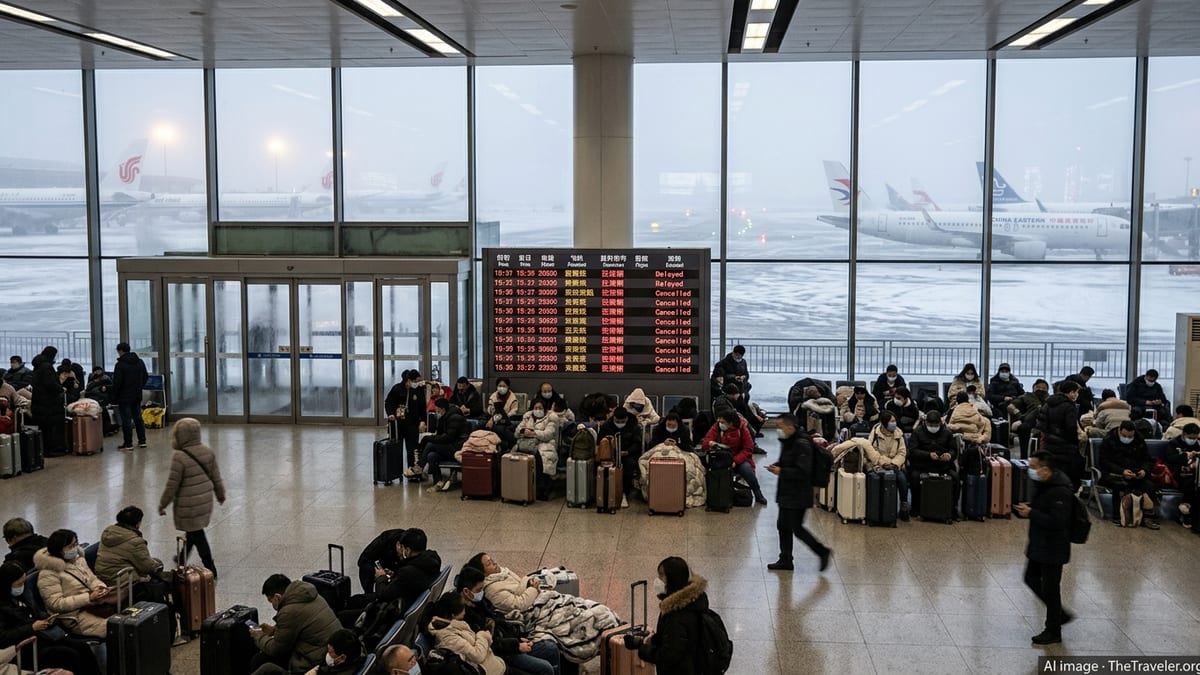
Scenes in all three hubs were marked by crowded departure halls, exhausted travelers sleeping on luggage, and long waits for updated boarding information. Airport loudspeakers repeatedly relayed warnings that further delays were likely as the weather system continued to evolve through the evening.
How Air China, China Eastern, and China Express Responded
Air China implemented an expanded irregular-operations plan, including free rebooking for passengers on affected routes and, where capacity allowed, priority standby lists on alternative departures the same or following day. The carrier also deployed additional customer-service teams at hub airports to manage queues and to direct travelers to self-service kiosks for itinerary changes where those remained functional.
China Eastern offered fee waivers for one-time changes on tickets touching disrupted airports within a defined travel window, encouraging passengers with flexible plans to move journeys to later dates. The airline said it was working to upgauge certain trunk routes between Beijing, Shanghai, and Chengdu to larger aircraft once conditions permitted, in order to clear the backlog more quickly.
China Express Airlines, whose network is particularly vulnerable to localized closures at smaller regional airports, focused on consolidating passengers from multiple canceled regional legs onto fewer, weather-viable departures. The carrier advised travelers originating from remote cities to check status repeatedly before heading to the airport, noting that runway and visibility assessments at smaller fields can change rapidly.
All three airlines reiterated that compensation and accommodation policies would vary depending on whether delays and cancellations were classified as weather-related, which typically places them outside standard liability rules. However, they pledged to provide basic assistance such as meal vouchers, bottled water, and overnight arrangements in cases where passengers were stranded far from home without immediate rebooking options.
What Passengers on Affected Flights Need to Know
Travelers whose flights were among the 60 cancellations are being urged to use official airline apps, customer hotlines, and airport service counters to confirm whether they have been automatically rebooked or must manually select a new departure. Same-day alternatives remain limited on heavily affected routes, particularly in and out of Beijing and Chengdu, where spare seats were quickly snapped up.
Those facing delays rather than cancellations are advised to remain close to their departure gates, as airlines attempt to compress turnaround times once operating conditions briefly improve. Boarding times can shift with little notice when gaps in air traffic flow open up, and carriers often prefer to dispatch ready flights quickly to prevent further schedule slippage later in the day.
Passengers with tight onward connections, especially international legs from Beijing or Shanghai, are being encouraged to proactively contact their airlines to explore rerouting via alternative hubs or rescheduling to future dates. Travel agents and online booking platforms across China have reported a surge in change requests, and some are temporarily prioritizing customers with same- or next-day travel to manage demand.
For travelers who decide to postpone trips entirely, most economy tickets purchased directly from Air China, China Eastern, or China Express on impacted dates can be changed without standard modification fees, although fare differences may still apply. Policies for tickets bought through third-party platforms or issued as part of package tours may differ, and passengers are being urged to review fine-print conditions before making changes.
Outlook for the Coming Days and Practical Advice
Meteorological forecasts suggest that the most severe band of wintry weather will gradually shift eastward and weaken over the next 24 to 48 hours, which should allow flight operations to stabilize progressively at Beijing, Shanghai, and Chengdu. However, residual delays are likely to persist as airlines reposition aircraft and crews and work through the backlog of displaced passengers.
Industry analysts note that Chinese carriers and airports have become more proactive in pre-emptive cancellations during severe weather events, preferring early schedule cuts over ad hoc, last-minute disruptions that can leave aircraft and crews out of position for days. While this approach can be frustrating for affected travelers, it often shortens overall recovery times once conditions improve.
Passengers with flights scheduled over the next few days are advised to monitor status updates closely and to allow extra time for check-in, security, and potential terminal transfers, especially in Beijing and Shanghai where airport layouts are extensive. Travelers should also keep boarding passes, receipts for meals and accommodation, and any written notices from airlines, as these may be needed later for insurance claims or reimbursement requests.
For now, the combination of winter weather and peak travel demand is expected to keep pressure on China’s air transport system. Travelers planning essential journeys through Beijing, Shanghai, or Chengdu are being urged to build in generous buffers, remain flexible with routing and timing, and stay engaged with real-time updates from airlines and airports as the situation evolves.