

More news on this day
Severe winter weather across parts of China and Southeast Asia has led to 17 flight cancellations and 154 delays on China Express, Air China and Cambodia Airlines, leaving hundreds of passengers stranded and scrambling for alternatives at major hubs in Beijing, Chengdu and Ho Chi Minh City on Friday.
Storm Systems Trigger Chain Reaction of Disruptions
According to operational data from airport authorities and the three carriers, a fast-moving cold front over northern and western China combined with heavy rain and low cloud over southern Vietnam has created challenging conditions for pilots and air traffic controllers. The most significant impacts are being felt at Beijing Capital International Airport, Chengdu Tianfu International Airport and Ho Chi Minh City’s Tan Son Nhat International Airport, where visibility has periodically dropped below safe landing thresholds.
Air China has been hardest hit at Beijing, where gusty crosswinds and intermittent snow showers forced a temporary reduction in runway capacity. Several early morning departures bound for cities in western China left late, creating what airline staff described as a rolling wave of knock-on delays throughout the day on key trunk routes. China Express, which operates a dense network of regional flights into secondary airports, has also seen its schedule thrown off balance as aircraft and crews ended up out of position.
In Vietnam, intense tropical downpours and thunderstorms over Ho Chi Minh City have disrupted approach patterns into Tan Son Nhat, prompting Cambodia Airlines and its codeshare partners to slow or suspend operations on short-haul routes between southern China, Phnom Penh and Ho Chi Minh City. The result is a patchwork of cancellations, late arrivals and missed connections across the region’s already busy pre-weekend travel period.
While aviation authorities stressed that safety has not been compromised, they acknowledged that the combination of winter weather in northern Asia and convective storms in the tropics is stretching airport infrastructure and airline contingency planning. Passengers are being urged to build extra time into their journeys and to check for real-time updates before leaving for the airport.
Beijing: Crosswinds and Low Clouds Hit Air China Operations
At Beijing Capital, where Air China maintains its primary hub, the morning departure banks were disrupted by shifting winds and low clouds that periodically forced air traffic control to alter runway configurations. Several medium-haul flights to cities such as Guangzhou, Shenzhen and Xi’an departed more than an hour late, while at least two northbound services were held at the gate awaiting improved visibility along their planned routes.
Air China has canceled a portion of its short-haul domestic flights serving smaller northern and northeastern cities, accounting for several of the 17 flights scrapped systemwide. These cancellations were concentrated in off-peak time bands to free up runway slots for longer-range services and to create breathing room for congestion that had begun to build on the ground and in the airspace around Beijing.
Inside Terminal 3, passengers reported long but generally orderly lines at rebooking and customer service counters. Ground staff equipped with tablets were seen moving through queuing areas to identify travelers with imminent international connections, prioritizing them for re-accommodation. However, some passengers complained of limited information about new departure times as airlines awaited updated weather and slot allocations.
With the cold front expected to linger over the North China Plain into the weekend, Beijing-based carriers have warned that residual delays may persist even after conditions improve. Aircraft and crews displaced by Friday’s disruption will need several rotations to return to their scheduled patterns, potentially affecting travelers for at least another 24 to 36 hours.
Chengdu: Regional Hub Under Pressure for China Express
Chengdu Tianfu International Airport, a rapidly growing hub for traffic into western China, has emerged as a key pressure point for China Express. The carrier, which focuses heavily on linking smaller inland cities with larger regional centers, has seen multiple sectors delayed as deteriorating weather along mountainous routes forces more conservative operating margins.
Low cloud ceilings, mountain wave turbulence and occasional icing reports on approaches into Chengdu have required wider spacing between aircraft, reducing the number of flights the airport can safely handle each hour. As a result, at least several China Express flights to secondary cities in Sichuan, Guizhou and Chongqing provinces have been postponed, with departure times pushed back repeatedly as air traffic control recalibrates capacity.
Passengers at Chengdu reported crowded gate areas and limited seating as delays stacked up through the afternoon. Airport announcements emphasized that safety considerations were driving the slower traffic flow and urged travelers to remain near their gates, as revised boarding calls could come with little notice if weather windows opened unexpectedly.
To ease pressure on Chengdu Tianfu, some China Express flights are being consolidated, with passengers rebooked onto later services operating larger aircraft where possible. While this can reduce overall disruption for the network, it has meant that a handful of lightly booked flights were among those 17 cancellations, adding to frustration for travelers who had planned same-day returns or tight onward connections.
Ho Chi Minh City: Tropical Downpours Disrupt Cambodia Airlines Links
Further south, heavy rain and thunderstorms over Ho Chi Minh City have complicated operations for Cambodia Airlines and other regional carriers operating at Tan Son Nhat. Intense but short-lived cloudbursts have triggered go-arounds and holding patterns for arriving aircraft, while lightning in the vicinity of the airport has temporarily halted ramp activities on several occasions, slowing baggage handling and aircraft turnaround times.
Cambodia Airlines has delayed and, in some cases, combined flights on key links between Phnom Penh, Ho Chi Minh City and southern China as it seeks to maintain connectivity while respecting weather-related safety constraints. Several services that were scheduled to position aircraft for evening departures from Cambodia were either significantly late or canceled outright, contributing to the tally of 17 scrapped flights and further complicating crew rostering.
At Tan Son Nhat, passengers faced long queues at check-in counters and security checkpoints, as late-arriving aircraft led to clusters of departures departing within short time windows whenever the weather eased. Airport staff handed out bottled water and basic refreshments to some of the worst affected travelers, but many passengers expressed concern about missed meetings, tours and connecting flights onward to other Southeast Asian cities.
Vietnamese meteorologists have warned that the unstable weather pattern over the southern region could persist intermittently over the next day, particularly during late afternoon and evening peak periods when thunderstorm activity is typically strongest. Travelers passing through Ho Chi Minh City are being advised to avoid last-minute arrivals at the airport and to be prepared for potentially lengthy waits at the gate.
Passengers Face Long Waits, Limited Options and Uncertain Timelines
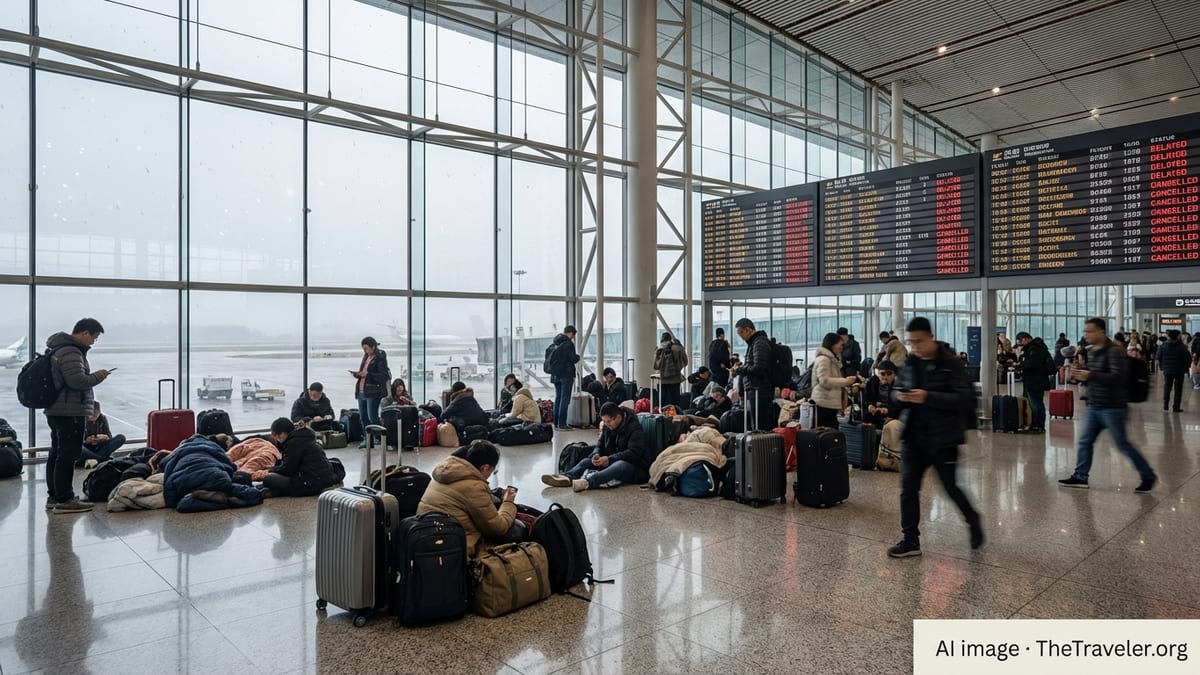
Across Beijing, Chengdu and Ho Chi Minh City, the human impact of the disruption has been strikingly similar. Families with small children, business travelers on tight schedules and international tourists unfamiliar with local procedures all found themselves sitting on terminal floors, clustered around power outlets to keep phones and laptops charged while waiting for updated flight information.
Many of the 154 delayed flights are running several hours behind schedule, and the pattern of rolling revisions has made it difficult for passengers to plan around the disruption. Some travelers have opted to abandon flights entirely in favor of high-speed rail or long-distance buses where such alternatives exist, particularly on popular domestic corridors within China. However, demand for last-minute ground transport has surged, making seats harder to find and sometimes more expensive.
Airlines have activated irregular operations protocols, providing meal vouchers and, in more severe delay cases, hotel accommodation to eligible passengers. Yet not all travelers qualify for such support, especially when weather is deemed to be an extraordinary circumstance outside the airline’s control. This has left some stranded passengers seeking out nearby budget hotels or spending the night in terminal seating areas, especially in Beijing and Chengdu where onward ground transport late at night can be limited.
Language barriers and crowded conditions have further complicated the situation for foreign travelers. While major airports have boosted staffing at information desks and deployed multilingual announcements, some passengers reported confusion about whether to remain airside, proceed to immigration checkpoints or return to check-in counters to rebook their journeys.
Full Overview of Affected Routes and Carriers
The 17 canceled flights and 154 delayed services are spread across a mix of domestic and regional routes, with patterns emerging around the most weather-sensitive sectors. For Air China, the bulk of affected flights are short-haul domestic services connecting Beijing with other major Chinese cities and a limited number of nearby international destinations in Northeast Asia. These flights typically operate at high frequency, allowing the airline to consolidate passengers onto later departures where seats are available.
China Express has seen its schedule disrupted primarily on point-to-point routes linking Chengdu and other western hubs with smaller inland airports. These routes, which often involve flying through complex terrain and variable weather conditions, are particularly vulnerable to stringent safety requirements around visibility, wind shear and icing. When operations are suspended or slowed, the relative scarcity of alternative flights can leave passengers with fewer immediate rebooking options than those traveling on trunk routes.
Cambodia Airlines’ impacted flights include short-haul regional services between Ho Chi Minh City, Phnom Penh and select destinations in southern China and mainland Southeast Asia. Because many of these routes are part of broader connection chains, delays at one end of the network can ripple outward, affecting passengers who may have boarded on-time flights earlier in the day only to find their onward segments delayed or canceled upon arrival.
While exact flight numbers and timings continue to change as airlines adjust their operations to evolving conditions, aviation analysts note that the disruption is significant but still falls within the range of what major Asian carriers have handled in past winter and monsoon seasons. The scale of impact, they say, is magnified for passengers because it is concentrated at a handful of critical hubs that act as gateways for both domestic and international travel.
What Travelers Should Expect Over the Next 24 to 48 Hours
Weather forecasts suggest a gradual improvement in flying conditions over parts of northern China, which should allow Air China and China Express to begin clearing backlogs at Beijing and Chengdu. However, airline operations teams caution that even as skies clear, it can take many hours to reposition aircraft and crews, reopen closed flight legs and restore normal rotation patterns. Travelers scheduled to depart over the next day are likely to encounter residual delays, particularly on early morning flights where aircraft may arrive late from overnight sectors.
In Southeast Asia, meteorologists expect continued pockets of heavy rain and thunderstorms around Ho Chi Minh City during peak afternoon and evening hours. Cambodia Airlines and other regional carriers are therefore planning their schedules with extra buffers, meaning some flights may depart later than originally advertised in order to reduce the risk of mid-operation disruptions. Passengers heading to or through Tan Son Nhat should monitor airline apps or airport information screens closely and consider arriving at the airport earlier than usual in case security and check-in lines lengthen during weather-induced surges.
Travelers connecting between domestic Chinese flights and regional services into Southeast Asia may experience compounded disruption as delays in one part of the network affect tight international connections. To mitigate this risk, some airlines are proactively rebooking customers onto later flights or rerouting them through alternative hubs with more stable weather conditions, even if this adds a stop to the journey.
Industry observers say that while the worst of the immediate disruption could ease within a day or two, further bouts of severe weather are likely through the remaining winter period in northern Asia and the ongoing rainy season in parts of Southeast Asia. They advise that passengers build more flexibility into itineraries that pass through weather-prone hubs such as Beijing, Chengdu and Ho Chi Minh City over the coming weeks.
Practical Advice for Affected and Upcoming Travelers
For those already caught up in the disruption, airline and airport officials recommend staying as connected as possible to official information channels. Mobile apps and text alerts from carriers generally update faster than departure boards, particularly when last-minute gate changes or aircraft swaps occur. Passengers are also urged to keep boarding passes and receipts for any extra expenses, such as meals or accommodation, which may be needed later when seeking compensation or goodwill gestures from airlines.
Experts advise travelers to avoid passing through security until they have a reasonably firm departure time, especially at airports where food and seating options are better on the landside. Once delays stretch into several hours, it can be more comfortable to remain in public areas, only proceeding to the gate area closer to boarding, provided immigration and security wait times are taken into account.
Those planning future trips through Beijing, Chengdu or Ho Chi Minh City in the coming days may want to select longer connection windows when booking, allowing additional time to absorb potential delays. Where possible, choosing earlier departures in the day can improve the odds of same-day completion of a journey, as airlines have more subsequent flights available to re-accommodate disrupted passengers.
While the current episode of severe weather is causing significant short-term pain for travelers, aviation authorities emphasize that strict adherence to safety protocols is the primary reason flights are being delayed or canceled. They underscore that operating in marginal conditions without such precautions would pose unacceptable risks, and that patience and preparedness remain the most effective tools for passengers navigating increasingly unpredictable weather in the region.