

More news on this day
Thousands of travelers across Asia are facing cascading disruptions this week as severe weather systems over China, Malaysia and Indonesia trigger hundreds of flight delays and cancellations at some of the region’s busiest hubs.
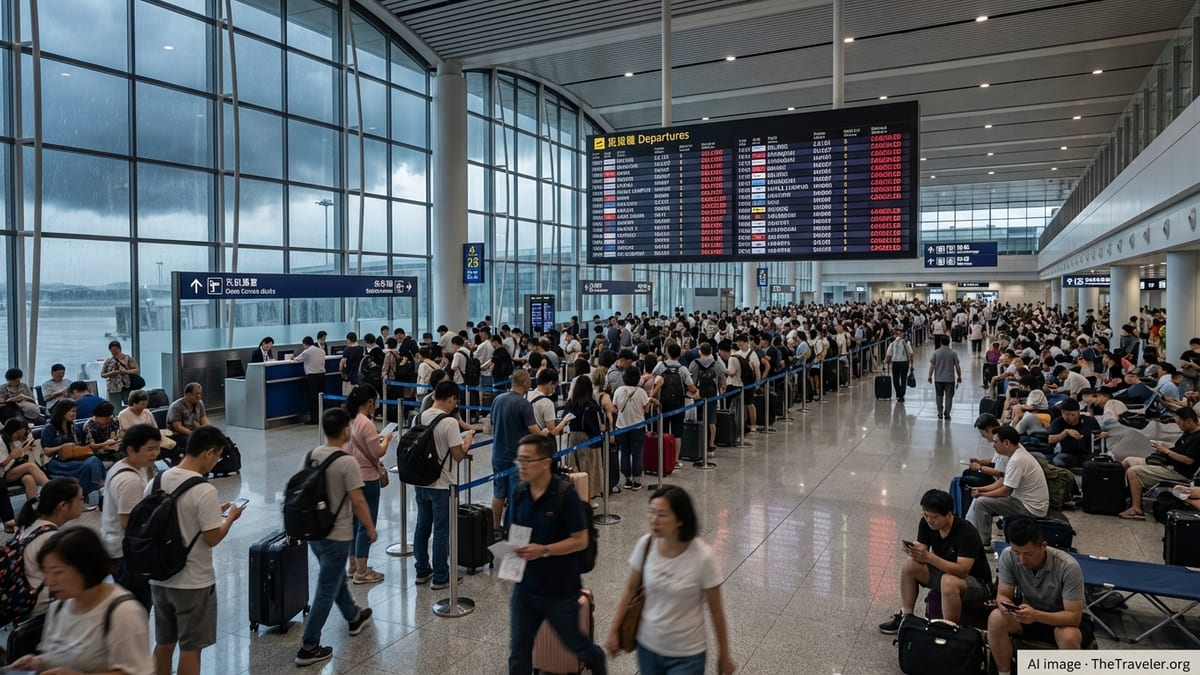
China’s Major Hubs Grapple With Fresh Wave of Disruptions
In China, a new band of storms and persistent low cloud has unleashed another round of aviation disruption centered on Beijing, Shanghai and Chengdu. Airlines and airport operators reported more than 41 flights canceled and over 1,100 delayed on Friday, as air-traffic controllers slowed arrival and departure flows for safety.
The weather turmoil comes hard on the heels of the country’s heavy Spring Festival travel rush, when passenger volumes were already pushing infrastructure to its limits. The latest delays have left terminal halls crowded with stranded travelers queuing at service counters, searching for scarce rebooking options and last-minute hotel rooms.
Operationally, Chinese carriers have focused on preserving long-haul and trunk routes, consolidating frequencies and rolling delays down the schedule rather than canceling outright wherever possible. Shorter regional flights have borne the brunt of cancellations, with knock-on effects for connections across East and Southeast Asia.
Meteorologists expect unsettled conditions, including low cloud ceilings and pockets of freezing air at cruising altitudes, to linger into the weekend. Airlines are advising passengers on China routes to monitor flight status closely, allow extra time at airports and be prepared for last-minute gate or schedule changes.
Stormy Skies Slow Traffic Through Kuala Lumpur and Malaysian Gateways
Farther south, Malaysia’s key aviation hub at Kuala Lumpur International Airport has also been hit by heavy rain, thunderstorms and shifting winds that have slowed aircraft movements and complicated ground handling. Over the past 48 hours, regional data show Malaysian airports among the highest in Asia for delays, with dozens of late departures and a smaller number of cancellations rippling through domestic and regional networks.
Low-cost and full-service carriers alike, including AirAsia and Malaysia Airlines, have been forced to pad turnaround times, hold aircraft on the ground during lightning activity and stagger takeoffs during periods of reduced visibility. That has produced long queues at security and check-in, as well as crowded boarding gates as departure times repeatedly slide back.
Travelers connecting through Kuala Lumpur to secondary cities around the region have been particularly vulnerable. Missed onward flights and crew duty-time limits have resulted in overnight stays for some passengers, who reported difficulty securing hotel accommodation near the airport during peak disruption periods.
Malaysia’s meteorological authorities have warned that more intense downpours and localized thunderstorms remain possible as the northeast monsoon pattern transitions, keeping the risk of disruption elevated for at least several days.
Indonesia Battles Flooding, Monsoon Rains and Airport Delays
Indonesia, already in the grip of its monsoon season, is experiencing a combination of heavy rain, flash flooding and weather-related flight disruption that is testing airports and airlines across the archipelago. In Bali, intense downpours earlier in the week led to widespread flooding in parts of Denpasar and surrounding tourist districts, with images of hotel guests being ferried through knee-deep water circulating widely.
At I Gusti Ngurah Rai International Airport in Denpasar, several flights were diverted or delayed when extreme rain and gusting winds reduced visibility and raised safety concerns. Airport authorities said operations have since returned to normal, but warned that any renewed bursts of heavy rain could again affect scheduling, particularly for smaller regional aircraft and tight connection windows.
Jakarta and other major Indonesian hubs, including Makassar and Surabaya, have also reported significant disruption as storm cells track across busy domestic corridors. Recent tallies from regional aviation monitors show Indonesia featuring prominently in Asia’s daily delay and cancellation statistics, with carriers such as Batik Air, Garuda Indonesia, Citilink and Lion Air all impacted.
Authorities are coordinating closely with meteorological agencies to adjust runway use, manage airspace congestion and prioritize flights into and out of the most weather-affected regions. Passengers are being urged to reconfirm departure times and expect potential holding patterns or diversions if conditions deteriorate mid-flight.
Regional Knock-On Effects as Asia’s Air Grid Stretches
The convergence of severe weather in China, Malaysia and Indonesia is amplifying strain across Asia’s interconnected air network. Over recent days, multiple monitoring services have tracked successive waves of disruption, with one day’s tally recording 54 flight cancellations and more than 2,600 delays across key Asian airports, and another logging 89 cancellations and more than 1,100 delays as storms persisted.
While those figures cover a broader swath of countries, China, Malaysia and Indonesia stand out as consistent hotspots, with major hubs in Beijing, Shanghai, Kuala Lumpur and Jakarta sending ripples of delay through connecting cities in Thailand, Singapore, Japan and beyond. When aircraft and crews are trapped on the wrong side of storms, schedule recovery can take days rather than hours.
Airlines have responded by issuing flexible rebooking options on affected routes, adding larger aircraft on certain sectors to absorb backlogs and trimming nonessential frequencies to free up capacity. Still, with many flights running near full during the late-winter and early-spring travel period, spare seats remain scarce, particularly in premium cabins and on weekend departures.
Industry analysts note that the current bout of disruption highlights the vulnerability of Asia’s fast-growing aviation sector to increasingly volatile weather patterns. With more intense rain events, shifting storm tracks and congested airports, relatively localized systems over a handful of hubs can quickly cascade into regionwide delays.
What Travelers Should Expect in the Coming Days
Forecasters in China and Southeast Asia expect conditions to gradually stabilize, but emphasize that scattered storms, low cloud and heavy showers remain in the outlook for several days, especially over coastal and low-lying regions. That leaves the door open for further tactical delays and isolated cancellations, even as airlines work to clear stranded passengers from earlier disruptions.
Travelers scheduled to fly through Beijing, Shanghai, Kuala Lumpur, Jakarta, Denpasar and other affected airports are being advised to build in extra time, keep contact information updated with their airline and monitor notifications closely on the day of travel. Those with tight connections or cruise and tour departures may want to consider arriving a day earlier to create a buffer.
Airport authorities across the three countries say they are reinforcing staffing at check-in, security and customer service points to handle surges when weather briefly improves and banks of delayed flights push through. Additional buses and ground equipment are being prepositioned where flooding or heavy rain has complicated aircraft parking and taxi operations.
For now, the message from carriers and regulators is that safety remains paramount, even if it means frustrating queues and missed plans. As one senior operations manager in the region put it this week, flights can be rebooked, but trying to race storms and low visibility is not an option.