

More news on this day
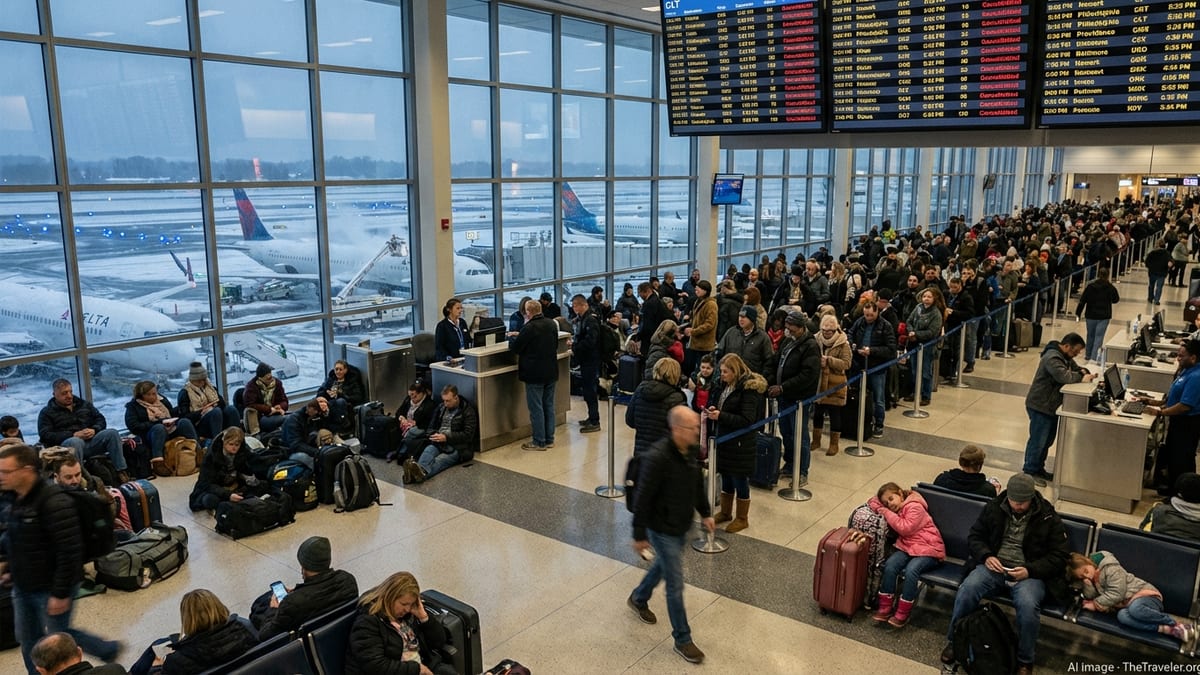
Thousands of passengers were stranded at Charlotte Douglas International Airport on Sunday as severe winter weather forced American Airlines and several regional partners to ground 81 flights and delay more than 200 others, triggering a fresh wave of disruption across some of the United States’ busiest East Coast routes.
Storm-Battered Hub Buckles Under Fresh Wave of Disruptions
Charlotte Douglas International Airport, one of American Airlines’ largest hubs, once again found itself at the epicenter of a cascading air travel meltdown as a powerful winter storm intersected with the carrier’s tightly wound regional network. Airport departure boards shifted from orderly grids of on-time flights to dense red blocks of cancellations and long columns of delays in a matter of hours.
By late afternoon Sunday, airport and flight-tracking data indicated that at least 81 flights linked to Charlotte had been canceled, with well over 200 more delayed. The heaviest impact fell on American Airlines and its regional affiliates, including Piedmont Airlines, Republic Airways, and Endeavor Air, as well as low-cost carrier Frontier Airlines, which all operate key feeder services through the North Carolina hub.
Inside the terminal, the operational crisis translated into scenes familiar to winter travelers: families camped on the floor with carry-on bags as makeshift pillows, long lines at customer service counters, and departure gates overflowing with passengers anxiously refreshing airline apps. The combination of aircraft out of position, limited crew availability, deteriorating conditions along the East Coast, and tight turnaround windows made recovery slow and uncertain.
Airport officials urged travelers to arrive early, stay in close contact with their airlines, and prepare for extended waits, while emphasizing that safety considerations around strong winds, low visibility, and icy conditions remained paramount in decisions to ground or delay flights.
Ripple Effects Hit Newark, Philadelphia, Rhode Island, and Baltimore
While the operational breakdown was most visible in Charlotte, the disruption rippled outward along some of the country’s busiest travel corridors. Flights to and from Newark Liberty International Airport and Philadelphia International Airport were among the hardest hit, as fast-deteriorating conditions in the Northeast made the already strained network even more fragile.
Routes into Rhode Island’s T.F. Green International Airport near Providence and Baltimore/Washington International Thurgood Marshall Airport also saw mounting disruption, with late-afternoon arrivals diverted or canceled and morning departures scrubbed preemptively. For many travelers, Charlotte was just one leg of a longer itinerary that included connections onward to New York, Boston, or smaller regional airports across New England and the Mid-Atlantic.
As ground conditions worsened along the Interstate 95 corridor and blizzard warnings expanded, airlines reduced schedules into the Northeast to bare-bones levels, treating many of the affected cities as temporary no-go zones. That decision left travelers whose journeys originated or connected through Charlotte with limited rebooking options and multi-day delays in some cases.
The situation was further complicated by the fact that major Northeast airports such as Newark and Philadelphia were already grappling with large numbers of cancellations tied to the broader nor’easter. Each new round of weather-related disruptions effectively removed additional aircraft and crews from circulation, compounding the challenge of clearing backlogs at downline hubs.
Regional Operators Piedmont, Republic, and Endeavor Bear the Brunt
Behind the numbers at Charlotte were the regional airlines that quietly carry a significant share of the traffic flying under big-brand names. Piedmont Airlines, based in Salisbury, Maryland, runs numerous short-haul routes in and out of Charlotte on behalf of American, linking the hub to smaller communities across the Carolinas, Virginia, and the Mid-Atlantic. When storms shut down or slow operations, these short segments are particularly vulnerable, because they tend to operate with less schedule padding and smaller aircraft.
Republic Airways, which flies regional jets for major carriers including American, and Endeavor Air, a primary regional operator for Delta, also saw a high percentage of their Charlotte-linked flights disrupted. Both airlines rely on tight rotation patterns in which a single aircraft can be scheduled to perform multiple legs in a single day, often across different regions. When one early flight is canceled or heavily delayed by weather, an entire day’s worth of segments can unravel.
For passengers, the distinction between mainline and regional operators is often invisible, but the consequences of disruption can be markedly different. Regional flights frequently have fewer daily frequencies, meaning that travelers whose flights are canceled might not find a same-day alternative. Additionally, the smallest regional jets can be more susceptible to crosswinds and runway contamination thresholds, leading to conservative cancellation decisions during intense winter storms.
Frontier Airlines, which operates a smaller but strategically important schedule from Charlotte, also canceled and delayed flights as the storm intensified. While ultra-low-cost carriers generally run lean operations, with fewer backup crews and spare aircraft, they face the same air traffic control constraints and safety-focused weather minimums as their larger competitors, leaving them little room to maneuver during severe conditions.
Stranded Passengers Face Long Lines, Scarce Seats, and Rising Costs
For the thousands of passengers caught in the disruption, the operational statistics translated into long, uncertain hours inside the terminal. Queues at airline service desks snaked deep into concourses as travelers sought rebooking, hotel vouchers, and reliable information. Many reported being offered itineraries that would get them to their final destinations one or even two days later than planned, with limited flexibility around timing or routing.
Available hotel rooms in the vicinity of Charlotte Douglas quickly became scarce and more expensive, as a surge of stranded travelers competed for last-minute accommodation. Some airlines distributed hotel and meal vouchers to eligible passengers, prioritizing those with longer delays or missed connections, while others encouraged customers to make their own arrangements, citing the weather-driven nature of the disruption.
Families with young children and older travelers appeared particularly affected, as they juggled fatigue, limited seating, and a shortage of quiet spaces in crowded terminals. Charging outlets and seating near flight information screens were in especially high demand, underscoring the degree to which modern travel recovery efforts depend on continuous digital updates.
Staffing pressures also showed, as gate and customer service agents struggled to handle a crush of rebooking requests while coping with their own extended shifts. Despite repeated announcements urging passengers to use airline apps and websites where possible, many travelers insisted on speaking with agents in person, seeking guarantees or bespoke solutions that automated tools could not easily provide.
Weather System Ties Southern Hub to Northeast Blizzard Zone
The turmoil at Charlotte was deeply intertwined with the powerful winter system hammering the Northeast. Forecasters warned of heavy snow, fierce winds, and dangerous wind chills along a broad swath from Maryland through New Jersey, Rhode Island, and into New England, prompting state and local governments to issue emergency declarations and travel advisories.
Although Charlotte itself did not experience the extreme snowfall totals forecast farther north, the airport’s role as a connecting hub for East Coast and transcontinental traffic meant its operations were acutely sensitive to conditions hundreds of miles away. Aircraft bound for Newark, Philadelphia, Providence, and Baltimore could not depart if destination runways were closed, visibility dropped below landing minima, or ground crews could not safely service planes.
As the storm’s core shifted up the coast, airlines made increasingly aggressive preemptive cuts to their schedules, aiming to avoid the more chaotic scenario of last-minute cancellations after passengers had already boarded. This strategy, now common during high-impact weather events, is intended to give travelers more time to adjust their plans, though it also concentrates disruption into a narrower time window.
Meteorologists indicated that while the worst of the storm would likely pass within 24 to 36 hours, lingering effects on air travel could extend well beyond that, as airlines worked to reposition aircraft, return crews to legal duty status, and gradually restore full schedules across their networks.
American Airlines and Partners Roll Out Waivers and Reduced Schedules
In response to the unfolding disruption, American Airlines and multiple regional partners issued or expanded flexible travel policies, allowing customers booked through the affected airports to change flights without standard change fees or fare differences on select dates and routes. The policies typically covered travel through Charlotte, Newark, Philadelphia, Providence, Baltimore, and other airports in the storm’s path.
Carriers also trimmed schedules for the coming days, a move designed both to reflect reduced demand and to build resilience into operations. By operating fewer flights, airlines hope to create buffer time for deicing, longer taxi sequences, and unplanned delays, reducing the risk that minor hiccups will snowball into systemwide meltdowns.
Industry analysts noted that American’s heavy dependence on Charlotte as an East Coast connecting point can be a vulnerability during weather extremes, especially when systems simultaneously affect both the Southeast and the Northeast. The intricate choreography of regional jets feeding into long-haul departures leaves little slack if storms or high winds close multiple destination airports at once.
For travelers with flexibility, airline representatives encouraged rebooking into later-week departures, avoiding the immediate post-storm recovery window when flights are likely to be full and standby lists long. Those with urgent travel needs were advised to monitor their flight status closely and consider alternative routings via hubs less affected by the storm, where seats were still available.
Salisbury and Smaller Regional Airports Feel the Secondary Shock
Beyond the big hubs, smaller regional airports linked to Charlotte quietly absorbed their own share of the fallout. Salisbury, Maryland, home to Piedmont Airlines and a key node in American’s regional network, saw multiple inbound and outbound flights canceled as the airline prioritized aircraft and crews for higher-density routes.
Communities served only a few times a day by regional jets or turboprops felt the pinch especially acutely. For travelers departing from small-city airports in the Carolinas, Virginia, and the Mid-Atlantic, the cancellation of a single Charlotte-bound flight often meant losing an entire day of connectivity to the national network. With limited ground transportation alternatives, some passengers resorted to multi-hour drives to larger airports, hoping to find open seats on the shrinking number of departures.
Airport officials at smaller fields reported that while terminal crowds were smaller than those in Charlotte, the frustration level could be just as high, as passengers confronted the prospect of missed cruises, business meetings, and once-in-a-lifetime events. Staff worked to keep communication lines open, posting updated departure boards and relaying airline advisories as quickly as they were received.
The situation underscored the disproportionate impact that a storm-focused disruption at a major hub can have on rural and small-city travelers, whose access to the air network is more fragile and whose options for rerouting are, in many cases, extremely limited.
What Travelers Can Expect in the Days Ahead
With storm conditions continuing in parts of the Northeast and airlines operating reduced schedules, travelers passing through Charlotte and other affected airports should prepare for a protracted recovery period. Even as weather improves, residual delays and sporadic cancellations are likely as carriers work through aircraft and crew imbalances created by the storm.
Experts advise passengers to confirm flight status repeatedly in the 24 hours before departure, use airline apps to rebook proactively when eligible, and avoid checking bags if possible, to maintain flexibility in case of last-minute changes. Those with fixed commitments are urged to build in additional buffer time, recognizing that the knock-on effects of this disruption could linger through several schedule cycles.
For now, the scenes playing out at Charlotte Douglas International Airport serve as a vivid reminder of how quickly a single storm system can entangle an interconnected air network, stranding thousands of travelers far from the worst of the weather itself. As airlines, airports, and passengers collectively navigate yet another winter shock, the experience will likely feed fresh debates over infrastructure resilience, schedule design, and how best to shield travelers from the most punishing effects of extreme weather on modern air travel.