

More news on this day
Travelers across the United States are confronting a cascade of delays and cancellations at James M Cox Dayton International Airport, as powerful Midwest storms, scattered power issues and ripple effects from airline disruptions converge into a deeply frustrating travel experience.
Get the latest news straight to your inbox!
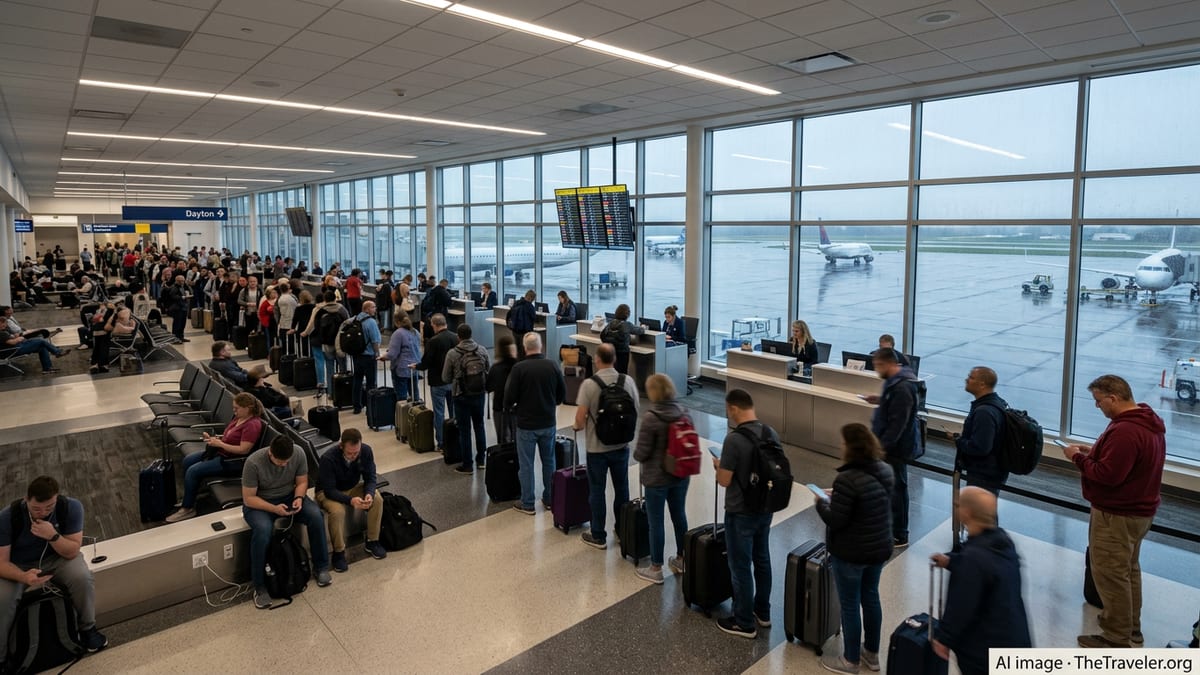
Storm System Slams the Region and Snarls Air Travel
A fast-moving storm complex sweeping across parts of the Midwest and Great Lakes from March 13 to March 16 has produced damaging winds, hazardous driving conditions and scattered power interruptions across Ohio. Publicly available weather summaries describe the system as part of a broader pattern of intense late-winter storms affecting large sections of North America in early 2026, putting added strain on aviation networks already operating near capacity.
Dayton’s location along key east-west and north-south routes has placed its airport directly in the path of shifting storm bands, low cloud ceilings and gusty crosswinds. Flight-tracking data and airline status boards show rolling delays throughout the weekend, with some departures held on the ground while conditions improved along onward routes, and arriving aircraft forced into holding patterns or diversions.
While the most dramatic headlines have centered on larger hub airports, regional facilities like James M Cox Dayton International have experienced their own share of turbulence. Dayton often serves as an alternate for other Ohio airports when weather deteriorates, which can quickly turn a modest schedule into an overburdened operation once rerouted aircraft and crews begin to arrive.
Travelers report a familiar pattern: flights repeatedly pushed back in small increments, occasional last-minute cancellations when crew duty limits are reached, and long lines at customer service desks as passengers attempt to rebook. The result is a perception of “unbelievable” disruption, even where the underlying causes are scattered across hundreds of miles of airspace.
Power and Infrastructure Strains Add to the Chaos
As the storm system intensified, utility and community updates across the Dayton metro area pointed to wind-related damage, including downed trees and power lines and localized outages. Social media posts from nearby neighborhoods such as Vandalia and Fairborn over the March 13 weekend described extended power losses for some residents, underscoring how fragile the electrical grid can be during high-wind events.
Airports are typically protected by multiple layers of backup power, and publicly available planning and infrastructure documents for Dayton indicate ongoing investment in electrical resilience, including emergency power pedestals and related systems. Even with that protection, however, short power disturbances or voltage fluctuations in the surrounding grid can still affect roadway access, traffic signals, nearby hotels and businesses that serve airport passengers.
These community-level issues matter for travelers. When a storm knocks out power in surrounding suburbs, shuttle operators may face detours, ride-hailing services can become scarce, and restaurants or convenience stores near the terminal may be forced to close or limit service. For stranded passengers suddenly rebooked for the next morning, finding a room, a meal or even a place to charge a phone can become unexpectedly difficult.
In this latest episode, travelers connecting through Dayton during the peak of the storm have faced a convergence of inside-the-terminal and outside-the-terminal disruptions: airport systems generally remained operational, but the broader infrastructure that supports smooth travel frayed under the pressure of high winds and scattered outages.
National Airline Disruptions Ripple Through a Regional Hub
The problems at Dayton have not developed in isolation. Airline operations across the country have been stressed by the same weather pattern, along with equipment outages and traffic management initiatives at distant facilities. Public coverage over the weekend highlighted how a radar or surface-detection equipment issue affecting several airports forced ground stops and delays elsewhere in the network, contributing to missed connections and rolling schedule changes.
When a major airline experiences cascading problems at a coastal or hub airport, the effect is quickly felt hundreds of miles away. Regional spokes like Dayton often see inbound flights arriving late, crews timing out before they can complete their next segment, or aircraft repositioned to different cities to recover the overall schedule. Even when local conditions in Dayton appear manageable, passengers can encounter cancelled or heavily delayed flights because the aircraft they were waiting for never left its previous airport.
Recent shifts in regional airline basing and staffing around Dayton have also shaped how resilient the airport can be during major weather events. Public announcements over the past year outlining corporate moves and staffing changes at regional carriers underscore the tight margins with which many smaller airports now operate. A handful of delayed crews or grounded regional jets can quickly translate into a disproportionate number of disrupted itineraries for local travelers.
For passengers, the distinction between a local and a network problem is largely academic. The practical reality is a growing stack of rolling delays on departure boards, longer hold times to reach airline call centers and a scramble to secure the remaining seats on alternative routes.
Tourists and Domestic Travelers Confront a Travel Nightmare
For leisure travelers and visiting families, the timing of the latest disruptions could hardly be worse. Early spring often brings a mix of school breaks, sporting events and short domestic getaways, sending a wave of occasional flyers through airports like Dayton. Many of these travelers have less flexibility in their plans and are more vulnerable to last-minute schedule changes.
Reports from passengers describe hours spent in terminal seating areas as departure times slipped into the evening, with some ultimately forced to overnight in Dayton or nearby cities when connections were missed. Others attempting to start vacations from Dayton faced the equally dispiriting experience of being told to go home and return days later, once the worst of the storm-related backlog had cleared.
Families traveling with children, older adults and those connecting from smaller surrounding communities felt the strain most acutely. With rental car lots filling quickly and intercity buses or trains offering limited options, many found themselves effectively tied to the airport, watching national disruption play out on local departure boards.
The psychological toll is amplified by the perception that the situation is both widespread and unpredictable. Passengers scrolling through airline apps and news alerts over the weekend saw reports of thousands of flights interrupted nationwide, feeding the sense that no single carrier or route could be counted on with certainty.
What Travelers Can Expect in the Coming Days
Looking ahead to the next few days, publicly available forecasts suggest that the most severe phase of the storm system will gradually move east, with conditions in Ohio expected to stabilize as winds ease and temperatures moderate. Airlines typically spend several days working through the residual effects of such events, repositioning aircraft and crews and rebuilding confidence in schedules.
At James M Cox Dayton International, that likely means a period of elevated risk for schedule changes, even as operations appear closer to normal. Travelers booked through the airport in the short term should anticipate the possibility of last-minute gate changes, tight connection windows and periodic holds tied to congestion at larger hubs.
Industry analysts often note that smaller airports can recover relatively quickly once weather and network constraints ease, since their flight volumes are lower and gate resources are less saturated. Nonetheless, passengers connecting through Dayton in the aftermath of this disruptive stretch may still encounter isolated cancellations as carriers rebalance capacity.
For now, the weekend’s events serve as a pointed reminder that even a mid-sized regional airport can become the epicenter of a travel nightmare when severe weather, fragile infrastructure and nationwide airline complexities collide. As storms grow more erratic and networks increasingly interconnected, travelers across the United States may see scenes like those in Dayton repeated with increasing frequency each season.