

More news on this day
Severe weather sweeping across northern and western China has triggered widespread air travel disruption in Yunnan, Gansu and Inner Mongolia, with 26 flights cancelled and 673 delayed, hitting passengers flying with China Eastern, Shandong Airlines and China Express Airlines during a busy late-winter travel period.
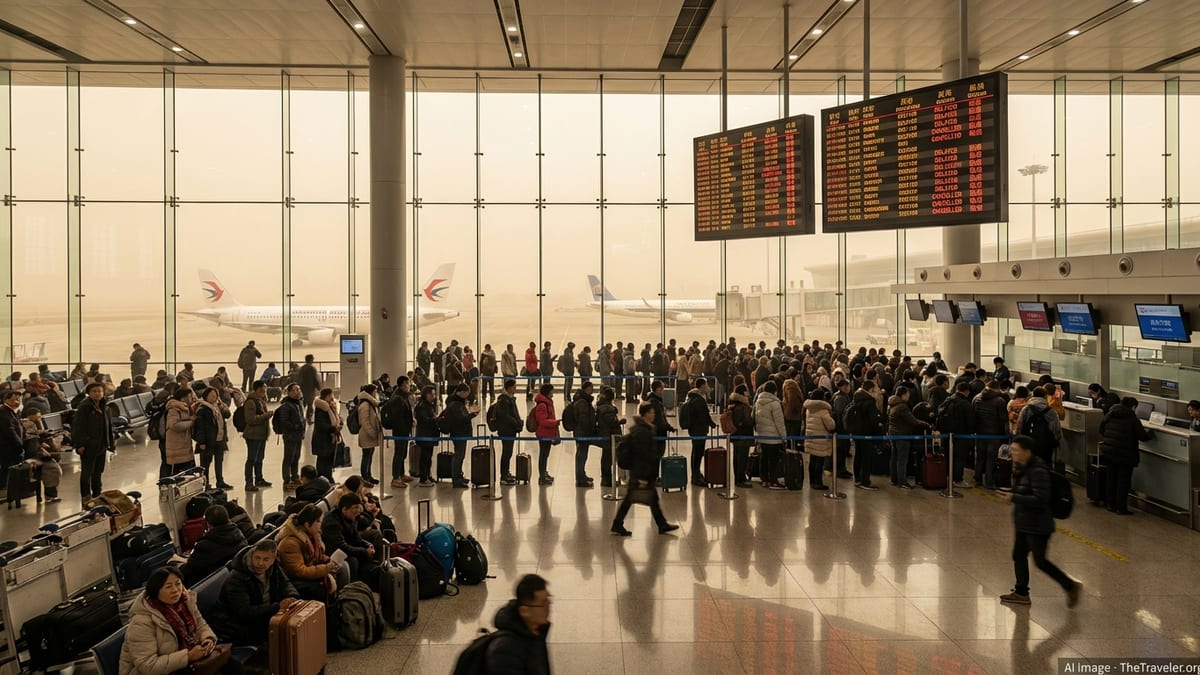
Storm Systems Bring Sand, Wind and Low Visibility
The disruption comes as Chinese meteorological authorities activate an emergency response for major weather events, warning of strong winds, blowing sand and sandstorms across large parts of the country. Forecasts for the weekend highlight particularly hazardous conditions in regions including Inner Mongolia, Gansu and stretches of the northwest air corridor that connects Yunnan with northern hubs. These systems have sharply reduced visibility and created unsafe conditions for take-off and landing at a number of regional airports.
According to official advisories, a cold air mass moving east and south from Central Asia has combined with dry surface conditions to generate widespread dust and sand, especially across Inner Mongolia and Gansu. While Yunnan lies further south and is not directly in the sandstorm belt, high-altitude turbulence and unstable air masses along approach routes into Kunming and other airports have also forced airlines to slow operations and build in additional safety buffers. The result has been cascading delays and a growing queue of displaced passengers.
China operates a four-tier weather warning system, and the current alerts for strong winds and sandstorms have prompted tighter operational thresholds for pilots and air traffic controllers. Even where airports remain technically open, crosswinds and fast-changing visibility have meant that many flights cannot safely depart or arrive on schedule. With aircraft out of position and crew duty limits quickly reached, widespread knock-on delays have become unavoidable.
Key Airports and Routes Most Affected
While the disruptions are spread across a wide geography, several airports in Yunnan, Gansu and Inner Mongolia have emerged as particular pinch points. In Yunnan, Kunming Changshui International Airport has seen a series of late departures and diversions, with crews required to navigate turbulent conditions in the surrounding mountain approaches. Regional links from Kunming to smaller Yunnan cities and onward to northern destinations have been especially vulnerable.
In Gansu, Lanzhou is bearing the brunt of the weather’s impact on northwest flight corridors. Strong winds and intermittent dust have complicated operations at Lanzhou Zhongchuan International Airport, a key connecting point for passengers traveling between central and western China. Delays in and out of Lanzhou have quickly cascaded to flights involving other provincial capitals, amplifying the impact well beyond the immediate storm zone.
Inner Mongolia, meanwhile, is experiencing some of the harshest conditions, with sand-laden winds sweeping across key regional hubs. Airports serving cities such as Hohhot and other northern gateways have reported unstable visibility, forcing ground stops, extended holding patterns and diversions to less-affected fields. Routes that link Inner Mongolia with Harbin, Xi’an, Kunming and other major cities have consequently seen a high proportion of the 26 cancellations and hundreds of delays now logged.
Because many of these airports serve as secondary or regional hubs rather than primary national gateways, spare capacity to absorb disrupted flights is limited. Once hourly arrival and departure slots fill or weather windows close, airlines have little choice but to cancel services outright, compounding the total number of grounded flights in a short space of time.
How Major Chinese Carriers Are Responding
The latest wave of severe weather has hit three key players in China’s airline network structure: China Eastern, Shandong Airlines and China Express Airlines. Each operates an extensive mesh of domestic routes that knits together primary and secondary cities, meaning any prolonged weather event in the northwest or north can ripple across the national schedule.
China Eastern, one of the country’s largest full-service carriers, has reported cancellations and significant delays on services feeding Kunming and connecting Yunnan with hubs in the north and east. Some short-haul domestic flights have been proactively grounded to preserve aircraft availability and protect longer-haul operations. Passengers on affected routes are being offered free changes within a limited window and, where possible, have been rerouted via less-affected hubs.
Shandong Airlines, which has a strong presence in northern and western China, has seen its operations disrupted on routes linking cities such as Lanzhou and other interior hubs. With winds and dust particularly intense along some of its core corridors, the airline has adopted a cautious stance, slowing rotations and trimming individual frequencies. While this approach minimizes the likelihood of airborne diversions or last-minute returns, it has increased waiting times and made same-day rebooking more difficult for travelers.
China Express Airlines, a specialist regional carrier that serves many smaller cities and border-area airports, has also been heavily affected. Its model relies on high aircraft utilization and tight turnarounds at relatively weather-exposed airfields in Inner Mongolia and adjacent regions. When sandstorms and strong winds shut down those airfields, the carrier has few alternatives for rerouting. Grounded aircraft and out-of-position crews have compounded the impact, contributing to the tally of 26 cancellations and generating a disproportionate number of delays among short-haul connections.
Impact on Passengers: Long Queues, Missed Connections
For travelers, the numbers translate into a challenging experience on the ground. Across airports in the affected provinces, passengers have faced long queues at check-in desks and transfer counters as they seek information, rebooking options and basic assistance such as meal vouchers or overnight accommodation. With 673 flights delayed, the crush is particularly acute during peak departure banks in the morning and late evening, when many domestic services are scheduled to depart.
Business travelers and those with onward international connections have been among the hardest hit, especially where their itineraries relied on tight connections via Kunming or other regional hubs. Some passengers have reported missing same-day long-haul departures after their feeder flights from Inner Mongolia or Gansu arrived late or were cancelled outright. In such cases, travelers must often wait until the next available long-haul service, which may not depart until the following day given current demand patterns.
Families and leisure travelers, meanwhile, have had to contend with crowded terminal areas and limited seating as delays stretched into multiple hours. Airport staff have worked to maintain order and provide updates, but sudden weather-driven changes have meant that departure boards can shift rapidly, with flights moving from “delayed” to “cancelled” in a short period. For visitors unfamiliar with Chinese-language announcements or local airline procedures, this has added a layer of confusion and anxiety.
For those already in the air when conditions deteriorated, diversions and holding patterns have led to extended flight times. In some instances, aircraft bound for storm-affected airports have been forced to circle while awaiting improvement or have diverted to alternate airfields, where passengers then had to disembark and await further instructions. This has strained both airline and airport resources, with buses, hotel rooms and catering services suddenly in high demand.
Rights, Refunds and Rebooking: What Travelers Can Expect
When weather is the root cause of disruption, airlines in China, as in many other markets, are generally not required to provide cash compensation. However, they remain responsible for ensuring passenger safety and assisting with reasonable care, such as providing updates, basic refreshments and support in rebooking onto the next available flights. Policies vary by carrier, but most affected airlines have activated temporary measures to ease the strain on stranded customers.
China Eastern has typically offered free ticket changes within a defined period for flights directly affected by weather advisories, subject to seat availability on alternate services. Where passengers choose not to travel at all because of the disruption, refunds may be possible, often with relaxed penalties compared to normal conditions. Shandong Airlines and China Express Airlines have followed a broadly similar pattern, focusing on fee waivers for rebooking and more flexible routing options when seats can be found on other departures.
For passengers who purchased tickets through online travel agencies or third-party booking platforms, the process can be more complex. In many cases, changes must be processed through the original point of sale, leading to additional waiting time and, in some instances, differing interpretations of airline rules. Travelers are advised to retain all receipts for meals, ground transport and any unexpected hotel stays, as some costs may be reimbursable depending on the fare conditions and any goodwill policies announced by carriers in the days ahead.
It is also important for travelers to understand that airport and weather-related safety restrictions ultimately override individual itineraries. Even if a flight still appears on a booking app as “on time,” it may be subject to last-minute operational decisions by air traffic control based on the latest wind and visibility data. In such a fast-changing environment, passengers who stay closely engaged with airline communication channels are at a clear advantage when it comes to securing earlier alternative options.
How to Navigate Travel During Northern China Weather Alerts
For travelers with upcoming plans to or through Yunnan, Gansu, Inner Mongolia and neighboring regions, the current disruption is a reminder of how quickly seasonal weather systems can affect flight reliability. The first practical step is to monitor the status of your flight at regular intervals in the 24 hours before departure, using both airline apps and airport information channels. In periods of active sandstorm or strong-wind alerts, schedules can shift multiple times in a single day.
Building additional flexibility into itineraries can also reduce the risk of cascading problems. Where possible, travelers booking domestic connections to long-haul flights from major hubs might consider leaving a wider buffer between arrival and departure, particularly in late winter and early spring, when northern China is prone to dust storms and high winds. Opting for earlier flights in the day can provide more room for same-day rebooking if conditions deteriorate.
At the airport, arriving early can make a material difference in access to alternatives if your flight is cancelled or severely delayed. Passengers who are among the first to reach customer-service desks typically have a better chance of securing scarce seats on later departures. Having a backup plan for accommodation near major hubs such as Kunming or Lanzhou is also prudent, especially when forecasts indicate that difficult conditions may persist overnight or into the following day.
Finally, comprehensive travel insurance that explicitly covers delays and cancellations can help offset some of the financial impact. Policies differ widely, but many offer lump-sum benefits once a delay exceeds a set number of hours, as well as coverage for additional hotel nights and meals. Given the rising frequency of weather-related disruption in northern China and across the wider region, such coverage is becoming an increasingly important part of travel planning.
What This Disruption Signals for China’s Wider Travel Network
The current wave of cancellations and delays in Yunnan, Gansu and Inner Mongolia underscores the vulnerability of China’s rapidly expanding aviation network to extreme and fast-changing weather. As more secondary and tertiary cities gain direct air links, a growing share of national traffic is routed through airports that are closer to deserts, plateaus and other weather-exposed landscapes. Events like the present one reveal how operational strain can accumulate quickly when several such airports are simultaneously hit by strong winds and poor visibility.
For airlines, this episode is likely to feed into ongoing discussions about fleet deployment, schedule padding and contingency planning. Carriers that rely heavily on tight rotations in weather-prone corridors may look more closely at adding operational buffers during peak risk seasons, even if that reduces theoretical aircraft utilization. Investments in more advanced forecasting tools and closer coordination with meteorological services may also follow, as operators aim to anticipate and preempt the worst bottlenecks.
From a traveler’s point of view, the disruption serves as a timely reminder that China’s vast scale and varied climate can have very real consequences for journey reliability. Even as infrastructure improves and airlines refine their response protocols, periods of sandstorms, heavy winds and unstable air masses will remain a recurring feature of the country’s travel landscape. Understanding where and when those risks are highest can help passengers make more informed decisions about routing, timing and trip insurance.
For now, with 26 flights cancelled and 673 delayed amid severe weather alerts, the priority across Yunnan, Gansu and Inner Mongolia remains getting stranded passengers moving again while keeping safety paramount. As conditions gradually improve and winds subside, airlines are expected to ramp services back up, but schedules may remain uneven for several days as carriers reposition aircraft and crews and clear the backlog of disrupted journeys.