

More news on this day
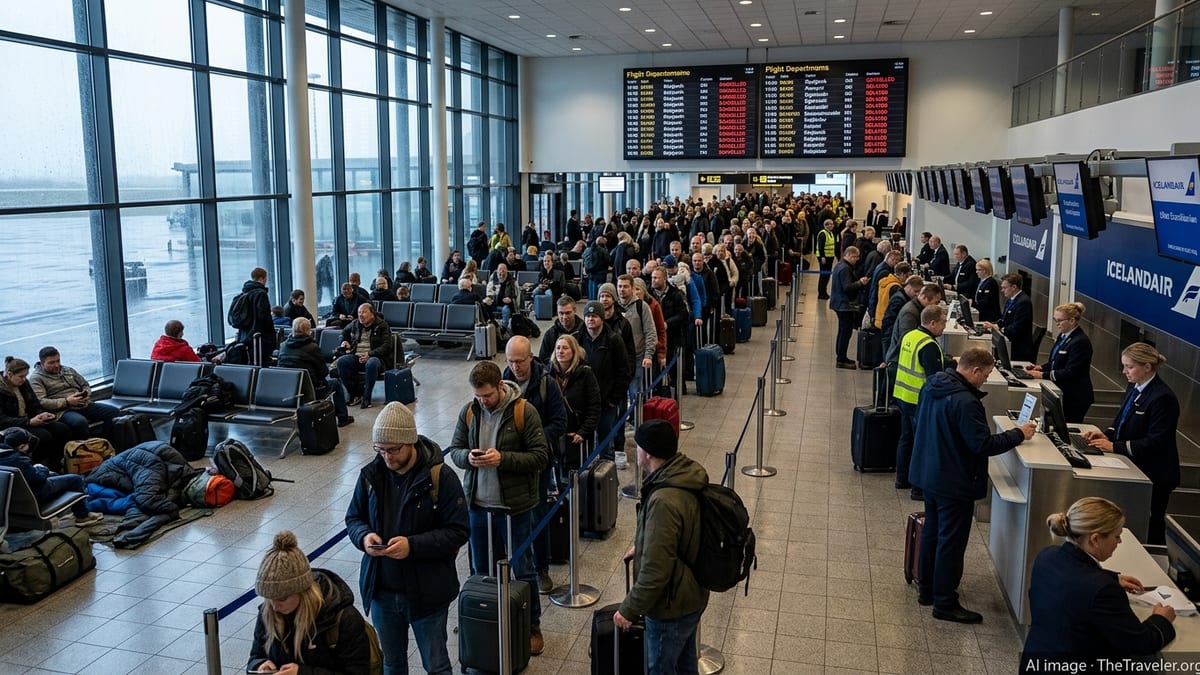
Hundreds of travellers were left stranded across Iceland on Thursday as more than forty flights were reportedly cancelled or heavily delayed at Reykjavík, Keflavík, Akureyri, Egilsstaðir and Ísafjörður airports, affecting operations by Icelandair, Scandinavian Airlines and other regional and international carriers amid deteriorating weather and operational disruption.
Get the latest news straight to your inbox!
Wide-Ranging Disruption From Capital to Regional Hubs
Published reports and live airport information indicate that air travel across Iceland came under acute strain, with cancellations and rolling delays affecting both domestic and international services. Reykjavík Airport, the main domestic gateway, saw multiple turnarounds and scrubbed departures, while Keflavík International Airport experienced knock-on disruption in its transatlantic and European schedules.
Regional airports at Akureyri in the north, Egilsstaðir in the east and Ísafjörður in the Westfjords also reported grounded aircraft, limiting vital domestic connections that link outlying communities to the capital area. Travellers attempting to reposition between Icelandic regions in order to salvage international connections faced shrinking options as the day progressed.
According to publicly available flight boards and airline status pages, more than forty departures and arrivals were listed as cancelled, with additional services flagged as significantly delayed. Passenger accounts on social media channels described long queues at service desks and uncertainty over when replacement flights might become available.
The scale of disruption placed additional pressure on Iceland’s already busy aviation network, which relies heavily on tightly timed connections through Reykjavík and Keflavík, especially during peak travel periods. Even a short burst of adverse conditions can therefore ripple quickly through the system and leave travellers without same-day alternatives.
Icelandair, Air Iceland Connect Legacy Routes and SAS Affected
Icelandair, the country’s largest carrier, experienced a significant portion of the cancellations, particularly on routes connecting Keflavík and Reykjavík with regional airports such as Akureyri and Egilsstaðir, as well as select European destinations. Publicly visible schedules showed several domestic rotations removed from service, alongside a smaller number of international flights that were either cancelled outright or retimed.
Some of the impacted domestic services operate along former Air Iceland Connect routes, which were brought under the Icelandair brand in recent years but continue to rely on smaller aircraft serving short runways in challenging terrain. These operations are especially sensitive to shifts in wind, cloud ceiling and visibility, making them among the first to be halted when conditions deteriorate along the coast or in mountain passes.
Scandinavian Airlines and several other European carriers serving Keflavík also reported cancellations or extended delays on flights to and from major hubs. Passengers transiting via Iceland to reach onward destinations in mainland Europe or North America reported missed connections and were advised via automated notifications and airline apps of new itineraries or overnight stays.
The wide carrier mix involved in the disruption complicated rebooking efforts, particularly for travellers whose journeys were stitched together across multiple airlines or booking platforms. In many cases, re-routing required coordination between Icelandic operators and partner airlines based in Copenhagen, Oslo, Stockholm and other European capitals.
Strong Winds, Low Visibility and Operational Constraints
Iceland’s aviation infrastructure is no stranger to severe and fast-changing conditions, especially in the late winter and early spring months when strong Atlantic systems move across the island. Forecasts for Thursday pointed to high winds, shifting gusts and intermittent poor visibility, all of which can restrict safe landing and take-off windows at exposed airfields.
Regional airports such as Ísafjörður are known for their dramatic settings, surrounded by steep fjord walls and narrow approaches that demand both favourable weather and highly specific wind profiles. Under such circumstances, even modest deteriorations in crosswinds or cloud base can force dispatchers to suspend operations until conditions stabilize, resulting in short-notice cancellations for domestic travellers.
Operational constraints and aircraft positioning also appear to have played a role. When early flights are unable to depart or land as planned, aircraft and crew can be left out of place for later sectors, amplifying the scale of disruption through the day. This effect is particularly visible in a compact network like Iceland’s, where a single aircraft might be scheduled to complete multiple domestic segments linking Reykjavík, Akureyri and Egilsstaðir.
Publicly accessible aviation data show that similar weather-driven events in recent years have occasionally triggered large clusters of cancellations, though the resilience of the system often allows operations to resume relatively quickly once wind speeds drop and visibility improves. Travellers, however, can face much longer delays as airlines work through backlogs and accommodate stranded passengers on limited-capacity flights.
Knock-On Impact on Travellers and Tourism Plans
The wave of cancellations disrupted a wide spectrum of journeys, from Icelanders relying on domestic flights for medical appointments and business travel to international visitors arriving for short holidays or onward cruises. Many passengers at Keflavík faced the particular challenge of rebooking long-haul connections with only a small number of available seats remaining during a busy travel period.
Reports from affected travellers described uncertainty around hotel availability near the capital area as stranded passengers sought last-minute accommodation. Some visitors opted to adjust their itineraries by extending stays in Reykjavík or, conversely, cutting planned regional excursions to ensure they could reach Keflavík in time for rescheduled outbound flights.
The disruption also threatened tightly scheduled winter and shoulder-season tourism activities, including northern lights excursions, glacier tours and regional city breaks built around short domestic hops to Akureyri or Egilsstaðir. Tour operators that depend on reliable flight links to move guests between Reykjavík and the countryside were left to improvise with buses and altered itineraries where road conditions allowed.
Travel advisories from airlines and tourism bodies have in recent seasons increasingly stressed the importance of flexibility when planning trips to Iceland, recommending buffer time before and after key long-haul segments. The latest wave of cancellations is likely to reinforce that message among both repeat visitors and first-time travellers.
Guidance for Affected Passengers and Future Travel
Publicly available consumer guidance on European and Icelandic air travel rights notes that passengers whose flights are cancelled are generally entitled to rebooking or a refund, and may in some circumstances be eligible for additional care such as meals and accommodation while waiting for new flights. The specific options depend on the ticket type, route, airline and the underlying cause of the disruption.
Travellers whose itineraries involve more than one carrier are advised in published advice to pay close attention to whether their journey is booked on a single ticket or comprises separate reservations. In complex cases involving connecting services between Icelandair, Scandinavian Airlines and other partners, assistance can vary depending on which airline issued the original ticket and where the disruption occurred.
For those planning upcoming trips, travel experts and online forums frequently recommend building generous layover times into journeys that rely on Reykjavík and Keflavík as connecting points, as well as considering an extra day at either end of an Iceland itinerary to buffer against weather-related disruptions. Flexible hotel bookings and comprehensive travel insurance that covers delays and cancellations are commonly cited as additional safeguards.
While Iceland’s aviation sector has shown strong resilience in the face of volcanic activity and harsh North Atlantic weather, the latest wave of cancellations underscores the vulnerability of a hub-and-spoke network concentrated in a small number of airports. Travellers are likely to watch closely for further updates from airlines and airport operators as conditions evolve over the coming days.