

More news on this day
Thousands of travelers across China faced widespread disruption on March 31, 2026, as severe weather in major cities triggered at least 501 new flight cancellations and 7,947 delays across multiple airlines and airports.
Get the latest news straight to your inbox!
Storm Systems Batter Key Aviation Hubs
Heavy rain, thunderstorms and low cloud over eastern and southern China converged on Tuesday to create some of the most significant nationwide air travel disruption so far this year. Weather systems moving through Guangdong and the Yangtze River Delta reduced visibility and forced air traffic managers to slow arrivals and departures at some of the country’s busiest hubs, including Guangzhou, Shenzhen, Shanghai and Beijing.
Recent coverage from Chinese and international outlets indicates that the most intense conditions were centered on Guangdong, where convective storms, hail and localized flooding affected ground transport around Guangzhou and Shenzhen. Those conditions rippled quickly through the air network, contributing to long departure queues, airborne holding patterns and diversions to alternative airports as crews waited for windows of improved visibility.
According to published airport and aviation data, the impact extended far beyond the immediate storm zones. Beijing Capital and Daxing, Shanghai Pudong and Hongqiao, and other large hubs such as Chengdu, Chongqing, Nanjing and Hangzhou all reported elevated delay and cancellation rates linked to weather and air traffic flow controls. With many of these facilities already operating at high utilization, relatively short-lived storms translated into cascading operational challenges.
Publicly available meteorological forecasts show that unstable conditions remain in place over parts of southern and eastern China, raising the possibility of continued operational constraints in the short term. Travelers planning to pass through affected hubs are being advised in media reports to monitor conditions closely and allow additional time for connections.
China’s Major Carriers Hit by Disruption Wave
Operational data collated from flight tracking and industry reports indicates that a wide cross-section of Chinese airlines has been affected. Large network carriers including China Southern Airlines, China Eastern Airlines and Hainan Airlines have each registered higher than usual same-day cancellations and significant numbers of delayed departures and arrivals on March 31.
Smaller and low cost operators, such as Spring Airlines, Sichuan Airlines and 9 Air, have also faced schedule disruptions on routes touching Guangzhou, Shenzhen, Shanghai and Beijing. These carriers often rely on fast aircraft turnarounds and dense utilization patterns, leaving them particularly vulnerable when weather or airspace restrictions squeeze the timetable.
Aggregated figures drawing on airport movement logs and commercial flight-status platforms point to at least 501 newly reported cancellations and 7,947 delays across mainland Chinese airports over the course of the day. While these numbers fluctuate as airlines re-time flights and update status information, they underscore the scale of the operational stress bearing on both major and regional carriers.
Industry analyses note that even when airlines avoid outright cancellations, extended ground holds and rerouting add costs and complexity. Crews may time out under duty rules, maintenance windows can be compressed, and aircraft may end up out of position for subsequent rotations, extending disruption beyond the initial weather event.
Guangzhou, Shenzhen, Shanghai and Beijing Among Worst Affected
Airport-level data reviewed by travel industry publications shows that Guangzhou Baiyun International Airport and Shenzhen Bao’an International Airport have been among the hardest hit. High volumes of traffic combined with intense convective weather around the Pearl River Delta produced some of the nation’s highest same-day delay rates, with large shares of the day’s scheduled movements departing late or arriving behind schedule.
Shanghai’s twin airports, Pudong and Hongqiao, also recorded substantial knock-on effects. While local conditions at times allowed operations to continue, flow restrictions linked to weather along arrival and departure routes forced adjustments to the schedule. Published figures from aviation trackers show hundreds of delayed flights across both facilities as aircraft waited for available slots in constrained airspace.
In the north, Beijing Capital and Beijing Daxing experienced their own wave of disruption as storms and congestion propagated through the network. Coverage by travel-focused outlets describes elevated levels of delays at both airports, with a mixture of weather, congestion and earlier disruptions at southern and eastern hubs contributing to the bottlenecks.
Secondary hubs including Chengdu, Chongqing, Nanjing, Hangzhou, Zhengzhou and others also reported notable irregular operations. While conditions at those airports were sometimes less severe than in Guangdong, their heavy reliance on connections to Guangzhou, Shenzhen, Shanghai and Beijing made them vulnerable to missed inbound connections and late-arriving aircraft.
Thousands of Passengers Stranded or Rebooked
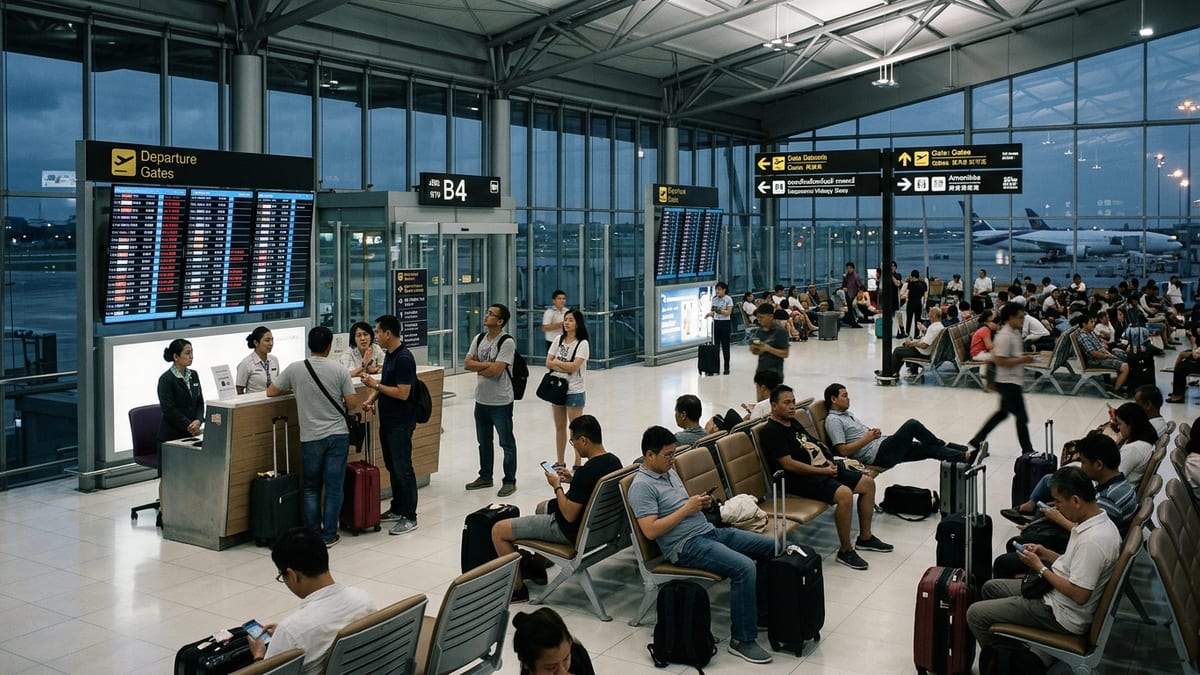
The large volume of delayed and canceled flights has translated into crowded terminals and improvised overnight stays for many passengers. News reports and social media posts from affected airports describe long lines at check in and transfer counters as travelers sought rebooking options, refunds or alternative arrangements on high speed rail.
Publicly available information from consumer and aviation platforms indicates that some passengers experienced delays stretching to several hours, particularly on trunk routes linking Guangzhou or Shenzhen with Shanghai and Beijing. In other cases, cancellations forced travelers onto later departures, with availability constrained by school holiday and early spring travel demand.
Travel advisories circulating across local media encourage passengers to check real time flight status through airline apps or airport information channels before heading to the airport. With tight seating availability on many popular routes, travelers whose journeys are not time sensitive are being urged to consider voluntary rebooking to later dates to ease pressure on the system.
Although conditions on March 31 have been especially disruptive, analysts note that China’s domestic market is accustomed to managing weather-related irregular operations during peak summer and typhoon seasons. The concentration of simultaneous disruptions across multiple hubs, however, has amplified the effect on passengers in this instance.
Operational and Policy Implications for China’s Aviation Sector
The latest wave of weather-related disruption is prompting fresh scrutiny of resilience within China’s air transport system. Commentaries in specialist aviation media highlight the challenge of balancing rapid growth in passenger numbers with infrastructure and airspace capacity that can absorb sudden weather shocks without cascading delays.
Several recent analyses have pointed to the importance of improving real time coordination among airlines, airports and air traffic management when storms affect multiple hubs at once. Published discussions emphasize tools such as dynamic slot management, enhanced use of diversion airports and more flexible crew and fleet planning to reduce the risk of prolonged knock-on effects.
At the same time, passenger rights and communication practices are again in the spotlight. Consumer-facing guidance from travel organizations stresses that clear, timely updates and straightforward rebooking or refund options can mitigate some of the frustration associated with large-scale disruption events, even when the root cause lies in adverse weather.
With forecasts pointing to continued unsettled conditions in parts of southern and eastern China, aviation observers are watching closely to see how quickly normal operations can be restored and what adjustments carriers and airports may adopt to better withstand similar shocks in the months ahead.