

More news on this day
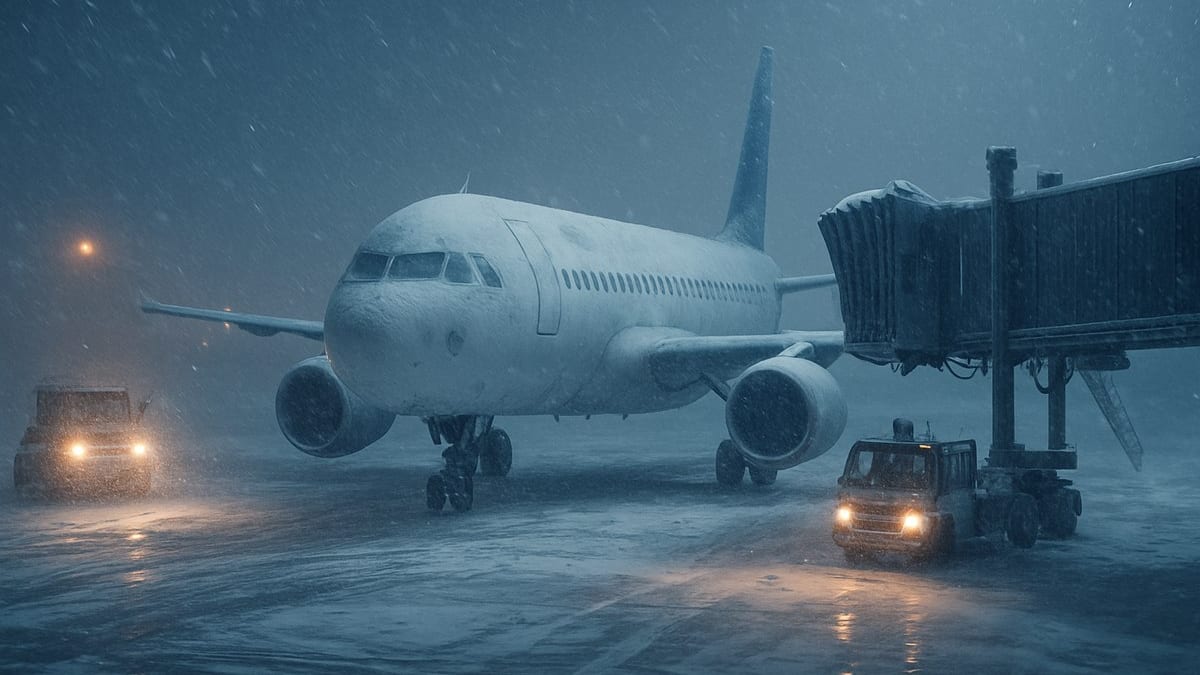
Canada’s air travel network has entered one of its most disruptive periods of the season as a series of late-winter storms brings heavy snow, freezing rain and extreme cold to major aviation hubs, triggering widespread delays, cancellations and missed connections for travelers across the country and beyond.
Get the latest news straight to your inbox!
Storm Systems Converge on Major Canadian Hubs
The latest round of severe weather has hit at the tail end of the winter season, with active systems sweeping across Ontario, Quebec, the Prairies and parts of Atlantic Canada. Publicly available meteorological data and news coverage describe a combination of heavy, wet snow, strong winds and freezing rain, conditions that significantly reduce runway capacity and extend the time required for de-icing operations.
Recent reports indicate that on Sunday, April 5, 2026, more than 400 flights were delayed and over 80 cancelled across Canadian airports as the weather deteriorated, with Toronto Pearson, Vancouver, Montreal and Calgary among the hardest hit. Earlier in the week, a powerful late-season storm on March 31 had already disrupted operations, with data showing around 87 cancellations and nearly 400 delays in a single day at key hubs.
These disruptions build on a pattern that has run through much of the 2025–26 winter. A prolonged cold wave in January and multiple winter storms through February and March have repeatedly affected schedules, especially at Toronto Pearson, Montreal Trudeau, Vancouver, Calgary and Ottawa, where tightly banked operations leave little room to recover when visibility drops or runways must be cleared.
For many travelers, the result has been long queues at check-in and security, extended waits on board while aircraft line up for de-icing, and sudden changes to itineraries as airlines consolidate or cancel flights in response to rapidly changing conditions.
Airlines Slash Schedules as Cancellations Mount
Canadian carriers have again moved into disruption-management mode. According to travel-industry tracking and published operational data, the latest storm cycle has produced dozens of cancellations at Air Canada, WestJet and Jazz Aviation, alongside widespread delays affecting flight banks in Toronto, Montreal, Vancouver and other cities. Porter Airlines, with a strong presence in Toronto City Centre and Ottawa, has reported fewer outright cancellations but considerable knock-on delays as its network absorbs the impact.
On March 31, Jazz Aviation accounted for the largest single share of grounded flights in Canada, while Air Canada logged more than 20 cancellations and well over 250 delays. A few days later, as another system moved through on April 5, disruption figures again climbed into the hundreds, underscoring how quickly winter conditions can ripple through a national network that depends on precise timing and narrow connection windows.
Operational bulletins from airlines and airports show that carriers have been preemptively trimming schedules at select hubs when major snow or ice events are forecast. Toronto Pearson temporarily shifted to a reduced schedule ahead of an expected ice storm in February, cancelling more than 160 flights in advance in order to keep remaining operations flowing and to create space for runway clearing and de-icing.
Despite these measures, completion and on-time performance data for January and February reveal that winter operations remain vulnerable. While some low-cost carriers have highlighted relatively strong completion rates during the season, legacy airlines have seen pressure on both cancellation levels and punctuality as they balance safety margins, crew duty limits and aircraft positioning.
Traveler Impact: Missed Connections and Overnight Stays
For passengers, the disruption is playing out as a succession of missed connections, diverted flights and unexpected overnight stays in hub cities. Travel advisories note that when winter weather closes in on a major hub such as Toronto or Montreal, even a modest increase in de-icing time per aircraft can cascade into multi-hour delays across an entire day’s schedule.
Travel-focused outlets are reporting that thousands of travelers have been stranded at Canadian airports over multiple storm events since early January, with some long-haul passengers arriving to discover that their onward regional flights have already departed or been cancelled. In some cases, regional feeders have suspended segments entirely for part of the day, concentrating limited resources on maintaining core trunk routes while conditions are at their worst.
Advisories published by airlines and travel-safety organizations emphasize that passengers should monitor flight status closely, as same-day changes and rolling delays have become common during active weather windows. Many carriers are offering flexible rebooking policies during specific storm periods, allowing travelers to move their trips to different days or times without change fees, subject to availability.
However, accommodation and alternative routing can still be challenging when a large portion of the network is affected at once. With seats on later flights filling quickly, some travelers are accepting multi-stop routings through secondary hubs or even choosing ground alternatives for shorter regional journeys rather than waiting out the backlog in crowded terminals.
Regional Disparities and Strain on Smaller Airports
While the highest raw numbers of cancellations are concentrated at the largest hubs, the impact on smaller and regional airports has been just as disruptive. Coverage from regional news outlets describes episodes where freezing rain and blowing snow in Atlantic Canada and parts of the Prairies have forced local airports to suspend operations for several hours at a time, cutting off communities that rely heavily on air links.
In Atlantic Canada, winter storms and nor’easter-type systems through late January and February brought repeated closures and limited schedules at airports in Nova Scotia and Newfoundland and Labrador. Even when major hubs such as Toronto and Montreal remained partially operational, downline airports in Atlantic Canada often faced local conditions that prevented safe landings or departures, amplifying the number of stranded passengers.
On the Prairies, surges of Arctic air have combined with heavy snow to reduce visibility and drive wind chills to dangerous levels. Reports indicate that airlines serving Calgary, Edmonton and Winnipeg have at times reduced frequencies or combined flights to manage crew and aircraft utilization while keeping essential connectivity in place.
These regional challenges highlight how Canada’s vast geography magnifies the effect of winter weather on aviation. A single storm system can simultaneously affect multiple climatic zones, from coastal freezing rain to inland blizzards, leaving planners with few unaffected rerouting options within the domestic network.
Resilience, Climate Risk and the Outlook for Spring
The latest wave of cancellations and delays is reigniting debate about how well Canada’s air travel system can cope with increasingly volatile winter conditions. Travel analysts note that the 2025–26 season has featured a mix of extreme cold snaps, heavy snowfall events and late-season storms that have pushed existing de-icing infrastructure, runway clearing capacity and crew scheduling systems to their limits.
Industry commentary points to several ongoing adaptation strategies, including expanded de-icing pads, more specialized winter operations equipment and refined forecasting tools that allow airports and airlines to reduce schedules earlier when a major system is approaching. Nevertheless, recent storms demonstrate that even with conservative planning, weather can still paralyse critical hubs for significant portions of a day.
Climate researchers and policy discussions increasingly link these operational shocks to broader patterns of climate variability, with warmer oceans and shifting jet streams contributing to more erratic winter storm behavior. For airlines, that translates into a more complex risk environment in which traditional seasonal planning assumptions may no longer hold.
As Canada moves deeper into April, historical norms suggest that the worst of the winter weather should gradually ease. However, given the late-season storms already recorded on March 31 and April 5, travel advisories continue to urge passengers with upcoming trips to treat winter-weather flexibility as essential, rather than optional, when flying through Canadian hubs in the coming weeks.