

More news on this day
New routings linking Seychelles with Rome and Paris are emerging as a crucial back‑up for Italy and Europe’s tourism flows, as Gulf airspace disruption and suspended hub operations in the Middle East force airlines and travelers to rethink how they move between the Indian Ocean and the continent.
Get the latest news straight to your inbox!
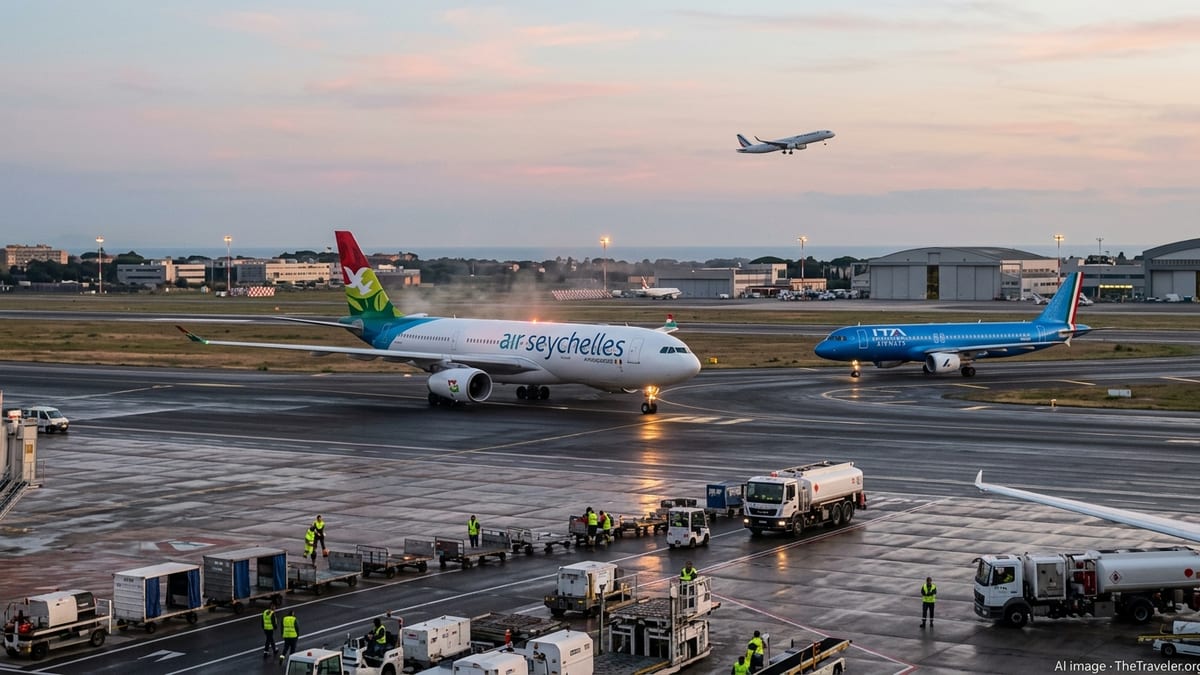
Gulf Airspace Disruption Reshapes Indian Ocean–Europe Corridors
The latest phase of conflict involving Iran and Gulf states, which escalated from 28 February 2026, has led to widespread airspace closures across Bahrain, Iraq, Israel, Kuwait, Qatar, Syria and parts of the United Arab Emirates. Publicly available operational summaries show that flights crossing the Gulf region on key Africa–Asia–Europe corridors have been heavily curtailed or diverted, with long-haul services rerouted away from traditional hubs.
Reports on the 2026 Iran conflict and related Strait of Hormuz crisis indicate that air operations at major Gulf airports, including Doha, Dubai and Abu Dhabi, have been disrupted or partially suspended, forcing airlines to cancel, delay or replan large numbers of flights. Eurocontrol data for early March points to a sharp decline in traffic between Europe and the Middle East, even as other long-haul flows to and from Europe remain comparatively resilient.
Logistics advisories issued in early March highlight a temporary reduction of global airfreight capacity by well over 10 percent, with Europe–Asia and Africa–Europe routes particularly exposed due to their historic reliance on Gulf hubs. For tourism, the same structural dependence means that travelers from Europe heading for beach destinations in the Indian Ocean, including Seychelles, face longer journeys, missed connections and fewer same-day options.
In this context, routings that bypass the Gulf entirely are getting fresh attention. Among them are services linking Seychelles with European gateways such as Rome and Paris, whether operated directly, via alternative hubs in Africa and the Indian Ocean, or structured as protected interline itineraries that keep passengers within African or Southern European airspace.
Italy’s Tourism Economy Seeks Alternative Gateways
Italy’s tourism sector has been enjoying a strong recovery, with Rome Fiumicino consolidating its position as the country’s primary intercontinental hub. Industry briefings describe a 2026 “flight boom” for Rome, marked by the return of long-haul connectivity to markets such as India and by new routes that extend the airport’s reach across Africa and the Indian Ocean basin.
Prior to the current Middle East crisis, much of Italy’s inbound and outbound long-haul leisure traffic to islands like Seychelles, Mauritius and the Maldives was routed through Gulf hubs operated by carriers based in the region. With many of those flights now suspended or rerouted, there is renewed focus on keeping Italy connected to warm‑weather destinations via routes that rely on European and African infrastructure rather than Gulf airspace.
Analysts following the situation note that India–Europe flights have already begun using Rome for technical refuelling and rerouting, illustrating how Italian airports can temporarily absorb flows displaced from the Gulf. The same logic applies in reverse for Indian Ocean tourism: if Seychelles flights can feed into Rome and then connect onward to European capitals, Italy’s role as a Mediterranean gateway is preserved even while traditional east–west corridors are constrained.
Tourism promotion bodies from Seychelles have repeatedly identified Italy as one of their top European source markets, and recent trade‑fair activity in Rimini underlines the mutual interest in maintaining easy access between the two destinations. In the current climate, that shared interest extends beyond marketing to the more fundamental question of aviation resilience.
Seychelles–Rome–Paris Links Offer a Non‑Gulf Safety Valve
Publicly available route data and schedules show that Seychelles today is connected to Europe both through direct and one‑stop services that do not require transiting the Gulf. Flights operated by African and European carriers via hubs such as Addis Ababa, Nairobi and Istanbul, as well as seasonal and charter operations to Italy and France, have long provided alternatives to Gulf‑based itineraries.
What is changing in 2026 is the strategic importance of those alternatives. With many Gulf carriers scaling back services, routings that pair Seychelles with Rome and Paris are increasingly being positioned as a stable bridge between the Indian Ocean and Europe. These itineraries typically route north‑west across East Africa and the eastern Mediterranean before entering European airspace, avoiding the most sensitive Gulf corridors while still keeping overall travel times competitive.
Travel trade coverage suggests that tour operators are actively re‑packaging Seychelles holidays for Italian and French travelers around these non‑Gulf options, emphasising protected connections through Rome Fiumicino and Paris Charles de Gaulle. Some itineraries combine scheduled legs with charter segments, creating bespoke Seychelles–Rome–Paris triangles designed to keep groups on a single ticket and under a single set of protections in case of further disruptions.
For independent travelers, the practical impact is that Seychelles can still be reached from Italy and wider Europe without transiting the Gulf, albeit sometimes with a longer flying time or an additional stop. As long as air corridors over the eastern Mediterranean and North Africa remain open, the Seychelles–Rome–Paris axis offers a comparatively predictable path for leisure travel.
Protecting Europe’s Tourism Lifeline Through Redundancy
The travel industry has long warned that over‑reliance on a handful of hubs concentrates risk in the event of geopolitical shocks. The current Gulf airspace disruption is putting that theory to the test. Eurocontrol’s latest aviation overviews show that while Europe’s overall traffic has held up, flows connected to the Middle East have plunged, demonstrating how quickly a single regional crisis can ripple across global networks.
In response, airlines and tourism boards are increasingly framing routes like Seychelles–Rome–Paris as elements of a broader redundancy strategy. By diversifying away from Gulf hubs and strengthening direct or near‑direct links between Africa, the Indian Ocean and Southern Europe, they aim to preserve visitor arrivals even when one part of the global system is constrained.
Travel risk consultants advising corporate and leisure clients now highlight the importance of avoiding single‑route dependencies. Briefings circulated in early March recommend planning around multiple corridors, favouring routings that remain within allied or lower‑risk airspace where feasible. For European tourism, that guidance effectively elevates the value of any Indian Ocean connection that can be maintained via Rome, Paris or other continental gateways.
For Seychelles, maintaining a visible presence in Rome and Paris schedules means safeguarding access to some of its highest‑spending visitor markets. For Italy and France, the same pattern ensures that their outbound travellers retain reliable access to long‑haul winter‑sun destinations, supporting airlines, hotels and tour operators at both ends of the route.
Outlook: More Direct Links and Flexible Routing Ahead
While the duration of the current Gulf airspace disruption remains uncertain, industry observers suggest that its legacy will be a stronger push toward diversified routing. Recent announcements of new Indian Ocean services from Rome, including direct flights to Mauritius, indicate that Italian carriers see long‑haul island destinations as a growth opportunity, independent of Gulf connectivity.
In parallel, Seychelles continues to broaden its global air links for the 2025–2026 seasons, encouraging more international airlines to serve the archipelago directly or through non‑Gulf hubs. Tourism Seychelles’ outreach in European markets, including Italy and France, reflects a strategy of deepening ties with carriers that can operate resilient routes in a more volatile geopolitical environment.
As schedules are adjusted for the northern winter of 2026–2027, more Seychelles–Europe itineraries are likely to be structured explicitly around Rome and Paris as anchor points. That could include additional seasonal charters, code‑shares and cooperative marketing arrangements designed to make the Seychelles–Rome–Paris triangle a familiar, mainstream option for European travelers.
For now, these routes are serving an immediate purpose: keeping a vital tourism lifeline open between Europe and the Indian Ocean at a moment when traditional Gulf pathways are constrained. How airlines, regulators and tourism boards build on this stopgap in the months ahead will help determine how resilient Europe’s long‑haul leisure market proves in the face of future shocks.