

More news on this day
A fresh wave of flight cancellations at San Francisco International Airport is rippling across the United States, snarling connections, overwhelming terminals and underscoring how fragile the country’s air travel network remains during a volatile late-winter season.
Get the latest news straight to your inbox!
Weather, Shutdown and a Fragile System Collide
Published coverage of nationwide airline operations in mid-March indicates that a powerful storm system sweeping across the central and eastern United States has already forced the cancellation of more than a thousand domestic flights, as carriers struggle to keep to their schedules. While the worst of the snow and ice is centered far from California, San Francisco International Airport, one of the country’s busiest hubs, has been pulled into the disruption as the knock-on effects hit transcontinental and connecting services.
The storm’s impact comes on top of a partial federal government shutdown that has strained aviation staffing and stretched security lines at key checkpoints. Publicly available information shows that the combination of severe weather, reduced staffing and heavy spring break demand has left airlines with little flexibility to recover when a major hub falters, turning local problems into coast-to-coast headaches.
Analysts note that San Francisco’s role as a primary West Coast gateway for Asia and a major domestic connection point amplifies every operational setback. When aircraft or crews fail to arrive from weather-battered airports in the Midwest or East, cancellations rapidly cascade through SFO’s departure boards, affecting travelers who have never set foot in the Bay Area.
SFO’s Chronic Vulnerability Meets a Spike in Demand
San Francisco International Airport has long battled a reputation as one of the most delay-prone major airports in the United States, a pattern transportation research has linked to its constrained runway layout and frequent low clouds that force wider spacing between landings. Historical delay statistics show that even routine bouts of fog or coastal wind can ripple into lengthy backups, especially during peak morning and evening banks of flights.
The latest disruptions are colliding with one of the busiest travel periods of the year. Spring break traffic and early-season business travel have filled planes and terminals, leaving fewer empty seats for passengers to be rebooked when flights are canceled. Social media posts and traveler forums in recent days describe repeated delays and last-minute cancellations on departures from SFO, particularly on routes connecting to major Midwestern and East Coast hubs that are also battling weather issues.
According to flight-tracking data summarized in recent media coverage, the broader U.S. system has seen thousands of cancellations and delays over several days as storms tracked from the Plains to the Atlantic seaboard. With SFO already operating with limited slack because of its infrastructure constraints, even a modest number of missed inbound aircraft can tip operations into gridlock.
Nationwide Domino Effect From a Bay Area Bottleneck
The latest wave of cancellations at San Francisco is contributing to a wider domino effect that stretches well beyond California. When SFO-based aircraft and crews are stranded, flights linking secondary markets across the country are also pulled from service, creating pockets of disruption at airports that are not directly affected by storms or staffing issues.
Reports from travelers connecting through SFO describe long lines at customer service counters, scrambling for scarce hotel rooms and difficulty securing alternative itineraries as seats vanish on remaining flights. Accounts on aviation forums indicate that some passengers have faced multiple rebookings in a single day, only to see each new departure time slip further into the night before being scrubbed entirely.
The hub-and-spoke structure of the U.S. airline system magnifies these shocks. When a major hub like San Francisco stumbles, regional spokes lose crucial links, stranding travelers in cities from the Mountain West to the Southeast. This week’s cancellations at SFO are feeding into a patchwork of snarled connections across the network, compounding the storm-related turmoil hitting other major airports.
Airlines Struggle to Reset Schedules
Carriers are racing to realign aircraft and crew rosters after several days of intense disruption. Publicly available operational data show that airlines have leaned on rolling delays, schedule thinning and selective cancellations to cope with both the weather impacts and resource constraints. In practical terms, that has meant repeated schedule changes for passengers attempting to depart or connect through San Francisco.
Travelers sharing their experiences online in recent days report a familiar pattern: initial short delays posted on departure boards, followed by a series of incremental pushes, gate changes and eventual cancellations. These rolling adjustments can keep travelers at SFO and other airports for hours in a state of uncertainty, complicating decisions about rebooking, lodging and ground transportation.
Industry observers note that the partial government shutdown has added another layer of complexity, with security staffing and air traffic management both operating under heightened strain. While there is no single cause behind the San Francisco cancellations, the convergence of weather, policy and structural vulnerabilities has left airlines with limited options to restore normal operations quickly.
Travelers Face Tough Choices as Disruptions Drag On
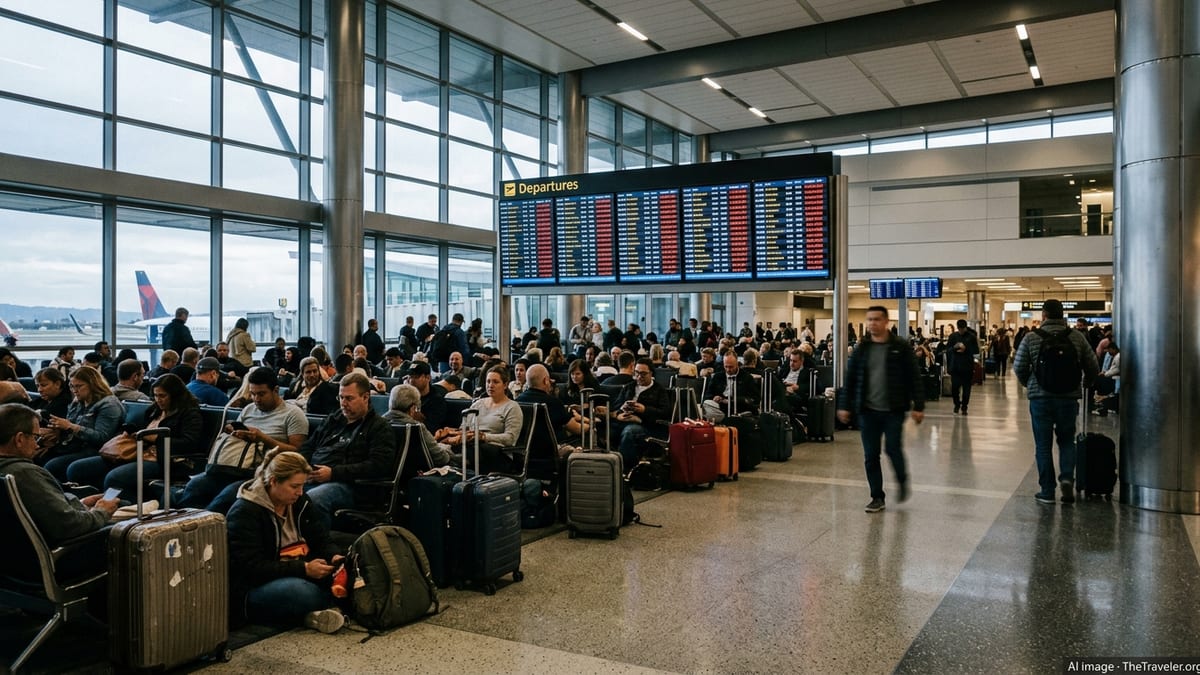
For passengers, the result has been a bruising travel experience. Accounts from recent days describe crowded concourses at SFO, with travelers camped on the floor near power outlets, lines snaking from rebooking counters and departure boards dominated by red cancellation notices. Many have turned to alternate West Coast airports or long-distance ground transportation to salvage trips.
Consumer advocates are urging travelers to monitor flight status frequently, consider options at nearby airports and document expenses incurred during extended disruptions. Published guidance from travel experts suggests that passengers may have more success rebooking via airline mobile apps or call centers than waiting in line at the airport when large blocks of flights are canceled simultaneously.
With the storm system only gradually exiting the eastern United States and federal budget negotiations unresolved, the broader air travel environment remains precarious. For now, San Francisco International Airport stands as one of the most visible pressure points in a system under sustained stress, and travelers across the country are feeling the impact every time its operations falter.