

More news on this day
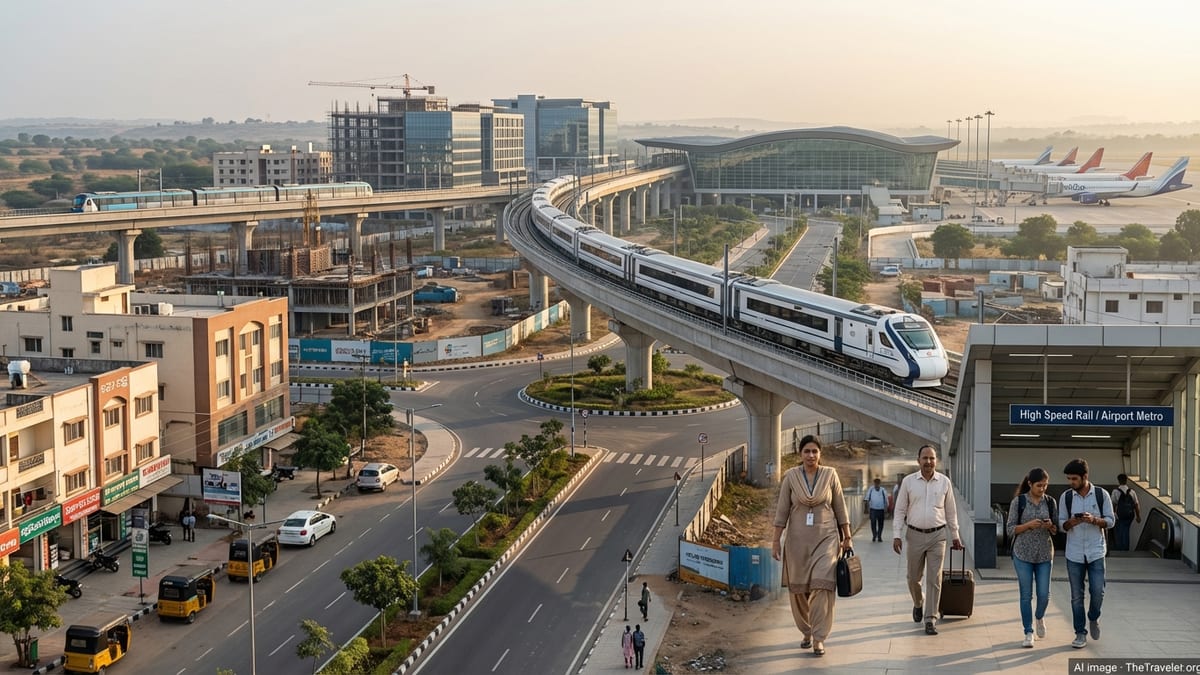
Shamshabad, the gateway to Hyderabad and home to Rajiv Gandhi International Airport, is poised to become the central junction of India’s next big transport story.
Newly announced high speed rail corridors converging here will transform the once-peripheral township into a national bullet train hub, stitching together Mumbai, Pune, Bengaluru and Chennai in a fast, seamless network that promises to redraw business and leisure travel across southern and western India.
More News
- Caribbean Travel to U.S. Upended by New Visa Freezes and Expanded Bans
- Mexico Restores E-Visas for Brazilians, Paving the Way for Borderless Tourism
- Philippine Airlines Joins Regional Carriers Powering Southeast Asia’s Tourism Boom
A Budget Announcement That Repositions Hyderabad on the Rail Map
The Union Budget for 2026 has given formal shape to a vision that railway planners have been nurturing for several years. Among the seven new high speed rail corridors announced, three either originate or terminate in Hyderabad, with Shamshabad identified as the operational focal point for the southern cluster. Senior South Central Railway officials describe the emerging plan as a three way terminal at Shamshabad that will function as a junction where high speed trains from multiple directions meet, turn around and interchange.
Railway Minister Ashwini Vaishnaw has positioned this network as a transformational push for the five southern states and western India. The corridors, designed for operating speeds of up to 320 to 350 kilometres per hour, will cut rail travel times between Hyderabad and Bengaluru to about two hours, between Hyderabad and Chennai to under three hours, and between Hyderabad and Pune to just under two hours. That kind of timing moves rail travel into the same consideration set as air for business travellers, while often undercutting it on price.
Crucially, the high speed links radiating from Shamshabad will dovetail with the planned Mumbai Pune high speed line and the longer Mumbai Hyderabad corridor already identified in the National Rail Plan. Taken together, these routes consolidate Hyderabad’s role not only as a southern technology hub but as a pivotal inland junction in India’s emerging high speed rail spine.
Why Shamshabad Was Chosen as the High Speed Junction
Shamshabad’s selection over the more centrally located Hyderabad Deccan or Secunderabad stations reflects a deliberate strategy to combine aviation scale, land availability and network geometry. The area already hosts one of India’s busiest international airports, extensive logistics parks and highway links to the Outer Ring Road, giving planners a ready-made intermodal platform that can support large volumes of passenger transfers between air, road and rail.
Unlike dense inner city locations, Shamshabad still has relatively more contiguous land parcels that can accommodate elevated high speed rail viaducts, a three way terminal and future maintenance depots. High speed trains require straight, wide corridors with limited curvature, and the open tracts south of Hyderabad offer a cleaner alignment for lines approaching from Pune and Mumbai in the northwest, Bengaluru in the southwest and Chennai in the southeast.
Equally significant is the desire to create a hassle free experience for long distance travellers. With the high speed station planned within quick reach of the airport precinct, passengers arriving on international or domestic flights will be able to board trains to Bengaluru, Chennai, Pune or eventually Mumbai without having to negotiate city traffic. For Hyderabad’s booming IT and pharmaceutical sectors, that integrated connectivity is expected to become a selling point in global boardrooms.
The New Corridors Converging on Shamshabad
The network blueprint emerging from railway and budget documents centres around three primary high speed corridors linked to Shamshabad. The first is the Pune Hyderabad line, which will connect to the Mumbai Pune high speed route. Once both are operational, passengers will be able to travel the roughly 190 kilometre stretch between Mumbai and Pune in under an hour and the onward leg from Pune to Hyderabad in about one hour and 55 minutes, effectively bringing Mumbai within roughly three hours of Hyderabad by bullet train.
The second corridor is the Hyderabad Bengaluru high speed line, mapped broadly through Mahabubnagar, Kurnool and Anantapur before reaching Karnataka’s capital. Current conventional trains on the corridor can take eight to eleven hours, depending on the service. High speed operations from Shamshabad are projected to pare that to just two hours, turning what used to be an overnight journey into a manageable day trip and opening up new possibilities for cross-city commuting at senior management levels.
The third major spoke from Shamshabad is the Hyderabad Chennai corridor, which is expected to run via Nalgonda, Amaravati and Nellore. Today, rail journeys between the two cities tend to take ten to twelve hours. Under the new plan, trains departing the Shamshabad junction should be able to complete the distance in around two hours and fifty five minutes, giving Hyderabad and Chennai a fast rail alternative on par with short-haul flights in overall door-to-door time.
Overlaying these with the longer Mumbai Hyderabad high speed corridor envisaged in the National Rail Plan, which targets future operations at up to 350 kilometres per hour, Shamshabad emerges as the physical crossroads of an extended western and southern bullet train triangle that links major economic centres along a dedicated, high speed grid.
From Airport Suburb to National Gateway
For Shamshabad itself, the high speed rail designation caps a dramatic transformation. Once regarded largely as an outlying suburb defined by its airport, the locality is now being written into central government planning documents as a national gateway. That change in status is likely to trigger a new wave of private investment ranging from hotels and conference centres to warehousing, data centres and residential townships aimed at professionals who value direct access to both flights and high speed trains.
The presence of the planned Airport Express Metro corridor, a semi high speed urban link designed to connect Hyderabad’s IT hub around Mindspace and Raidurg to the airport area in about twenty minutes, will further amplify this role. Together, the metro, airport and bullet train terminal will give Shamshabad a layered mobility ecosystem more typically associated with major global hubs rather than Indian suburbs.
Urban planners in Telangana see an opportunity to rebalance Hyderabad’s growth away from the already congested western corridors of Hitech City and Gachibowli. High speed rail is expected to draw a share of commercial development southwards, creating a more polycentric metropolitan area with multiple specialized nodes connected by rapid transit rather than a single dominant core.
Tourism and Travel: What It Means for TheTraveler.org Readers
For leisure travellers, the convergence of high speed lines at Shamshabad changes the way multi city itineraries across South India can be planned. A visitor flying into Hyderabad could, within a few years of the network becoming operational, spend a day exploring the Charminar and Golconda Fort, then board an evening high speed service to Bengaluru and arrive in time for dinner in the city’s buzzing restaurant districts. The next leg to Chennai, with its beaches and temples, would be another quick hop of under three hours.
Shorter journey times and predictable schedules are also likely to alter the economics of weekend getaways. Cities that today feel more like long haul rail trips, such as Pune or Chennai, will be reclassified in the minds of many Hyderabad residents as realistic weekend destinations accessible without the hassle of airport queues. Conversely, travellers based in Mumbai, Pune, Bengaluru or Chennai will find it easier to incorporate Hyderabad into longer regional routes.
Tour operators are beginning to sketch out sample high speed rail itineraries that align train departures with hotel check in times and airport arrivals. The presence of a central junction at Shamshabad simplifies such planning because it offers a common interchange point across lines, making it possible to design circular or triangular journeys that begin and end at the same hub without unnecessary backtracking.
Economic Upside for Hyderabad and the Southern States
Beyond passenger convenience, the decision to anchor multiple high speed corridors at Shamshabad reflects a broader economic strategy. The fast triangle formed by Hyderabad, Bengaluru and Chennai connects three of India’s most important technology and services clusters, while links to Pune and Mumbai tie in manufacturing, finance and automotive hubs. Policymakers argue that shrinking effective distances between these cities will facilitate cross-investment, labour mobility and supply chain coordination.
Hyderabad in particular stands to gain as a centrally located meeting ground. With travel times from neighbouring metros compressed into two to three hours, companies may opt to host regional conferences, training programmes and client events in the city, taking advantage of its lower real estate costs and growing hospitality infrastructure, especially around the airport corridor.
The construction phase of the high speed corridors will itself generate substantial employment in civil works, systems engineering and rolling stock manufacturing. Longer term, maintenance depots, operations centres and training institutes associated with the Shamshabad junction are expected to create specialized technical jobs, potentially supported by tie ups between Indian Railways entities and local engineering colleges.
Timelines, Technology and Implementation Challenges
While budgetary announcements and initial surveys have created considerable buzz, officials caution that the Shamshabad high speed hub will materialise over a multi year horizon. Detailed project reports for specific corridors are in various stages of preparation and review, and land acquisition, environmental clearances and financing structures will all have to be navigated before large scale construction begins.
The corridors converging on Shamshabad are envisioned as fully grade separated alignments built largely on elevated viaducts, a choice that reduces conflicts with existing rail and road traffic but increases structural complexity. The trains themselves are expected to draw on proven high speed technology similar to that being deployed on the Mumbai Ahmedabad bullet train, including dedicated high voltage electrification, advanced signalling and aerodynamic trainsets capable of sustained operations at 320 to 350 kilometres per hour.
Project agencies will also have to integrate the design of the Shamshabad terminal with the existing and planned infrastructure of the airport and metro lines. Seamless transfers will require careful attention to station layouts, passenger flows, baggage handling and wayfinding, particularly for international travellers who may be transiting between flights and trains after long journeys.
Cost is another critical consideration. High speed rail is capital intensive, and while officials argue that the long-term gains in productivity, regional growth and climate benefits justify the investment, funding models are still being refined. A mix of central allocations, multilateral lending and potential private participation in station development is likely, though final structures will only become clear as detailed studies progress.
FAQ
Q1. What does it mean that Shamshabad has been identified as a central junction for India’s high speed rail network?
It means that multiple high speed rail corridors will meet and interchange at a dedicated terminal near Shamshabad, effectively making it the main hub for bullet train services connecting Hyderabad with Mumbai, Pune, Bengaluru and Chennai.
Q2. Which high speed corridors will connect to Shamshabad?
The key planned corridors linked to Shamshabad include Pune Hyderabad, Hyderabad Bengaluru and Hyderabad Chennai, with the Pune leg connecting onward to Mumbai through the Mumbai Pune high speed line and a longer Mumbai Hyderabad corridor identified in national planning documents.
Q3. How fast will the trains be and how much time will they save?
The new services are being designed for operating speeds of around 320 to 350 kilometres per hour on dedicated tracks. Travel times between Hyderabad and Bengaluru are projected at about two hours, Hyderabad and Chennai at just under three hours, and Hyderabad and Pune at under two hours, compared with current rail journeys of eight to twelve hours.
Q4. Why was Shamshabad chosen instead of central Hyderabad stations?
Shamshabad offers better land availability for straight, elevated alignments, direct access to Rajiv Gandhi International Airport, and strong highway connections via the Outer Ring Road. These factors make it easier to build a large junction station and create smooth transfers between air, road, metro and high speed rail.
Q5. How will this benefit travellers using Hyderabad airport?
Passengers arriving at or departing from Hyderabad’s international airport will be able to connect directly to high speed trains serving Bengaluru, Chennai, Pune and eventually Mumbai with minimal ground travel, turning Shamshabad into a one stop gateway for both flights and fast intercity rail.
Q6. When are the Shamshabad high speed services expected to start?
The corridors are still in planning and survey stages, and officials speak in terms of a multi year rollout rather than specific start dates. Initial construction activity on some segments is expected later this decade, with full network commissioning likely to extend into the 2030s and beyond, depending on approvals and funding.
Q7. Will ticket prices be comparable to air fares?
Detailed fare structures have not yet been announced, but railway officials indicate that high speed trains are intended to offer an option that is competitive with air travel on total journey time while generally being more affordable, especially in standard classes.
Q8. How will Shamshabad’s development change because of the junction?
The area is expected to see increased investment in hotels, offices, logistics parks and residential projects aimed at travellers and professionals who value proximity to both the airport and high speed rail. Over time, Shamshabad is likely to evolve from an airport suburb into a major mixed use urban node.
Q9. Will the high speed lines affect existing conventional rail services from Hyderabad?
High speed trains will run on separate, dedicated tracks and are not expected to replace existing conventional services, which will continue to serve intermediate towns and price sensitive passengers. Instead, the new corridors will complement the current network by taking over long distance, time critical travel.
Q10. What should travellers keep in mind while planning future trips involving Shamshabad?
As the projects advance, travellers should watch for integrated scheduling between flights, metro lines and high speed trains, as well as emerging multi city itineraries that use Shamshabad as a hub. Booking patterns may shift toward rail for routes where high speed services offer similar door-to-door times to air at lower overall cost.