

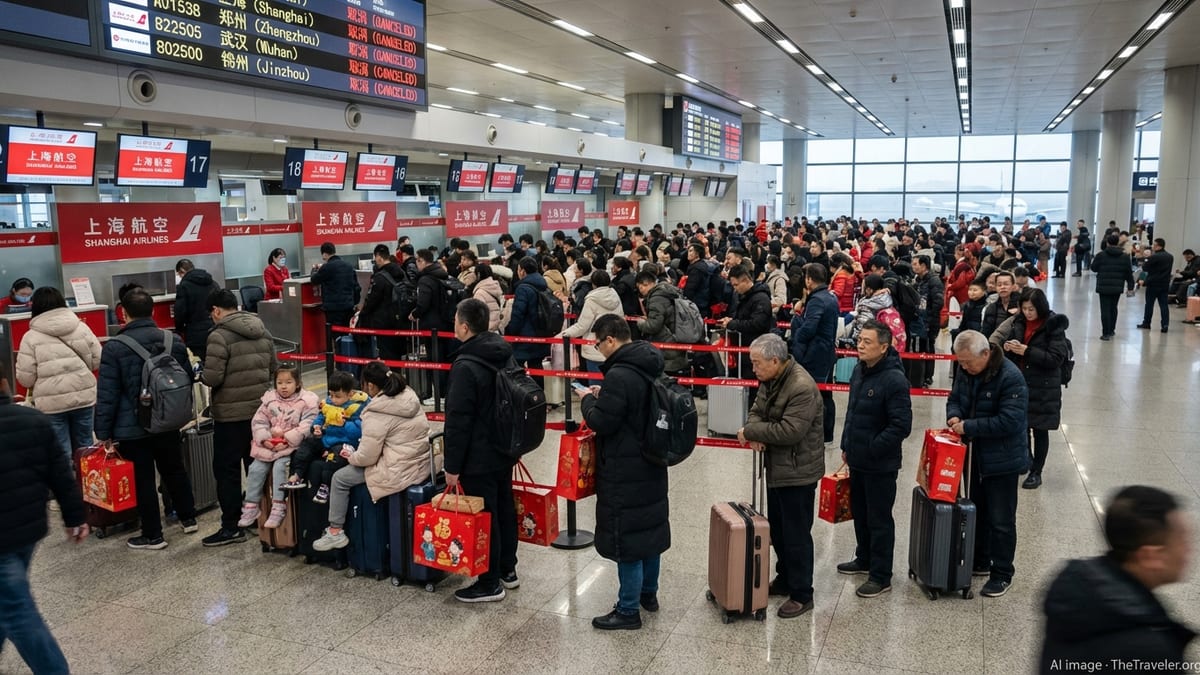
Hundreds of passengers were left stranded across several Chinese cities on Tuesday after Shanghai Airlines abruptly canceled a string of key domestic flights linking Shanghai with Zhengzhou, Wuhan, and Jinzhou, deepening disruption in an already fraught Lunar New Year travel season.
Key Routes Pulled as Lunar New Year Travel Peaks
The latest wave of cancellations hit Shanghai Airlines services operating between Shanghai’s two main hubs and important regional gateways in central and northeastern China. Flight-tracking data on Tuesday showed multiple Shanghai Airlines Boeing 737 services between Shanghai Pudong and Jinzhou, as well as Shanghai Hongqiao and the central cities of Zhengzhou and Wuhan, listed as canceled shortly before or on the day of departure.
Among the affected services were Shanghai Pudong to Jinzhou flights scheduled in the early morning, and round-trip connections between Shanghai Hongqiao and Zhengzhou and Wuhan during the evening peak. Passengers arriving at airports expecting routine domestic journeys instead found departure boards flashing red and queues forming at service counters, with many reporting limited information on when they might be rebooked.
The cancellations came during the first half of China’s 40-day Spring Festival travel period, one of the busiest annual movements of people anywhere in the world. Airlines across the country are already operating under pressure from high demand, tight aircraft utilization and shifting international capacity, leaving fewer options when schedules are suddenly disrupted.
While overall national focus has been on the sharp reduction of China–Japan flights in recent weeks, the sudden loss of several high-demand domestic Shanghai Airlines services underlined how fragile domestic connectivity can become when network plans are adjusted at short notice.
Passengers Face Night in Terminals and Scramble for Alternatives
At Shanghai’s Hongqiao and Pudong airports, travelers described a scene that echoed previous disruption events in China: snaking queues at airline counters, anxious passengers refreshing apps for updates, and families weighing whether to stay in the terminal overnight or seek hotel rooms far from the city center. Similar scenes were reported at Zhengzhou Xinzheng International Airport, Wuhan Tianhe International Airport, and Jinzhou’s regional airport as return legs were also canceled.
Several passengers took to Chinese social media to complain of long waits for rebooking and a lack of clear explanations from frontline staff. Others said they were offered seats on later flights, often via indirect routings, that would have them arriving at their destinations more than half a day late. With trains already heavily booked for the holiday rush, switching to rail at short notice was not a realistic option for many.
Travelers stranded in Shanghai spoke of difficulty finding reasonably priced hotel rooms near the airports, especially around Pudong, where accommodation prices tend to surge during major travel peaks. Some opted to remain airside overnight to avoid additional costs, stretching out on benches or the floor as they waited for a confirmed departure the following day.
For passengers in smaller Jinzhou, the options were even more limited. With their morning service to Shanghai scrubbed, many faced the choice of waiting for possible re-accommodation or arranging ground transport to larger hubs in the region. For families traveling with children and elderly relatives, those choices were particularly stressful.
Shanghai Airlines and Parent China Eastern Under Mounting Capacity Pressure
Shanghai Airlines, a subsidiary of China Eastern Airlines, plays a key role in feeding traffic into the Shanghai hub system from second- and third-tier cities. Its Boeing 737 fleet is heavily used on trunk domestic routes, including those to Zhengzhou, Wuhan and Jinzhou, which connect fast-growing provincial capitals and industrial centers to China’s financial hub.
China Eastern and its affiliates have been reconfiguring networks in recent months, particularly on international services to Japan, where thousands of flights have been cut since late 2025 amid deteriorating bilateral ties and shifting travel advisories. Analysts say those changes have complicated aircraft and crew planning, increasing the risk that even domestic sectors will be affected when schedules are recalibrated or operational issues emerge.
Industry observers note that Shanghai’s airports have been among the hardest hit by broader regional cuts, with Pudong bearing the brunt of cancellations on China–Japan routes and domestic rotations adjusted to absorb aircraft. When further disruptions hit, such as technical issues or crew shortages, carriers may have limited slack in the system, prompting last-minute cancellations on routes that usually see strong demand.
While Shanghai Airlines did not immediately issue a detailed public explanation for Tuesday’s cancellations, the pattern of affected flights suggested a tight operational environment rather than a single, isolated technical failure. Passengers, however, were more focused on immediate assistance than on the airline’s broader strategic challenges.
Refunds, Rebookings and Compensation: What Stranded Travelers Are Being Offered
At airport counters, Shanghai Airlines staff began processing free refunds and rebookings for those affected, in line with standard practice during airline-initiated cancellations. Passengers with flexible schedules and digital bookings were generally able to secure alternative flights within 24 hours, though often at inconvenient times or with added connections through other cities.
Travelers with fixed departure dates, tight onward connections or non-refundable hotel bookings at their destination faced a more complex picture. Some reported being offered meal vouchers and assistance with hotel stays, particularly in Shanghai, while others said they were told to arrange accommodation themselves and seek partial reimbursement later through customer service channels.
China’s aviation regulations require airlines to provide basic care and assistance during disruptions they control, but the application of those rules often varies depending on the circumstances and local airport arrangements. Legal experts and passenger advocates have long argued that domestic travelers need clearer, more consistently enforced rights when cancellations leave them stranded with significant out-of-pocket costs.
For now, much of the burden remains on travelers to retain receipts, document communication with the airline and pursue compensation after their journeys are finally completed. With Lunar New Year celebrations imminent, many of those stranded on Tuesday said they were more concerned with simply getting home or reaching family in time than with potential claims months down the line.
Domestic Disruptions Against a Backdrop of Wider Regional Turmoil
The Shanghai Airlines cancellations came against a backdrop of extraordinary turbulence in East Asian aviation. In recent weeks, Chinese carriers have scrapped thousands of flights on routes to Japan, citing a combination of diplomatic tension, shifting demand and safety concerns, and prompting many Chinese travelers to pivot to South Korea and Southeast Asia for their holidays.
Data from flight analytics providers show that Shanghai, Beijing and other major Chinese hubs have recorded some of the highest cancellation rates on international routes since late 2025, particularly on services to Osaka and other Japanese cities. Shanghai Pudong, the country’s primary international gateway, has already seen a significant share of its Japan-bound flights wiped from the schedule for the Spring Festival travel window.
Those cuts have had knock-on effects for domestic operations. Aircraft and crews originally rostered for international sectors have been redeployed on internal routes, while airlines revisit their network strategies and pricing. In such a fluid environment, the potential for misalignment between capacity and demand increases, raising the risk that last-minute trimming of domestic flights will occur when operational constraints tighten.
For passengers on the ground, the strategic backdrop offers little comfort. What they experience is a simple binary: flights that are operating and flights that are not. When a cancellation is announced with only hours to spare, the distinction between international politics, economic calculation and operational logistics tends to blur into a single, frustrating reality.
Echoes of Past Airport Flashpoints Raise Concerns
China has seen airport tensions boil over before when large numbers of passengers were stranded with limited information. A decade ago, angry travelers in Zhengzhou staged a riot after prolonged weather-related delays and patchy communication, smashing equipment and clashing with staff in scenes that drew nationwide attention. That incident prompted calls for better crisis management, clearer updates and more visible security during major disruptions.
While there were no immediate reports of serious confrontations related to Tuesday’s Shanghai Airlines cancellations, the scale of the disruption and the emotional stakes around Lunar New Year travel revived memories of past flashpoints. Social media posts from passengers in Zhengzhou and Wuhan showed crowded departure halls and tense arguments at counters as tempers frayed over perceived unfairness in rebooking queues.
Airport authorities in major hubs have since invested in more robust messaging systems, including push notifications through airline apps and terminal-wide announcements. Yet passengers caught up in the latest wave of cancellations said that information still felt sporadic, with some learning of changes from third-party flight trackers or online forums before official channels confirmed the bad news.
Experts in air transport management say that, during peak travel periods, communication can be as critical as capacity itself. When travelers believe they are being kept informed, they are more likely to cope with delays and cancellations without resorting to confrontation. When they feel ignored or confused, the likelihood of conflict in crowded terminals rises significantly.
What Travelers Can Do if Their Shanghai Airlines Flight Is Canceled
For passengers booked on upcoming Shanghai Airlines services to or from Shanghai, Zhengzhou, Wuhan or Jinzhou, the latest disruption serves as a reminder to monitor flight status closely in the days and hours before departure. Airline and airport apps, departure boards and third-party trackers can provide early warning of schedule changes, although official confirmation still rests with the carrier.
Passengers whose flights are canceled are typically entitled to a choice between a free refund and rebooking on the next available service. In practice, travelers with urgent plans should proactively approach customer service, either in person or via hotlines and chat channels, to secure the most suitable alternatives before remaining seats are snapped up.
Travel advisers also recommend packing essential items such as medications, chargers and a change of clothes in carry-on bags during the Spring Festival period, in case unexpected overnight stays become unavoidable. Keeping digital copies of tickets, receipts and communication with the airline can help smooth any later claims for compensation or reimbursement of expenses.
Despite the latest setback, China’s domestic aviation network remains vast, and many routes continue to operate at high frequencies. For now, however, the experience of those stranded by Shanghai Airlines on Tuesday underlines a hard truth for peak-period travel in China: even on well-served routes between major cities, confirmed tickets are not always a guarantee of a smooth journey.