

Hundreds of passengers were left stranded on Tuesday as Shanghai Airlines abruptly canceled a cluster of key domestic flights linking Shanghai with Zhengzhou, Wuhan and Jinzhou, snarling Lunar New Year travel plans at some of central and eastern China’s busiest airports.
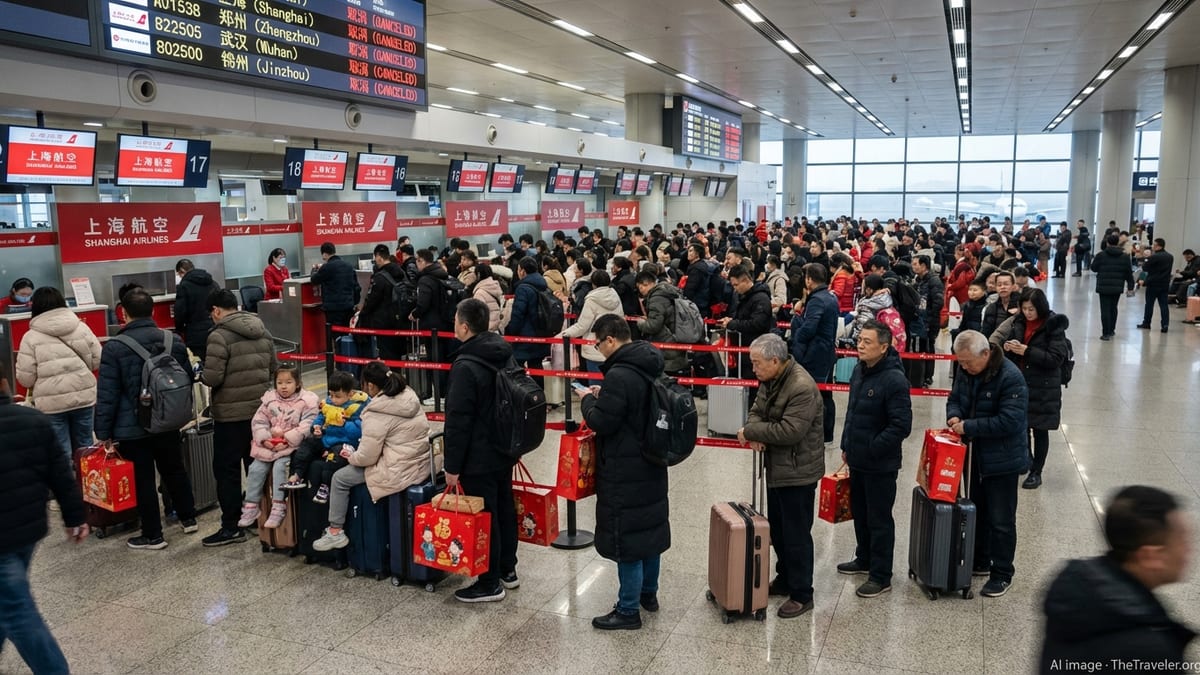
Key Shanghai Routes Abruptly Pulled From Tuesday Schedules
Operational data from real-time flight tracking platforms on Tuesday showed multiple Shanghai Airlines services scrubbed from the schedule, including Shanghai to Jinzhou and return, Shanghai to Zhengzhou and Wuhan, as well as evening inbound legs back to the city’s Hongqiao and Pudong hubs. On what should have been routine Boeing 737 services, departure boards instead flipped to “canceled,” triggering long queues at customer service counters and an immediate scramble for alternatives among domestic travelers.
The cancellations affected a mix of business and family travelers moving along some of China’s most important trunk routes. Zhengzhou in Henan province and Wuhan in Hubei are major inland hubs, while Jinzhou in Liaoning offers a key regional link to the northeastern seaboard. For travelers connecting onward through Shanghai, the sudden loss of flights turned carefully timed itineraries into an overnight puzzle, with many facing the prospect of extra hotel nights or lengthy detours by high speed rail.
Shanghai Airlines, a subsidiary of China Eastern and a familiar presence at both Shanghai Hongqiao and Pudong airports, did not immediately issue a detailed public breakdown of the affected flights. However, the pattern of Tuesday’s cancellations suggested a targeted reduction on select city pairs rather than a blanket operational shutdown, leaving other Shanghai Airlines services operating as scheduled even as passengers on the disrupted routes sought answers in crowded terminals.
The disruption came at a particularly sensitive moment in China’s peak winter travel season, with airports already operating under heavy pressure from Lunar New Year demand. While single day cancellations are not unusual in such a busy period, the clustering of multiple Shanghai Airlines flights on the same day and on the same corridors quickly elevated the event into a flashpoint for frustrated travelers.
Passengers Face Long Queues, Patchy Information and Rising Costs
By midday, social media posts and local reports from Zhengzhou, Wuhan and Jinzhou described scenes familiar to any seasoned traveler during a major disruption: snaking queues at airline counters, groups of passengers comparing text messages and app notifications, and families camped out on luggage trolleys with children in tow. Many reported receiving short notice of the cancellations, sometimes only upon arrival at the airport or while queuing at security checkpoints.
Passengers seeking to rebook onto alternative flights soon ran into the hard reality of constrained capacity. With the Lunar New Year travel window in full swing and seats at a premium, same day rebooking was challenging, especially for larger family groups. Some travelers interviewed by local outlets described being offered flights one or even two days later, or being advised to seek refunds and pursue high speed rail options instead, a costly and time consuming prospect for those without flexible schedules.
Accommodation and incidental expenses quickly became a pressing concern. At major hubs like Zhengzhou Xinzheng and Wuhan Tianhe, nearby hotels were reported to be filling rapidly as airlines and passengers negotiated overnight arrangements. While Chinese carriers commonly offer meal vouchers or partial hotel support during disruptions linked to operational issues, travelers complained of inconsistent implementation at different airports, with some counters reportedly steering affected passengers toward self funded solutions.
Platform and gate staff also appeared to struggle with the information gap. At least at some checkpoints, frontline employees could not immediately clarify whether the cancellations stemmed from weather, aircraft rotation challenges, crew availability or wider strategic schedule cuts. That ambiguity made it difficult for travelers to gauge whether they should hold out for a near term solution at the airport or abandon their trips altogether.
Weather, Network Strain and Policy Uncertainty Form a Volatile Backdrop
The latest Shanghai Airlines disruption did not occur in isolation. China’s aviation network has grappled with repeated bouts of irregular operations this winter, including a day of more than 1,100 disrupted flights across major hubs in early January, when airlines such as China Eastern and Shanghai Airlines absorbed dozens of cancellations and delays in Shanghai and beyond. Those events highlighted just how quickly congestion and air traffic control restrictions can cascade through tightly wound domestic schedules.
On top of weather related turbulence, carriers are still recalibrating capacity in response to shifting demand patterns, regulatory frameworks and geopolitical crosswinds. In recent weeks, Chinese media and aviation data providers have detailed a sharp surge in cancellations on China Japan routes, with Shanghai’s Pudong and Hongqiao airports among the hardest hit. While those cuts primarily affect international traffic, they underscore the fragility of wider network planning at a time when airlines are juggling domestic connectivity, regional diplomacy and evolving safety perceptions.
Domestically, smaller airlines and regional operators have also been trimming or suspending flights because of severe weather across central and southern China, particularly around transport hubs such as Zhengzhou and Xi’an. The accumulated effect is a system that often runs near the edge of its resilience, where an aircraft out of position in one city or a temporary crew shortage in another can trigger sudden cancellations along important routes like the Shanghai Zhengzhou Wuhan corridor served by Shanghai Airlines.
Industry analysts note that while China’s domestic aviation market has largely recovered in headline traffic terms, much of that recovery rests on network designs and crew rosters that leave little slack. During peak travel windows such as the forty day Spring Festival migration, any unplanned shock can translate into widespread disruption, a reality now being felt by the passengers stranded on Shanghai Airlines’ canceled flights.
Lunar New Year Travel Plans Upended for Families and Migrant Workers
The timing of Tuesday’s cancellations magnified their impact, as millions of Chinese travelers are on the move for the annual Spring Festival holidays. For families using Shanghai as a gateway to return home to inland provinces or to visit relatives in coastal cities, a lost flight can mean missing once a year reunions or key cultural celebrations. In interviews and online posts, some stranded passengers said they faced the painful choice between cutting trips short or missing the most important days of the holiday.
The disruptions also hit migrant workers traveling between central China and coastal employment hubs. Routes linking Shanghai with Zhengzhou and Wuhan serve not just tourists and business travelers but also large flows of workers who depend on affordable, timely transport to balance work commitments with family obligations back home. For those on tight budgets, added hotel nights, ticket change fees and last minute rail fares can swallow up a significant share of monthly wages.
Parents traveling with young children and elderly relatives reported the additional strain of spending long hours in crowded terminals with limited seating. While China’s newer airports offer improved facilities, including play areas and dedicated rest zones, congestion during the peak holiday travel weeks often outstrips available capacity. Images shared by travelers showed passengers resting on suitcases, sitting on the floor near power outlets and lining up outside service desks well into the evening.
The emotional toll was compounded by the lack of clear forward visibility. Without firm guarantees of when replacement flights might operate, many travelers felt caught between hope and resignation, wary of leaving the airport in case of sudden updates but increasingly exhausted by the wait. Some turned to online consumer forums to seek advice on compensation rights and to compare their experiences with disruptions at other airlines during the same period.
Shanghai Airlines and Regulators Face Mounting Questions
As the cancellations rippled across multiple cities, attention turned quickly to Shanghai Airlines’ communication strategy and operational planning. Travelers and commentators questioned why the airline appeared unable to provide timely, consistent explanations at all affected airports, and whether more could have been done to preemptively alert passengers via its app, text messages and partner booking platforms before they arrived at the terminals.
Shanghai Airlines operates largely in lockstep with parent carrier China Eastern, sharing resources such as aircraft, crew and maintenance bases. That integrated structure can provide efficiencies during normal operations but can also complicate disruption management, especially if several parts of the network are under strain simultaneously. Industry observers suggested that knock on effects from earlier delays, aircraft rotation changes or maintenance requirements may have contributed to Tuesday’s concentrated wave of cancellations.
China’s civil aviation regulators, who oversee airline scheduling and passenger rights frameworks, are also likely to examine the incident closely. In past disruptions, authorities have urged carriers to strengthen contingency plans, improve customer communication and ensure that passengers receive appropriate care, particularly vulnerable groups such as children, the elderly and those with reduced mobility. Whether Shanghai Airlines met those expectations across all affected airports will be a central question in any internal reviews.
Consumer advocates in China have repeatedly called for clearer, more consistently enforced rules around compensation for delays and cancellations not directly caused by extreme weather or air traffic control. Events like Tuesday’s Shanghai Airlines cancellations may add fresh impetus to those discussions, as more travelers rely on digital platforms to document their experiences and push for accountability.
Alternatives: High Speed Rail, Other Carriers and Rerouting via Secondary Hubs
With flights scrubbed and seats scarce on remaining services, many stranded passengers turned to China’s vast high speed rail network, which connects Shanghai, Zhengzhou, Wuhan and numerous cities in between. While rail travel times can be longer than a direct flight, the country’s dense grid of bullet train routes often provides a robust fallback, particularly on corridors where trains depart at regular intervals throughout the day.
Travel agents and online booking platforms reported a spike in last minute rail searches and ticket purchases on the affected city pairs, with some popular departure times selling out quickly. For travelers able to secure seats, high speed rail offered greater schedule certainty amid the aviation turmoil, though the rush also meant crowded trains and limited availability of sleeper berths on overnight services.
Others attempted to reroute through secondary aviation hubs, booking flights on other carriers via cities such as Nanjing, Hangzhou or Guangzhou in hopes of reaching their final destinations with minimal delay. This strategy can sometimes succeed in a fragmented disruption scenario, but on a high demand holiday week it also risks compounding complexity, as each leg introduces the possibility of additional delays or cancellations.
For international travelers connecting through Shanghai, particularly those inbound from Southeast Asia or Europe, the loss of domestic feeder flights to Zhengzhou, Wuhan and Jinzhou created further headaches. Some faced the prospect of overnight stays in Shanghai while they arranged alternate domestic legs, a reminder of the importance of building generous connection buffers when traveling through China’s busiest hubs during peak seasons.
What Travelers Can Learn for Future Trips Through China
Tuesday’s Shanghai Airlines disruption offers a series of lessons for travelers planning trips through Shanghai and China’s inland hubs. One recurring theme is the value of real time monitoring tools: third party flight tracking apps and airport operation dashboards often flag cancellations and extended delays before information filters through to all official channels, giving passengers a crucial head start in reshaping their plans.
Flexible booking choices also matter. Tickets that allow same day changes, or itineraries that mix airlines and high speed rail rather than relying on a single carrier and airport, can provide important fallback options in the event of a sudden schedule shock. While such flexibility can carry a premium upfront cost, many travelers caught up in this week’s turmoil found themselves paying more on the day for last minute alternatives than they might have spent on a more flexible fare from the outset.
Travel insurance tailored to disruption scenarios is another tool worth considering, particularly during volatile periods such as winter and the Lunar New Year migration. Policies that cover missed connections, unexpected accommodation and rebooking charges can cushion the financial blow of events like the Shanghai Airlines cancellations, though travelers should review terms carefully to understand how weather, operational and policy related causes are treated.
Above all, this week’s events reinforce the importance of allowing extra time and building contingency days into complex itineraries that pass through China’s largest hubs. As Shanghai Airlines and other carriers navigate a challenging mix of heavy seasonal demand, shifting international dynamics and lingering operational constraints, passengers who plan for disruption stand the best chance of reaching their destinations on time, even when key flights suddenly disappear from the departure board.