

More news on this day
Thousands of air travelers across Asia and Europe are facing long waits and missed connections after a wave of disruptions hit major hubs from Shanghai and Dalian to Liège, Frankfurt and airports in the United Kingdom on February 5.
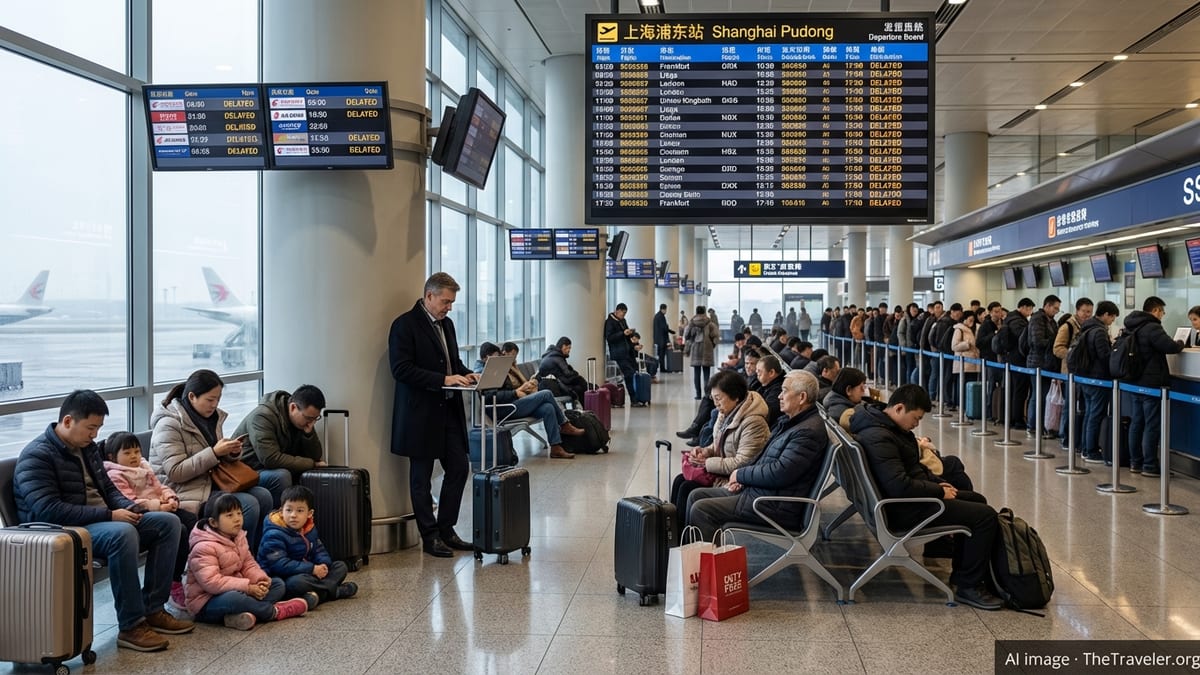
At the heart of the turmoil is Shanghai Pudong International Airport, where 403 flights were reported delayed and 4 cancelled, snarling operations for carriers including China Eastern, Asiana Airlines, Aeroflot and a string of regional and cargo operators. The knock-on effects are being felt across the wider network, stranding passengers far from their intended destinations and adding fresh stress to an already stretched global aviation system.
More News
- Caribbean Travel to U.S. Upended by New Visa Freezes and Expanded Bans
- Mexico Restores E-Visas for Brazilians, Paving the Way for Borderless Tourism
- Philippine Airlines Joins Regional Carriers Powering Southeast Asia’s Tourism Boom
Shanghai Disruptions Ripple Through Global Flight Network
Shanghai Pudong, one of the busiest international gateways in Asia, found itself in operational gridlock as delays mounted through the day. Airport data indicated 403 flights delayed alongside 4 cancellations, a relatively small number of outright scrubs but enough postponed departures and arrivals to overwhelm terminals and gate areas. With Shanghai serving as a crucial hub for connections into Europe, North America and the rest of Asia, even modest schedule slippages quickly cascaded through the network.
On the ground, long lines formed at airline service counters as travelers sought rebooking options, meal vouchers and overnight accommodation. Many passengers reported waiting hours for updated information on departure times or gate changes. Families with children, elderly travelers and business passengers on tight itineraries were among those hit hardest, as a single multi-hour delay in Shanghai meant missed onward flights in Europe and the United Kingdom and an uncertain path to their final destinations.
The impact extended well beyond Shanghai. Flights to and from regional Chinese hubs such as Dalian experienced knock-on schedule disruptions, while European gateways that handle a high volume of services from China, including Liège and Frankfurt, saw incoming operations bunch up or arrive off-slot. Ground handlers and air traffic controllers at those airports faced the difficult task of accommodating late arrivals while also maintaining their own departure schedules.
Weather, Congestion and Operational Strain Behind the Delays
Airport officials and aviation analysts point to a familiar mix of contributing factors: heavy traffic volumes, seasonal weather and the limited slack in airline and airport operations as global travel demand remains strong. In Shanghai, fog, low cloud and intermittent poor visibility have been cited in recent days as complicating factors for air traffic management. When runway capacity is temporarily reduced, departures and arrivals can quickly fall behind schedule, particularly at high-throughput hubs.
The timing is challenging. Early February is traditionally a busy period for travel in and around China as domestic tourism, business trips and international journeys pick up. Airlines have restored or expanded many routes that were cut during the pandemic years, leaving schedules running near full capacity. That means when a morning bank of flights is disrupted, there are few open slots later in the day to re-accommodate delayed services, pushing congestion into the afternoon and evening peaks.
Operational strain is also apparent at carrier and ground-staff level. Crews can run up against duty-time limits if earlier legs are delayed, forcing airlines to hold or reschedule later departures until rested personnel are available. Baggage handling, fueling, catering and de-icing services all face surges in demand as delayed flights turn around in compressed windows. The result is a rolling wave of disruptions that may outlast the original trigger.
Frankfurt, Liège and UK Hubs Grapple With Secondary Disruptions
In Europe, Frankfurt Airport, a major landing point for services from China and an essential connection hub for Lufthansa and partner airlines, has been battling its own operational challenges this week. Snowfall and icy conditions earlier in the week forced runway closures and led to isolated cancellations and significant delays as crews worked to clear surfaces and restore safe operations. Combined with today’s off-schedule arrivals from Asia, Frankfurt’s carefully timed waves of intercontinental and regional flights have come under renewed pressure.
Freight-focused airports such as Liège in Belgium, heavily used by cargo operators linking China with European distribution centers, have also felt the strain. While freight flights are generally less visible to the traveling public, congestion on those ramps can still affect runway availability and airspace management, subtly feeding back into the passenger side of the operation. Airlines and handlers have been juggling time-critical shipments with the need to reposition aircraft and crews for passenger services.
In the United Kingdom, major hubs including London Heathrow and regional airports with links to continental Europe have reported delays on inbound and outbound services connected to the troubled routes. Some long-haul departures to Asia have been held on the ground awaiting updated arrival time estimates for inbound aircraft, while a number of European feeder flights have missed their planned connection windows, forcing airlines to rebook travelers onto later departures.
Airlines Under Pressure: China Eastern, Asiana, Aeroflot and Others
Among the carriers most visibly affected today are China-based airlines and their Asian partners, along with European and Russian operators linking Shanghai to key continental hubs. Data from Shanghai Pudong show China Eastern with more than a hundred delayed flights and several cancellations as it attempts to manage a dense schedule of domestic and international services. Air China, Hainan Airlines, Shandong Airlines and other mainland carriers have also logged significant disruption.
International airlines including Asiana and Aeroflot are contending with late turnarounds and crew-time constraints as their aircraft arrive behind schedule into Shanghai or European airports. For long-haul operators, a delay on one leg can easily knock an entire rotation out of alignment, leaving aircraft out of position for the next day’s flights. That raises the risk that today’s issues will echo into tomorrow’s schedules, even if weather and congestion ease.
Low-cost and regional operators, which often run very tight schedules with limited spare aircraft, face particular challenges when disruption strikes. Every additional hour on the ground can lead to missed slot times at busy European hubs and force last-minute flight time changes, something leisure travelers and tour operators are now seeing play out on several routes between China, Belgium, Germany and the UK.
Stranded Passengers Face Long Queues, Unclear Information
For travelers caught up in the disruption, the most immediate reality is often a crowded terminal and uncertain information. At Shanghai Pudong, passengers have reported lengthy queues at service desks and limited seating in gate areas as delayed departures stack up. Some travelers heading to Europe or transiting on to North America have missed onward connections and are now facing enforced overnight stays in Shanghai or intermediate hubs such as Frankfurt and London.
Communication remains a recurring frustration. While many airlines push schedule updates through apps and text messages, sudden changes in runway status or air traffic control restrictions can lead to a flurry of revisions in short order. Passengers report receiving multiple departure time changes within a few hours, with boarding times shifting back repeatedly as the wider network struggles to rebalance.
Accommodation and basic services are an additional stress point. Airport-area hotels near Shanghai and Frankfurt quickly fill once large numbers of flights are disrupted, leaving some passengers to sleep on benches or in improvised rest areas. Food outlets and airport lounges see sudden spikes in demand as travelers wait out delays stretching beyond mealtimes. For families traveling with children, or for older passengers and those with reduced mobility, the combination of long queues, limited seating and shifting information can quickly become overwhelming.
What Travelers Can Do Now: Practical Steps in a Fluid Situation
For those currently on the move or due to travel through affected airports in the coming hours, the immediate advice from airport operators and airlines is to stay closely informed and allow more time than usual. Checking flight status on airline apps or departure boards before leaving for the airport can prevent an unnecessary wait in the terminal if a significant delay has already been logged. At the airport, staying close to the gate area, keeping boarding passes handy and monitoring announcements are critical, as boarding may begin quickly if a last-minute slot becomes available.
Travelers with tight connections, particularly those connecting from Asia into European or UK hubs, should proactively contact their airline as soon as a delay becomes apparent. Rebooking onto a later onward flight while seats remain available can be easier than waiting until after a connection is officially missed. Those who booked through a travel agent or tour operator may also have access to additional support channels or alternative routing options.
Keeping receipts for meals, transportation and accommodation is important, especially for passengers traveling within or to the European Union, the United Kingdom or other jurisdictions with strong air passenger rights frameworks. Depending on the underlying cause of the delay and local regulations, some travelers may later be entitled to reimbursement or compensation. While the immediate priority is simply completing the journey, preserving documentation can make a significant difference once the disruption has passed.
What This Wave of Delays Signals for 2026 Travel
This latest episode of widespread disruption highlights how sensitive the global aviation system remains to localized shocks. A combination of adverse weather at major hubs, tight airline schedules and high passenger demand means that a few hours of reduced runway capacity in one city can send ripples across continents. Early 2026 has already seen several episodes of operational stress at European airports due to winter weather, and today’s Shanghai-centered disruption underlines the continued vulnerability of long-haul networks.
For travelers, the lesson is to build more resilience into itineraries, particularly when crossing regions that are entering or already in peak travel or severe-weather seasons. Longer connection times, flexible tickets and comprehensive travel insurance are increasingly worth considering, especially for complex trips involving multiple carriers. Corporate travel managers are similarly reassessing routing decisions and minimum connection times for business-critical journeys.
Airports and airlines, meanwhile, face renewed questions about capacity planning, staffing levels and infrastructure investment. As passenger volumes push back toward or beyond pre-pandemic levels, the margin for error narrows. Industry observers expect to see continued emphasis on improved data sharing between airports, airlines and air traffic control to better anticipate bottlenecks and recover more quickly when disruptions occur, but such changes will take time to yield visible benefits for travelers on the ground.
FAQ
Q1. Which airports are most affected by the current wave of delays?
Shanghai Pudong International Airport is at the center of the disruption, with hundreds of flights delayed and several cancelled, while secondary effects are being felt at Dalian, Liège, Frankfurt and a number of UK airports that handle connecting flights to and from China.
Q2. Which airlines have been hit hardest?
China-based carriers such as China Eastern and Air China are among those facing large numbers of delayed services, alongside international operators including Asiana Airlines, Aeroflot and several European airlines that link Shanghai and other Chinese cities with hubs in Germany, Belgium and the United Kingdom.
Q3. What is causing so many delays on a single day?
A mix of factors is at play, including seasonal weather challenges, congestion at major hubs, tight airline schedules and operational constraints such as crew duty limits and ground-handling capacity. Together, these pressures have reduced flexibility in the system and turned local disruptions into network-wide problems.
Q4. How long are passengers being delayed on average?
Delay lengths vary widely, from under an hour to several hours or more on some long-haul routes. At hubs like Shanghai and Frankfurt, clusters of departures have been pushed back into later time windows, leading many travelers to miss scheduled connections and significantly extending their total journey time.
Q5. Are more cancellations expected, or mainly delays?
So far, delays far outnumber outright cancellations, as airlines generally prefer to operate flights later rather than cancel them entirely. However, if aircraft and crews fall too far out of position, or if weather deteriorates again at key airports, additional cancellations cannot be ruled out.
Q6. What should I do if my connection in Frankfurt or London looks impossible?
Contact your airline or travel provider as soon as a substantial delay becomes clear, rather than waiting until you have already missed the connection. Ask about rebooking options, alternative routings and, if necessary, overnight accommodation so you have a confirmed plan as early as possible.
Q7. Will travel insurance cover costs from these disruptions?
Coverage depends on your specific policy, but many comprehensive travel insurance plans include benefits for trip delays, missed connections and extra accommodation or meal expenses. Keep all receipts and any written confirmation of delays or cancellations from the airline to support a later claim.
Q8. Are passengers entitled to compensation from airlines?
Entitlements vary by jurisdiction and by the cause of the disruption. In parts of Europe and the UK, strong passenger-rights regulations apply in some situations, while delays clearly caused by severe weather may fall outside compensation rules. Travelers should review the conditions of carriage for their airline and check applicable local regulations.
Q9. How can I reduce my risk of being stranded on future trips?
Allowing longer connection times, avoiding the tightest possible layovers, traveling with carry-on luggage where practical and booking all segments on a single ticket can make it easier to be rebooked when problems arise. Monitoring weather forecasts and airport news before departure can also alert you to emerging issues.
Q10. When is the situation likely to improve?
The outlook depends on how quickly airports and airlines can clear today’s backlog and whether weather and operational conditions stabilize. Some knock-on effects may persist into tomorrow’s schedules, but if runway capacity and staffing remain steady, many carriers will aim to bring operations closer to normal within the next 24 to 48 hours.