

More news on this day
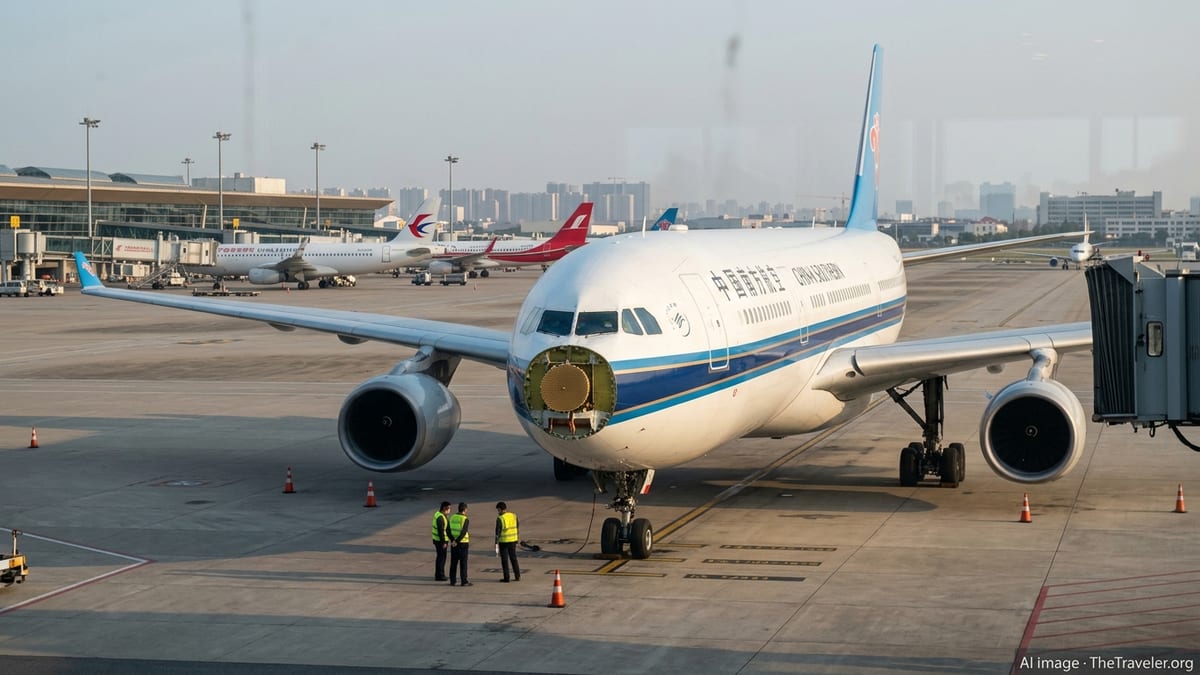
Passengers on a China Southern Airlines flight from Shanghai experienced a dramatic but ultimately safe return to the airport after a bird strike tore away most of the Airbus A330’s nose radome, leaving the jet looking “noseless” as it taxied back to the gate.
Get the latest news straight to your inbox!
Wildlife Collision Over Shanghai
Publicly available flight tracking data and images shared on aviation forums indicate that the incident involved China Southern flight CZ3554, operating an Airbus A330 from Shanghai Hongqiao to Shenzhen. Shortly after takeoff, the aircraft is reported to have struck one or more birds, severely damaging the forward radome, the composite nose structure that houses the weather radar.
Photographs taken after the return show the aircraft on the ground with most of its radome missing, exposing the greenish structural elements around the radar assembly and giving the jet an abrupt, cut-off profile. Commentators on aviation platforms quickly dubbed it a “noseless” A330, underscoring the unusual extent of the visible damage.
Despite the dramatic appearance, publicly available information suggests the crew declared an emergency, leveled off at a relatively low altitude and turned back toward Shanghai soon after the strike. The aircraft followed a short holding pattern before making a precautionary landing, where emergency services stood by.
There have been no reports of injuries among passengers or crew, and initial accounts indicate the aircraft remained controllable throughout the event. The quick decision to return to the departure airport is consistent with established procedures following significant structural or suspected system damage.
How Pilots Handle a ‘Noseless’ A330
While the images from Shanghai are striking, aviation safety specialists note that the A330, like other modern airliners, is designed to withstand substantial localized damage without compromising its basic ability to fly. The radome itself is not a primary load-bearing structure, and the aircraft’s critical control systems, including hydraulics and flight controls, are located further aft and protected by multiple layers of redundancy.
According to technical guidance published by Airbus and safety agencies, a severe radome strike can affect air data systems, weather radar and, in some cases, cockpit visibility if debris impacts the windshield. Crews are trained to treat such events as potential cases of unreliable airspeed or sensor failure and to revert to known pitch and power settings while cross-checking multiple instruments.
Reports from the Shanghai event indicate that the aircraft climbed only briefly before leveling off and returning, which likely reduced aerodynamic loads on the damaged nose section. By avoiding high-speed, high-altitude flight, the crew limited the stress on remaining structures and minimized the risk of further material separation in flight.
Once lined up for landing, pilots would focus on stabilized flight parameters, using runway length and favorable weather to their advantage. The safe touchdown and taxi back to the stand, despite the obvious damage, underline both adherence to procedure and the inherent resilience of the A330 design.
Inside the Radome: Why Bird Strikes Matter
Bird strikes are a long-recognized aviation hazard, particularly during takeoff and landing when aircraft are flying at lower altitudes where birds are more active. Industry data compiled by international safety organizations show thousands of bird strike reports annually worldwide, though only a small fraction result in serious damage.
The radome at the very front of an aircraft is built from composite materials that are transparent to radar waves but strong enough to withstand typical aerodynamic forces. In a high-energy collision with a large bird, however, the structure can crack, puncture or shear away, as appears to have occurred over Shanghai. The resulting debris can scrape surrounding fuselage panels or impact cockpit windows, though designs aim to prevent penetration into the occupied cabin.
Aviation incident databases list multiple historical cases in which radomes have been heavily dented or torn off in bird strikes, prompting diversions and precautionary landings. The Shanghai case is notable for the extent of the exposed nose section and the clarity of passenger and spotter photos, which have circulated widely on social media and aviation communities.
Following events like this, standard practice calls for a detailed inspection of the radar antenna, underlying structure and air data sensors. Maintenance reports typically assess not only visible damage but also possible internal delamination or cracking within composite layers, which may not be apparent from external views alone.
Shanghai’s Busy Skies and Wildlife Risks
Shanghai’s two major airports, Hongqiao and Pudong, handle dense traffic volumes connecting the city with domestic and international destinations. High flight frequencies, coupled with nearby wetlands and urban green spaces, mean that aircraft movements routinely intersect with bird habitats, especially during migration seasons.
Public documents from airport operators and aviation regulators describe a range of wildlife management measures in use at large hubs in mainland China, including habitat modification, routine runway inspections, acoustic deterrents, and coordination with local environmental agencies. Nonetheless, experts acknowledge that completely eliminating bird activity in the vicinity of major airports is not possible.
In this context, the Shanghai A330 incident aligns with a broader pattern seen at airports worldwide, where growth in air traffic and changes in urban ecology have contributed to periodic spikes in wildlife encounters. Past cases involving Chinese and international carriers have similarly involved returns to departure airports after suspected bird impacts to engines, wings or noses.
For travelers, these events can mean delays and aircraft changes, but the industry’s layered defenses are intended to keep such disruptions squarely in the realm of inconvenience rather than danger. The uneventful evacuation of passengers in Shanghai back to the terminal shows how routing, traffic management and ground readiness all play a part alongside cockpit decision-making.
Reassurance for Passengers and the Path Ahead
As images of the “noseless” A330 spread across social platforms, many viewers expressed disbelief that such an aircraft could land safely. Aviation safety data and engineering practice provide a different perspective, showing that modern jets are certified to endure significant damage scenarios and that crews train regularly for system failures and unexpected external impacts.
International safety statistics published in recent annual reports highlight that commercial air travel remains one of the safest modes of transportation, with major hull loss accidents exceedingly rare relative to flight hours. Wildlife strikes, though visually dramatic when they affect exposed structures like the nose, are typically survivable incidents when managed in accordance with procedures.
Shanghai’s latest wildlife collision episode is likely to feed into ongoing risk assessments and operational reviews, from refinements to bird control strategies on the airfield to simulator scenarios for flight crews based in the region. Training centers in China already operate full-flight simulators for Airbus widebodies, allowing pilots to rehearse system-degradation events that may follow severe structural impacts.
For visitors flying into or out of Shanghai, the episode serves as an unexpected reminder of the complex choreography behind every takeoff and landing in one of Asia’s busiest air corridors. The image of a safely parked, though “noseless,” A330 on the apron ultimately reinforces a key message of modern aviation: even when nature intervenes, design redundancy and disciplined crew responses keep journeys ending on solid ground.