

More news on this day
Passengers on a China Southern Airlines flight from Shanghai experienced a dramatic but ultimately safe return to the airport after an Airbus A330 landed with most of its nose section missing following a reported wildlife collision shortly after takeoff.
Get the latest news straight to your inbox!
Dramatic Return to Shanghai After Takeoff Incident
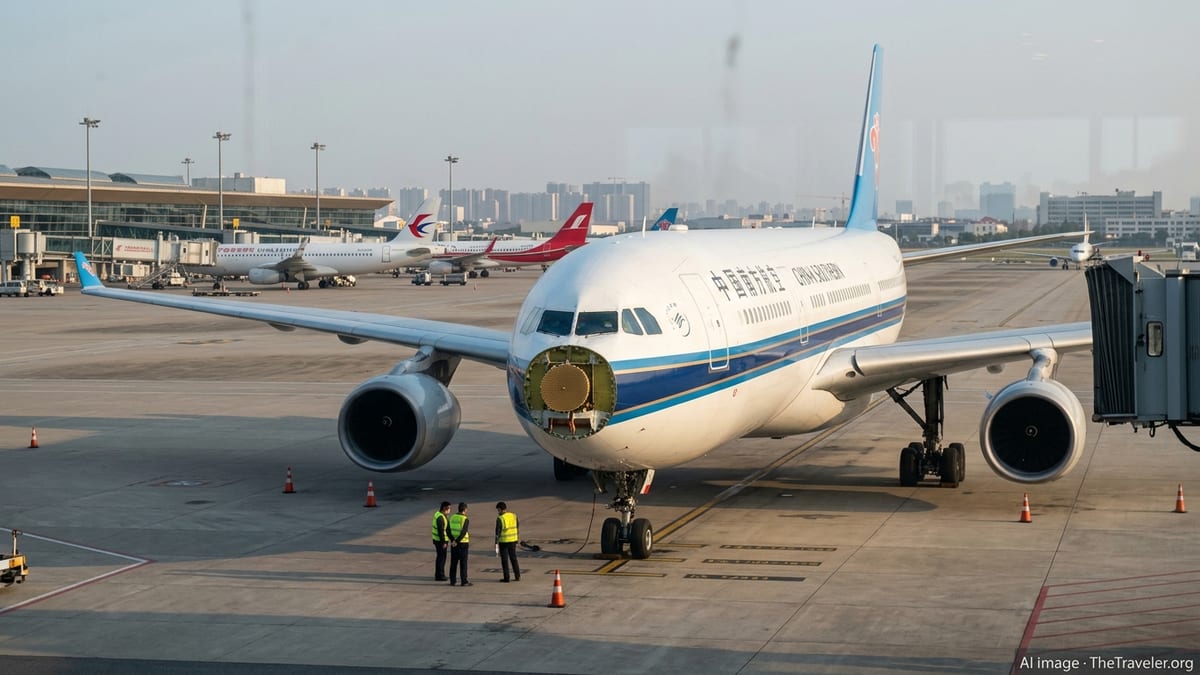
Publicly available flight-tracking data and aviation community reports indicate that China Southern flight CZ3554, operating an Airbus A330-300, departed Shanghai for Shenzhen on March 21, 2026, before quickly abandoning its climb and circling back to Shanghai. The aircraft later drew worldwide attention when images emerged showing the jet on the ground with its nose radome almost entirely gone, giving the widebody a strikingly "noseless" appearance.
Despite the severe damage to the forward fuselage, there were no immediate reports of injuries among passengers or crew. The aircraft touched down without further incident, and the situation was handled on the runway with emergency services standing by as a precaution. Available information suggests the crew elected to return soon after the suspected wildlife impact, minimizing exposure to higher speeds and altitudes.
Images circulated in global media and aviation forums show the exposed weather radar dish at the very front of the jet, framed by torn composite material and bent metal supports where the radome once sat. The visual impact of the damage has prompted widespread interest in how the aircraft remained controllable and able to land safely in one of the world’s busiest aviation hubs.
What a Missing Radome Means in Flight
The radome, the rounded nose cone of an airliner, is structurally light and aerodynamically shaped to protect sensitive radar equipment rather than to bear heavy loads. Aviation safety literature describes it as a non-load-bearing structure designed primarily to smooth airflow and shield the weather radar from the elements. When it fails or is torn away, the aircraft’s underlying systems remain attached to the fuselage, but the aerodynamics around the nose can change abruptly.
In the Shanghai event, photographs suggest that the bird or wildlife impact either shattered the radome or caused it to open and then be ripped away by the slipstream. That sequence can generate heavy buffeting, increased drag and noise, along with strong vibration transmitted through the airframe. Pilots train to manage sudden configuration changes and unexpected noise, relying on core flight instruments and engine power settings rather than visual cues from the nose structure.
Industry incident reports on similar events describe the weather radar itself as relatively robustly mounted behind the radome. Even when the protective shell is destroyed, the radar antenna may remain largely intact, as appears to be the case in the Shanghai photos. However, operators typically remove the aircraft from service after such an incident for detailed structural checks of the nose section, radar mount and surrounding skin panels before any return to commercial use.
Pilot Decision-Making in a Wildlife Strike
Wildlife collisions shortly after takeoff are treated with particular caution because aircraft are still relatively low and heavy with fuel. Standard operating procedures and safety guidance emphasize the importance of promptly assessing control, engine performance and instrument reliability. When damage is suspected in the critical forward section of the fuselage, the safest option is often an immediate return to the departure airport, where long runways and full emergency response resources are available.
Reports on the Shanghai flight’s track show that the A330 leveled off and entered a brief holding pattern before lining up for approach, a pattern consistent with crews running through checklists, confirming system status and coordinating with air traffic services. The primary concerns in such a scenario would include potential damage to the pitot tubes and angle-of-attack sensors around the nose, which are essential for accurate airspeed and flight data indications.
In previous documented bird-strike cases involving nose damage, pilots have successfully landed by cross-checking multiple sources of information, including standby instruments and engine power references, and by flying conservative speeds and gentle configurations. The Shanghai crew’s ability to return quickly and land normally, despite the shock of seeing major structural damage ahead of the cockpit, aligns with broader trends showing how modern training and procedures help crews manage rare but high-visibility events.
Shanghai’s Growing Traffic and Bird-Strike Risk
Shanghai’s dual-airport system, anchored by Pudong International and Hongqiao International, has become one of Asia’s busiest aviation networks, with dense schedules of domestic and international services. As traffic has grown, so has global attention on wildlife-management practices at major airports. Bird strikes remain one of the most common hazards in civil aviation, especially in low-altitude phases of flight near runways and coastal wetlands.
Open-source regulatory documents and safety studies note that airports typically employ a mix of habitat management, bird-detection systems, acoustic deterrents and coordinated wildlife control to reduce the chances of bird strikes. However, no system can eliminate the risk entirely, and large birds or flocks can still intersect with departure and arrival paths in spite of mitigation efforts.
The Shanghai A330 event follows other recent nose-damage incidents at airports around the world that have circulated widely on social media. While the visual damage can appear alarming, overall accident statistics show that air transport remains one of the safest modes of travel, with most wildlife-strike events resulting in precautionary returns or inspections rather than serious injuries.
Engineering Lessons and Traveler Takeaways
For engineers and regulators, a high-profile case like the "noseless" Airbus in Shanghai provides fresh data on how radome structures behave under extreme impact loads and subsequent aerodynamic forces. Investigators can compare the pattern of tearing, hinge deformation and radar condition with maintenance records and design expectations, refining guidance on inspections, fastener checks and potential design enhancements.
For travelers, the incident highlights the resilience built into modern widebody aircraft and the conservative decision-making culture that underpins commercial aviation. The safe landing, lack of serious injury reports and orderly ground response demonstrate how crews, airport teams and aircraft systems are configured to cope with unexpected structural damage.
While images of a missing nose can be startling, the Shanghai flight’s outcome underscores that passenger jets are designed with significant margins and redundancy. Even when a wildlife encounter causes dramatic cosmetic damage, training, procedures and engineering work together to keep the aircraft flyable long enough to bring everyone back on the ground safely.