

More news on this day
Shanghai’s historic North Bund waterfront is emerging as one of Asia’s most closely watched cruise homeports for the 2026 season, as luxury liners return in growing numbers and China’s expanded visa-free entry regime makes it easier than ever for international travelers to step ashore.
Get the latest news straight to your inbox!
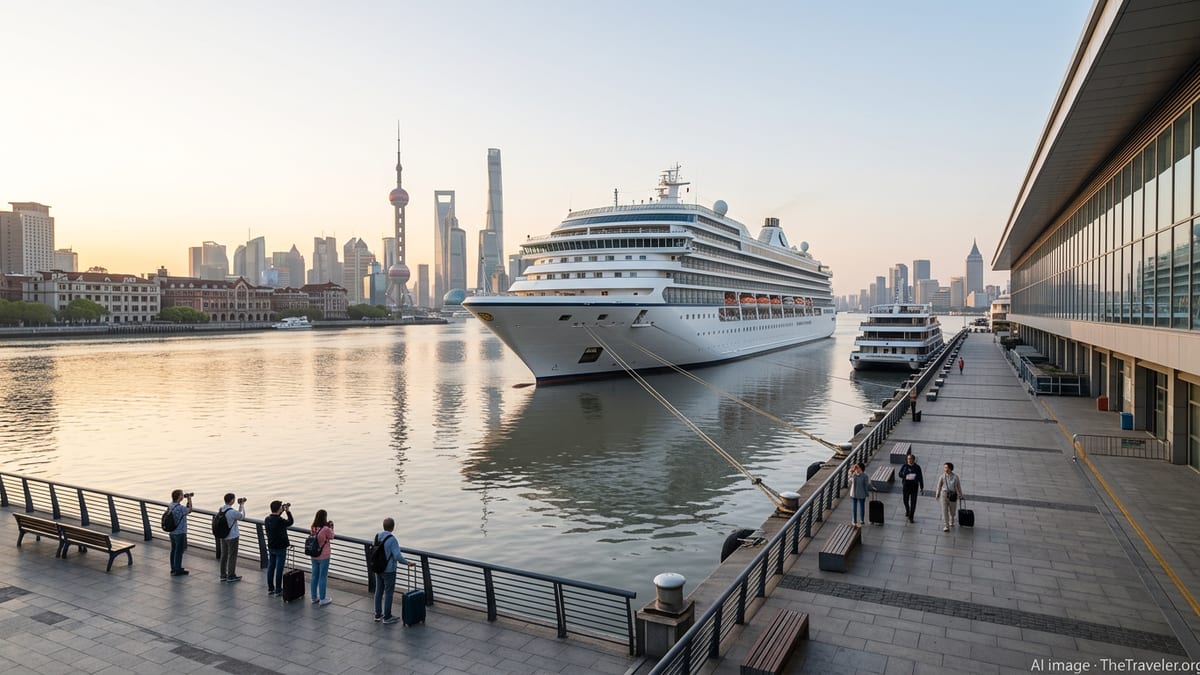
North Bund Repositions as a Front-Door Gateway to Shanghai
Recent seasons have seen Shanghai’s North Bund International Passenger Center regain prominence on global cruise itineraries. Publicly available information from municipal releases shows that the terminal has already handled a steady stream of international calls since 2024, including luxury vessels such as the Seven Seas Explorer and Oceania’s Insignia, bringing thousands of inbound visitors directly into the city’s urban core.
The North Bund’s location along the Huangpu River places arriving passengers within sight of Shanghai’s skyline, turning arrival itself into a tourism moment. City briefings indicate that the 3.4-kilometer North Bund waterfront has been fully opened as a continuous public promenade, integrating cruise operations with a growing cluster of cultural venues, conference facilities, and riverfront leisure spaces. This combination is helping to reposition the district as both a transportation hub and a premium urban destination in its own right.
For the 2025 season, official planning documents cited by local government portals projected at least 17 cruise ship calls at the North Bund terminal, signaling a deliberate shift toward higher-value, lower-volume itineraries anchored around upscale international brands. Market watchers expect that the momentum accumulated through 2024 and 2025 will carry into 2026, as more operators test Shanghai-focused voyages and coastal sailings that use the North Bund as a starting or ending point.
With competition intensifying across Asian ports, this strategic positioning as “Shanghai’s first stop” for many international cruise guests is seen as central to the North Bund’s long-term cruise development strategy for the mid-2020s and beyond.
Expanded Visa-Free Entry Transforms Cruise Planning
China’s evolving visa-free framework is emerging as a major driver behind cruise line decisions for the 2026 season. Since mid-2024, a national policy has allowed foreign tour groups arriving by cruise ship to enter visa-free through any designated cruise port along China’s coastline, provided they travel as part of an organized group and remain within approved regions. Subsequent adjustments have broadened the reach of unilateral and mutual visa waivers for air and sea arrivals, while also lengthening permitted stays for many eligible visitors.
By early 2026, publicly available policy summaries indicate that citizens of dozens of countries across Europe, the Americas, Oceania, the Middle East, and parts of Asia can enter mainland China visa-free for short visits, typically up to 30 days, for tourism, business, or family trips. Separate 240-hour transit exemptions further simplify short stays for travelers in transit to third countries, and recent guidelines for foreign nationals highlight cruise-specific arrangements that allow organized groups entering via Shanghai’s cruise terminals to travel within designated regions without advance visas.
This expanding web of waivers and transit schemes is particularly beneficial for cruise itineraries that combine Shanghai with multiple Chinese ports or regional hubs such as Japan and South Korea. It reduces administrative friction for passengers booking complex sailings and gives cruise planners more flexibility to schedule overnight calls and inland excursions, confident that immigration procedures are aligned with short-stay tourism patterns.
Industry-focused coverage suggests that these visa measures form part of a broader national strategy to revive international tourism flows and stimulate high-value spending in the post-pandemic era. For cruise travel in particular, the possibility of boarding in one country, calling at Shanghai’s North Bund, and exploring other Chinese coastal destinations without navigating a traditional visa application is emerging as a selling point for itineraries marketed for 2026 and beyond.
Luxury Ships Anchor a Higher-End Cruise Mix
The profile of vessels calling at Shanghai’s North Bund underscores a shift toward the luxury and premium segments. Local government updates highlight visits by ships such as the Seven Seas Explorer, widely marketed as an all-suite luxury vessel, and boutique-style ships used for coastal voyages targeting inbound tourists. These calls align with China’s stated ambition to attract higher-spending international visitors and to promote themed travel experiences that combine culture, shopping, and gastronomy.
The North Bund’s terminal infrastructure, originally designed for large international liners, is now being leveraged to host a mix of luxury ocean ships and smaller high-end vessels operating coastal routes. Reports on China’s cruise recovery point to the resumption of international sailings by European brands and the entrance of domestically operated upscale cruises, which together are expected to diversify the mix of ships using Shanghai’s ports in 2026.
Observers note that, after an initial post-pandemic recovery period in 2024 and 2025, China’s cruise sector is widely described as entering a “second golden decade” of development. Within that context, Shanghai is positioning its ports for quality rather than sheer volume, with the North Bund marketed as a showcase for refined urban experiences. This approach aligns with broader efforts to move beyond mass-market shore excursions to more curated encounters with local culture and contemporary city life.
For cruise passengers, the combination of luxury hardware and a revitalized riverside destination offers a different arrival experience compared with out-of-town terminals. The North Bund’s proximity to central Shanghai reduces transfer times and makes independent exploration more feasible, a factor that travel agents and cruise planners are already highlighting in promotional materials.
“Cruise + Shore Excursion” Experiences Take Center Stage
Shanghai’s Hongkou district, where the North Bund is located, has been actively promoting what local documents describe as “Cruise + Shore Excursion” products. These offerings bundle terminal arrival with themed half-day or full-day experiences across the city, often focusing on heritage architecture, arts venues, and culinary neighborhoods within easy reach of the waterfront.
Cultural programming is playing a visible role in this strategy. In 2024 and 2025, the North Bund terminal hosted events branded as cultural fairs for arriving cruise guests, with performances, crafts demonstrations, and interactive showcases staged directly on the quay or in adjacent public spaces. Municipal cultural communications portray these activities as a “window to the sea,” designed to make the first steps off the gangway feel like an immediate immersion into local traditions.
The 2026 season is widely expected to build on these foundations, with more sophisticated packages that link the North Bund to Shanghai’s museums, theaters, and creative districts. The presence of major conference and exhibition venues close to the waterfront also opens possibilities for combined cruise-and-business travel, as visitors time sailings around events or extend work trips with short cruises along China’s coast.
Travel industry commentary suggests that such integrated products are increasingly important in the global cruise market, where passengers look for deeper engagement with destinations instead of brief photo stops. For Shanghai, weaving the North Bund terminal into a broader narrative of contemporary urban culture may prove as valuable as expanding ship capacity itself.
North Bund’s Role in China’s Wider Cruise Comeback
Shanghai’s North Bund revival is unfolding against a backdrop of robust growth in cruise travel to and within China. National-level statistics reported by state and industry media describe a sharp rise in inbound cruise passenger movements since visa policies were eased, with multiple coastal terminals recording year-on-year surges in foreign arrivals. New routes, including China’s first coastal cruise specifically marketed to inbound tourists, have launched from Shanghai, reinforcing the city’s status as a primary hub.
At the same time, China’s broader visa-free expansion is reshaping the competitive landscape across Asia’s ports. As more nationalities gain visa-free or simplified entry to mainland China, cruise lines are reconsidering route planning, often adding or lengthening Shanghai calls in itineraries that once emphasized other regional gateways. Analysts note that visa flexibility can influence not just passenger demand but also deployment decisions for high-value ships, particularly in the luxury segment.
Looking to the 2026 season, Shanghai’s North Bund is poised to benefit from these intertwined trends. The terminal’s central location, upgraded waterfront, and growing cultural ecosystem give it an edge in attracting ships whose guests expect immediate access to major city experiences. When combined with China’s progressively more open entry regime for short-stay visitors, the conditions are favorable for North Bund to consolidate its reputation as a flagship port of call in Asia’s resurgent cruise circuit.
For international travelers planning cruises in 2026, the convergence of luxury ships, simplified entry procedures, and a revitalized urban waterfront means that stepping off a gangway at Shanghai’s North Bund is likely to be a highlight of any voyage through the region.