

More news on this day
China is intensifying efforts to position Shanghai’s North Bund as a leading international cruise gateway, with a nationwide visa-free entry policy for cruise tour groups and growing luxury ship deployments setting the stage for a busy 2026 season.
Get the latest news straight to your inbox!
Visa-Free Cruise Entry Policy Lifts Inbound Demand
China’s decision to fully implement visa-free entry for foreign tour groups arriving by cruise ship is reshaping inbound tourism dynamics along the country’s coast. The policy, introduced in May 2024, allows organized groups of at least two foreign travelers to enter visa free via designated cruise ports, including Shanghai, and to stay in China for up to 15 days. Publicly available information from the National Immigration Administration indicates that the arrangement covers 13 coastal cities and extends a pilot scheme that had previously centered on Shanghai.
The move coincides with a broader expansion of China’s visa-free access for short-stay visitors from dozens of countries, which is aimed at reviving international travel after the pandemic. Recent updates show that citizens of an increasing number of European and other countries can now enter China without a visa for limited periods, adding to the appeal of cruise itineraries that homeport or call in Shanghai.
Tourism and port data reported in Chinese media point to a strong uptick in cruise arrivals and passenger movements since the visa-free rules took effect. Shanghai’s inspection authorities have processed hundreds of cruise ship calls and millions of passenger trips over the past year, with a notable share linked directly to the 15-day exemption for cruise tour groups.
Industry analyses suggest the new policy reduces friction for international travelers who may have been deterred by paperwork and processing times. For cruise lines, it provides greater flexibility to design itineraries with multiple Chinese ports of call, while keeping shore excursion logistics relatively straightforward for foreign guests.
North Bund and Wusongkou Cement Role as Cruise Gateways
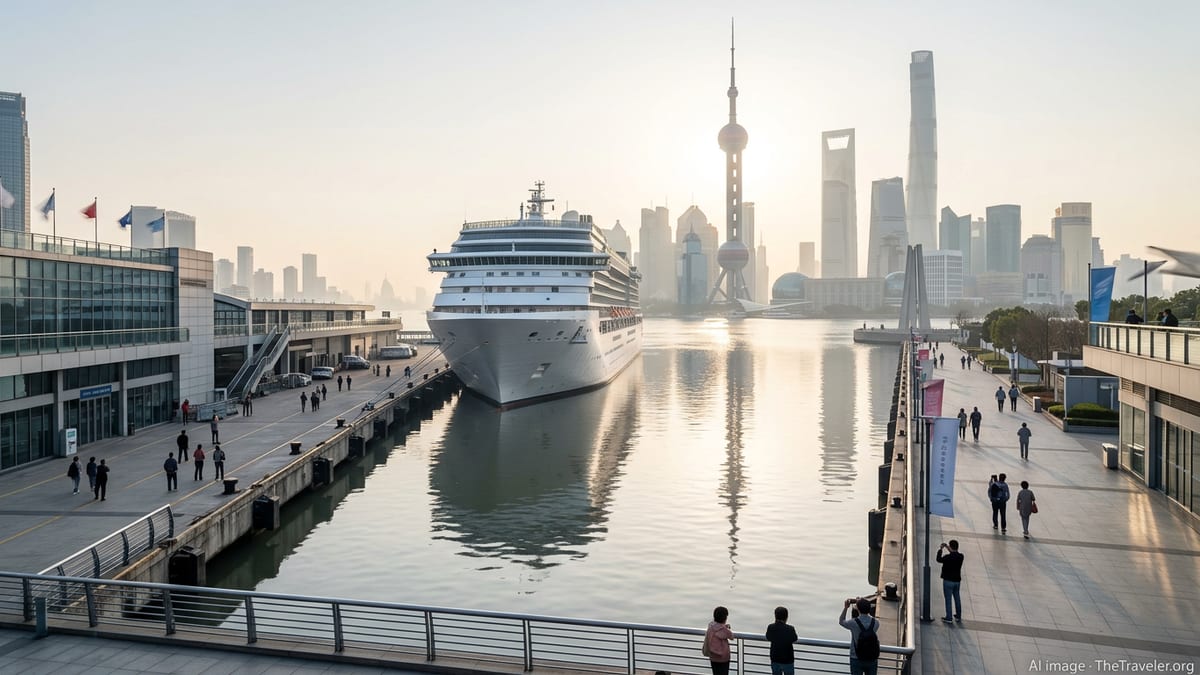
Within Shanghai, the North Bund waterfront and the nearby Wusongkou International Cruise Terminal are central to the city’s cruise ambitions. The North Bund area, anchored by Shanghai Port International Cruise Terminal on the Huangpu River, serves as a showcase for the city’s skyline, combining berths for large vessels with commercial towers, promenades and cultural venues.
Further downriver at the confluence of the Yangtze River estuary, Wusongkou International Cruise Terminal has emerged as one of Asia’s busiest homeports. Official district-level updates from Baoshan, where the terminal is located, highlight the simultaneous berthing of multiple large ships as a marker of capacity and operational scale. In 2025 the facility supported more than 200 cruise arrivals and departures, with local authorities describing the port as a key entry point for China’s cruise tourism market.
Passenger figures cited in state and local media reports underscore rapid growth. Wusongkou recorded dozens of cruise calls and hundreds of thousands of passenger movements in early 2025 alone, including tens of thousands of international visits. The combination of upgraded terminal infrastructure, dedicated customs and immigration facilities and improved ground transport links has strengthened the appeal of Shanghai as both a turnaround port and transit call.
Urban planners have framed the wider North Bund as a “world-class sitting room” on the Huangpu, integrating cruise operations with mixed-use redevelopment. The clustering of luxury hotels, retail, entertainment and office space around the cruise terminal is designed to capture more visitor spending and encourage pre- and post-cruise stays in the city.
Luxury and International Brands Expand Shanghai Presence
Global cruise operators are responding to the policy and infrastructure tailwinds by expanding deployments in China, with Shanghai often serving as a primary homeport. Coverage in trade and industry outlets describes a steady return of international brands to the mainland market, after a period of pandemic-related suspension and gradual resumption in 2023 and 2024.
At Shanghai’s Wusongkou terminal, multiple large ships have resumed or initiated homeport operations, including vessels from established European and North American cruise groups. Reports highlight days when several high-capacity ships are berthed at once, signaling a renewed push to use Shanghai as a base for sailings to Japan, South Korea and other Northeast Asian destinations.
Chinese-built and Chinese-flagged vessels are also playing a larger role on the North Bund and at Wusongkou. Domestic operators have launched new-generation ships aimed at the premium and luxury segments, with itineraries that combine regional ports of call with themed onboard experiences tailored to both Chinese and international guests. Industry commentary often portrays this as evidence that China’s cruise sector is shifting from a pure volume focus to a more diversified model emphasizing product quality and full value chains.
The presence of high-end ships has raised the profile of the North Bund as a symbolic arrival point for overseas travelers. Photographs and visual coverage of recent dockings frequently juxtapose gleaming cruise vessels with Shanghai’s modern skyline, reinforcing the city’s branding as an international maritime and financial center.
Visa-Free Policies Drive Strong International Passenger Arrivals
The visa-free framework for cruise tour groups is widely seen as a catalyst for rising foreign passenger arrivals at Shanghai’s cruise terminals. Chinese media accounts state that between May 2024 and mid-2025, Shanghai ports handled several million cruise passenger trips, including a significant increase in inbound travelers benefiting from simplified entry procedures.
Reports on the first international cruise arrivals of 2025 in Shanghai describe that a large majority of passengers qualified for the 15-day visa exemption, enabling them to disembark for sightseeing and shopping without applying for individual visas in advance. Travel agencies and cruise operators have subsequently promoted shore excursions that take advantage of the allowed geographic scope, which includes Shanghai and a range of coastal provinces, as well as the option to visit Beijing.
The broader expansion of China’s visa-free access for citizens of nearly 80 countries, reported by international news outlets in early 2026, is expected to reinforce these trends. Travelers from an expanding pool of European and other markets can now plan cruise-based visits that are easier to book and more spontaneous, with fewer administrative hurdles.
Market observers note that the easing of both cruise-specific and general entry requirements aligns with efforts to position China for a new phase of cruise development sometimes described as a “second golden decade.” Expectations center on higher inbound volumes, deeper integration with regional tourism circuits and the gradual return of long-haul fly-cruise itineraries using Shanghai as a gateway.
2026 Season Launch Signals Next Phase of Growth
Looking ahead, industry announcements point to a robust 2026 cruise season for Shanghai and the North Bund. Several major international lines have already outlined plans to extend or expand their homeport deployments in the city, scheduling additional sailings that run deeper into the shoulder months. These deployments are expected to bring more large, high-specification ships into regular rotation at Wusongkou and the North Bund terminals.
Trade briefings indicate that new and returning vessels will operate a mix of short regional cruises and longer itineraries, with calls in Japan, South Korea and other destinations across Northeast Asia. Some operators are planning repositioning voyages that start or end in Shanghai, giving foreign travelers opportunities to combine extended land stays in China with sea journeys under the visa-free framework for eligible groups.
Local development plans for the North Bund and Baoshan districts suggest ongoing enhancements to passenger facilities, intermodal connectivity and tourism services in advance of the 2026 season. Investments in terminal efficiency, digital immigration processes and visitor amenities are framed as critical to handling larger volumes of international guests while maintaining smooth turnarounds.
As the 2026 season approaches, Shanghai’s strategy appears to hinge on combining policy openness, upgraded infrastructure and a broadened mix of international and domestic cruise products. With visa-free entry now firmly embedded in the regulatory landscape for cruise tour groups, the North Bund and Wusongkou are positioned to play a central role in China’s broader effort to capture a larger share of global cruise tourism.