

More news on this day
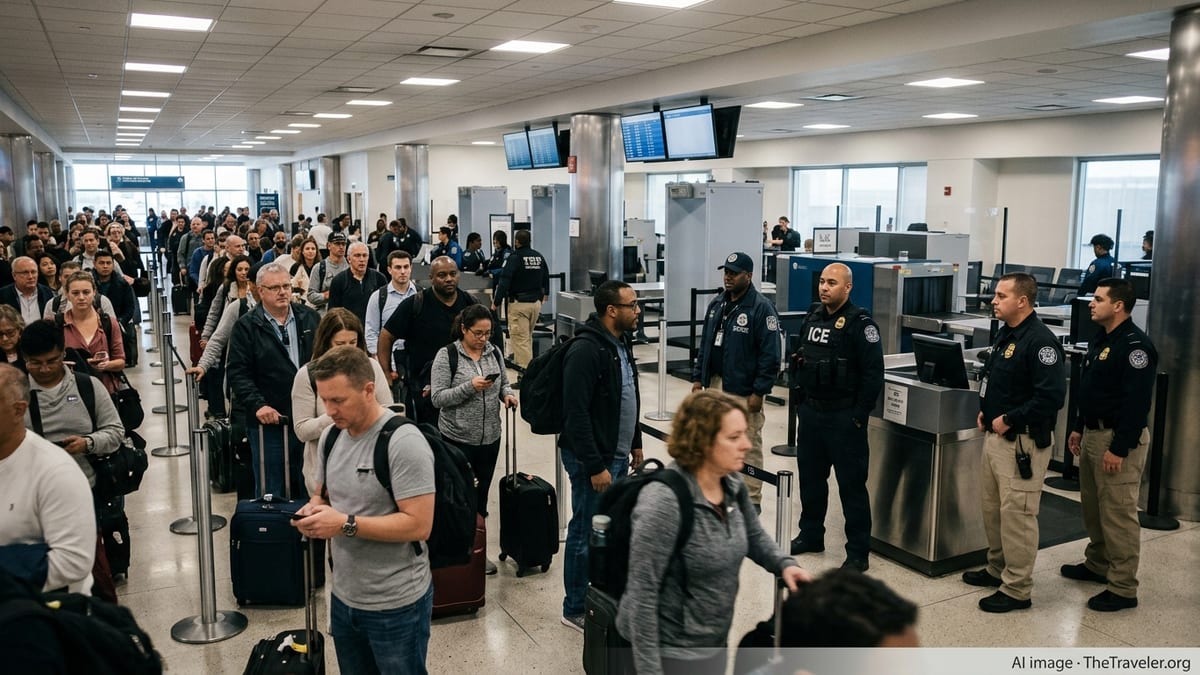
Immigration and Customs Enforcement officers are being shifted into major U.S. airports as Transportation Security Administration staffing buckles under a prolonged Department of Homeland Security funding lapse, deepening security backlogs and igniting a fresh wave of concern among travelers, unions and airport operators.
Get the latest news straight to your inbox!
Shutdown Stalemate Pushes Airports to Breaking Point
The latest partial shutdown of the Department of Homeland Security, now stretching beyond five weeks, is rippling most visibly through the nation’s airports. TSA personnel have been required to work without pay, and publicly available data and media coverage indicate rising sick calls at key hubs. At some of the country’s busiest airports, including Atlanta, Houston and Philadelphia, screening lines have at times stretched for hours as more security lanes are taken offline.
Reports indicate that in Philadelphia, nearly a quarter of TSA officers recently failed to report for duty, forcing the closure of multiple checkpoints and concentrating passengers in fewer lanes. Similar patterns have been reported in Houston, where long waits at George Bush Intercontinental Airport have been compounded by the partial closure of checkpoints. In Atlanta, the world’s busiest passenger airport, travelers over the past weekend faced screening delays that extended deep into terminal concourses as the staffing shortfall worsened.
These delays are unfolding against a broader backdrop of travel demand that remains near record levels. Recent aviation research has highlighted how security bottlenecks can cascade through the domestic flight network, converting checkpoint congestion into missed departures, aircraft rotations out of position and mounting knock-on delays. As the shutdown drags on and backlogs deepen, analysts warn that the system is losing resilience, leaving less margin to absorb weather or technical disruptions.
With no immediate legislative breakthrough in sight, the airport chokepoints have become a tangible symbol of the political impasse in Washington. Congressional efforts to pass a full year of Homeland Security funding have repeatedly stalled amid disputes over immigration enforcement policy, and proposals to temporarily fund TSA separately have so far failed to gain traction in the Senate.
ICE Officers Step Into Terminals as TSA Backlogs Grow
In this strained environment, the White House has moved to redeploy Immigration and Customs Enforcement officers to large airports. According to national and local news coverage, ICE personnel began appearing at security checkpoints this week at a growing list of facilities, including Chicago O’Hare, Houston’s airports and Philadelphia. Administration statements describe the move as an attempt to support TSA during an extraordinary staffing crunch.
Details of the deployment plan remain fluid, but early accounts from airports and travelers suggest ICE officers are being assigned to peripheral roles in and around checkpoints rather than primary screening duties. In some locations, they are visible near identity document podiums or queuing areas, often in tactical vests or plain clothes with agency identification. Union statements and subsequent clarifications from Homeland Security officials indicate that the officers are not certified to operate screening equipment or conduct full TSA-style inspections.
The optics of a heightened ICE presence in terminals have nonetheless drawn sharp attention. For many travelers, particularly immigrants and mixed-status families, the sight of immigration enforcement agents in what is ordinarily a civil aviation-security environment has added a layer of anxiety on top of long waits and uncertainty about missed flights. Travel industry observers say that the message it sends about the character of U.S. air travel, especially for international visitors, could carry reputational costs long after the shutdown ends.
Airport authorities in several cities have emphasized through public statements and social media updates that they expect ICE personnel to remain in support or observational roles, while TSA officers continue to handle federally mandated security functions. At other airports, local managers have indicated they are not currently planning to bring ICE into checkpoints, citing adequate staffing or concerns about passenger experience.
Safety, Training and Civil Liberties Concerns Intensify
The decision to insert ICE officers into the airport security environment has sparked vocal criticism from labor organizations and civil liberties advocates. The largest federal workers union representing TSA officers has circulated statements arguing that immigration agents are not trained in aviation security and that attempting to substitute them into screening workflows risks creating new vulnerabilities. According to these public comments, TSA officers undergo specialized training and recurring certification focused on detecting weapons, explosives and sophisticated concealment techniques tailored to the aviation setting.
Security researchers and former regulators quoted in recent coverage echo those concerns, warning that a visible show of force is not the same as effective risk mitigation. They point out that even marginal changes in how identity checks are conducted or how passengers are directed through lanes can have material consequences for both throughput and the probability of detecting prohibited items. In their view, adding armed officers who lack the relevant technical training could slow lines further or distract from established procedures.
Civil liberties organizations have also raised alarms about the blending of aviation security and immigration enforcement. Advocacy groups argue that putting ICE officers in passenger flow areas risks chilling lawful travel by noncitizens and naturalized Americans who may fear additional scrutiny or potential database checks unrelated to flight safety. They contend that the presence of immigration agents in spaces previously associated solely with transportation security may normalize broader data collection and questioning in a context where passengers feel they have little choice but to comply.
Legal scholars following shutdown-related policy moves note that the expansion of ICE into airport interiors, even in a support capacity, could eventually face court challenges if it leads to patterns of selective questioning or detention that appear motivated by national origin, language or perceived immigration status rather than concrete security concerns. For now, much depends on how airports and local ICE field offices choose to operationalize the deployment and whether they strictly confine officers to nonintrusive roles.
Travelers Adjust Plans as Industry Braces for Prolonged Disruption
For passengers, the practical impact of the shifting security landscape is already clear. Airlines and airports are urging travelers to arrive significantly earlier than usual, particularly at major hubs where staffing shortages are most acute. Social media posts and local news segments show lines snaking through ticketing halls at peak times, with some passengers missing flights despite arriving more than two hours before departure for domestic journeys.
Carriers and airport operators are reconfiguring terminal operations in real time to cope with the strain. Some airports have consolidated checkpoints, funneled travelers from quieter concourses to busier but better staffed lanes, or temporarily closed underused entrances to concentrate security resources. A handful have redeployed non-security employees to assist with crowd management and wayfinding, in an attempt to free remaining TSA officers to focus solely on screening tasks.
Travel industry analysts warn that if the shutdown continues into the spring and summer peak seasons, the economic fallout for tourism could widen. Extended security delays can prompt travelers to cancel short-haul trips, shift to alternative airports or postpone discretionary leisure travel altogether. For business travelers, lost productivity and missed connections ripple quickly through conference schedules, sales calls and supply chain planning.
On the policy front, the airport gridlock and controversial ICE deployments are adding pressure on lawmakers to find at least a temporary funding arrangement for Homeland Security. Several proposals under discussion in Congress would carve TSA out of the broader immigration dispute to ensure pay continuity for screeners, but these ideas face resistance from factions that view the shutdown leverage as central to pushing changes in enforcement practices at agencies such as Customs and Border Protection and ICE.
What Travelers Can Expect at Checkpoints in the Coming Days
In the near term, travelers can expect continued variability in checkpoint conditions from airport to airport and even hour to hour. Some facilities, particularly medium sized airports that have not seen significant staffing losses, are reporting relatively normal operations. Others, notably major hubs with already heavy baseline volumes, are cautioning that security waits could spike above two hours during morning and evening peaks.
Public guidance from airports and airlines consistently encourages passengers to build extra time into their itineraries, monitor airport social media feeds and flight status tools and be prepared for checkpoint layouts that may differ from recent experience. In cities where ICE deployments are underway, travelers are also being advised in local media coverage to anticipate a more visible law enforcement presence in terminal common areas and near security lanes.
Travel planners suggest that passengers who have flexibility consider booking flights outside peak hours, choosing itineraries with longer connection times and avoiding tight turnarounds for critical events. For those connecting through the most affected hubs, some experts recommend evaluating alternate routings or even rail options on shorter regional segments to reduce exposure to potential gridlock.
How long these extraordinary measures remain part of the airport experience will hinge on decisions made in Washington in the coming days. Until there is a clear resolution to the funding standoff, the combination of unpaid TSA staff, ad hoc ICE deployments and growing passenger volumes is likely to keep security backlogs and traveler unease at the forefront of the U.S. travel conversation.