

More news on this day
A fast-moving funding crisis at the Department of Homeland Security has plunged U.S. air travel into fresh uncertainty, with the Global Entry trusted traveler program now suspended and the future of TSA PreCheck subject to shifting guidance as the partial government shutdown drags on.
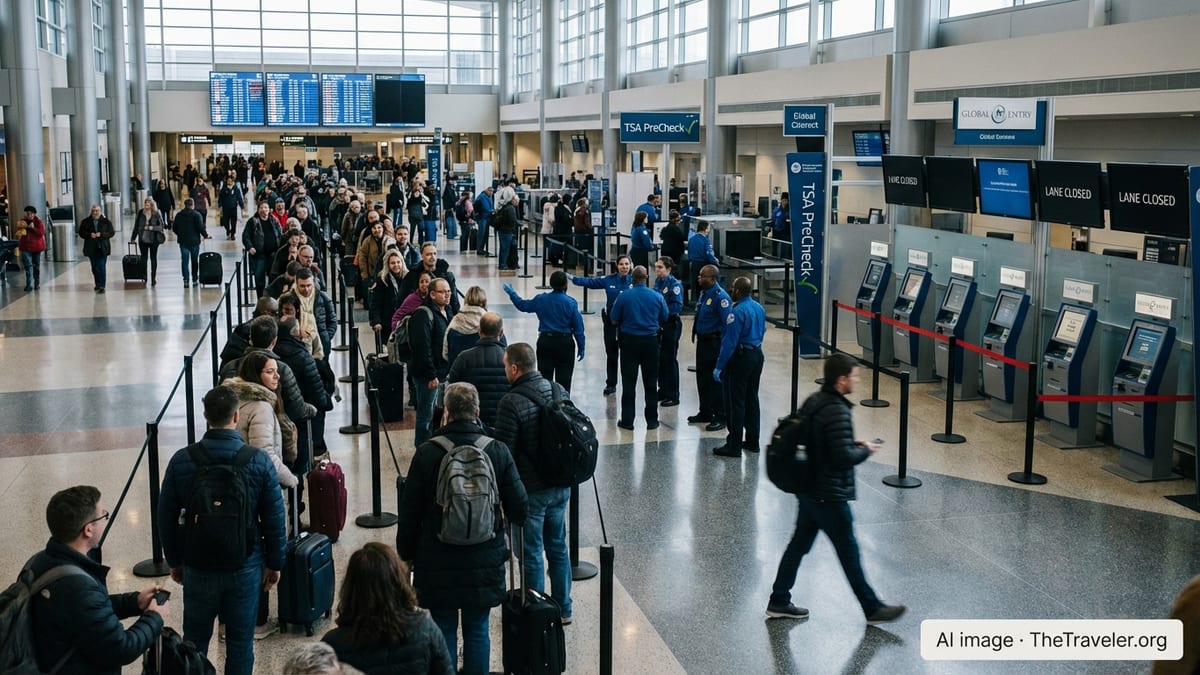
Global Entry Suspended as DHS Implements Emergency Measures
The Department of Homeland Security has formally suspended Global Entry, the popular trusted traveler program that speeds vetted passengers through U.S. customs, as part of a sweeping set of emergency measures triggered by the partial government shutdown affecting DHS. The shutdown, which began on February 14, has left the agency without full-year funding and forced officials to prioritize core security operations over facilitation programs at airports and land borders.
Global Entry kiosks are now being gradually taken offline at major international gateways, and U.S. Customs and Border Protection officers are redirecting resources back into standard inspection lines. While international arrivals can still enter the country, they must do so through regular processing, erasing one of the key time-saving tools for frequent flyers and business travelers who rely on expedited clearance to make tight connections.
DHS officials have framed the suspension as a temporary but necessary step to “preserve limited funds” and manage staffing under shutdown protocols that require many personnel to work without pay. Travel industry groups, however, warn that ending Global Entry, even briefly, risks cascading delays at customs facilities that were already under pressure from strong international demand and winter weather disruptions.
TSA PreCheck Survives Initial Suspension Order but Faces Strain
In contrast to Global Entry, TSA PreCheck remains operational after a dramatic reversal by DHS and the Transportation Security Administration. An initial shutdown plan called for suspending both programs as of early Sunday morning, effectively closing dedicated PreCheck lanes at airport security checkpoints nationwide. Within hours of the deadline, however, TSA confirmed that PreCheck would stay open, citing coordination with the White House and a fresh assessment of operational needs.
That reversal ended a tense weekend of mixed signals for millions of travelers who pay for the privilege of shorter, faster security lines. At some airports, PreCheck lanes continued to function past the original cutoff time, while others temporarily redirected passengers into standard screening queues until updated guidance arrived. By Sunday afternoon, TSA spokespeople were stressing that “at this time” PreCheck remains available with no change for the traveling public.
Behind the scenes, officials acknowledge that the survival of PreCheck is not guaranteed if the shutdown continues deep into the spring. As unpaid shifts mount and overtime budgets evaporate, TSA may be forced to consolidate lanes or curtail hours for dedicated PreCheck screening, particularly at smaller or regional airports. The agency has said it will evaluate operations on a case by case basis as staffing constraints emerge, leaving travelers and airlines bracing for a patchwork of local impacts.
Travelers Face Longer Lines, Confusion and Uneven Airport Conditions
The shutdown’s impact is already being felt in terminal corridors and customs halls, where confused travelers have confronted a shifting landscape of signs, closed kiosks and inconsistent information. At some major hubs, Global Entry kiosks now sit dark behind stanchions, while agents direct even pre-vetted travelers into the same serpentine queues as first-time visitors. For passengers returning from long-haul international flights, the loss of expedited processing has translated into missed connections and unplanned overnight stays.
Security checkpoints are experiencing similar turbulence, though not yet the wholesale breakdown that many feared when DHS first floated the idea of suspending PreCheck. At airports in cities such as Washington, San Francisco and Orlando, PreCheck lanes remained open over the weekend, albeit with longer-than-normal waits as staffing was stretched thin and blizzard-related flight disruptions in the Northeast pushed more passengers into already busy terminals.
Airlines are attempting to cushion the blow by waiving change fees in weather-affected regions and urging customers to arrive at airports earlier than usual. But carriers admit that there is little they can do to offset government-driven constraints on customs and security throughput. Frequent flyers who built travel schedules around the reliability of expedited programs say they now feel caught in a policy crossfire, paying for benefits that can disappear overnight depending on the state of negotiations in Washington.
Political Standoff Over DHS Funding Drives Policy Whiplash
The underlying cause of the disruption is a narrow but consequential shutdown that affects only the Department of Homeland Security while leaving the rest of the federal government open. Lawmakers failed to reach an agreement on DHS appropriations ahead of a February 14 deadline, with disputes centered on immigration enforcement, border operations and oversight of the department’s sprawling security apparatus.
Because key DHS agencies are financed partly through user fees and multiyear appropriations, many frontline operations have been able to continue. Immigration and Customs Enforcement, Customs and Border Protection and parts of Citizenship and Immigration Services are still functioning, though with employees increasingly working without pay. TSA staff are similarly classified as essential, meaning they must report for duty even as paychecks are delayed, raising concerns about morale, retention and the potential for increased sickouts if the shutdown stretches on.
Within this fraught landscape, trusted traveler programs became both a financial and symbolic target. DHS initially framed the suspension of TSA PreCheck and Global Entry as part of a wider suite of belt-tightening moves, arguing that the department had to refocus personnel on the majority of travelers rather than providing premium services. Political critics, however, quickly cast the move as an attempt to weaponize the inconvenience of air travel, using popular programs as leverage in a high stakes funding dispute.
Airlines and Airports Warn of Economic and Operational Fallout
U.S. airlines, airport operators and travel industry associations have reacted sharply to the suspension of Global Entry and the threatened curtailment of TSA PreCheck. Trade groups representing major carriers warn that the loss of expedited customs processing could ripple through already tight flight schedules, especially at international hubs where arrival banks are carefully timed and small delays can rapidly snowball into wider disruptions.
Airport executives point to recent history. Previous government funding crises demonstrated how even modest slowdowns in security or customs can translate into long lines, missed flights and passenger complaints that linger long after normal operations resume. With the airline industry still recalibrating to post-pandemic travel patterns and chronic staffing shortages, many fear the timing of this shutdown could undercut fragile gains in on time performance and customer satisfaction scores.
Economists who track the travel and tourism sector note that while trusted traveler programs are optional, they play an outsized role in attracting high value business travelers and encouraging frequent trips. If disruptions persist, companies may scale back last minute international travel, shift meetings online or reroute itineraries through foreign hubs where clearance is more predictable. That in turn could dent revenues not only for airlines but for hotels, convention centers and local tourism economies in gateway cities.
Trusted Traveler Programs’ Funding Structure Comes Under Scrutiny
The chaos surrounding Global Entry and TSA PreCheck has also revived a long running debate about how these programs are funded and managed. Both rely heavily on application and renewal fees paid by travelers, with the revenue designed to cover background checks, enrollment centers, technology and some staffing. Industry groups argue that this fee based structure should insulate the programs from short-term appropriations battles, allowing them to remain fully operational even when broader agency budgets are squeezed.
DHS officials counter that while user fees help, the programs are still woven into a broader operational fabric that depends on annual funding for TSA and Customs and Border Protection. Screeners and officers who process PreCheck and Global Entry travelers are the same employees who handle standard lanes and general customs inspections, meaning that any serious budget constraint inevitably affects both premium and regular services.
The current shutdown has exposed how little transparency exists around exactly how fee revenue is allocated, what reserves are available and which functions can legally continue without new appropriations. Some lawmakers are now calling for a clearer firewall between traveler funded programs and the rest of DHS, suggesting that Congress could pass targeted protections to prevent future suspensions of services that millions of Americans have effectively prepaid.
What Travelers Should Expect in the Coming Weeks
For now, travelers enrolled in TSA PreCheck can still use dedicated security lanes where they are available, though they should be prepared for longer lines and occasional last minute changes if local staffing issues force airports to consolidate checkpoints. Signs and announcements may lag behind real time operational decisions, so passengers are being urged to verify checkpoint status upon arriving at the airport and to build extra time into their journeys.
Those who rely on Global Entry should plan for the program to remain offline for the duration of the shutdown. Airlines and airports are advising international travelers to expect full customs inspections, have documentation ready and schedule longer connection windows on return flights to the United States, particularly when traveling through busy coastal hubs. Enrollment centers for Global Entry and other trusted traveler programs are also facing disruptions, with appointments likely to be canceled or postponed until funding is restored.
As negotiations continue in Washington, both DHS and the travel industry are watching closely for signs of a breakthrough that could bring swift relief to strained airport operations. But if the shutdown persists, the suspension of Global Entry and the fragile status of TSA PreCheck may become emblematic of a larger question: how reliably the U.S. government can maintain the infrastructure that underpins modern air travel when political brinkmanship turns funding into a recurring crisis.