

More news on this day
As a prolonged Department of Homeland Security funding standoff ripples through the U.S. aviation system, South Florida’s busiest airports are bracing for deeper disruption amid a controversial proposal to send Immigration and Customs Enforcement agents into airport security roles.
Get the latest news straight to your inbox!
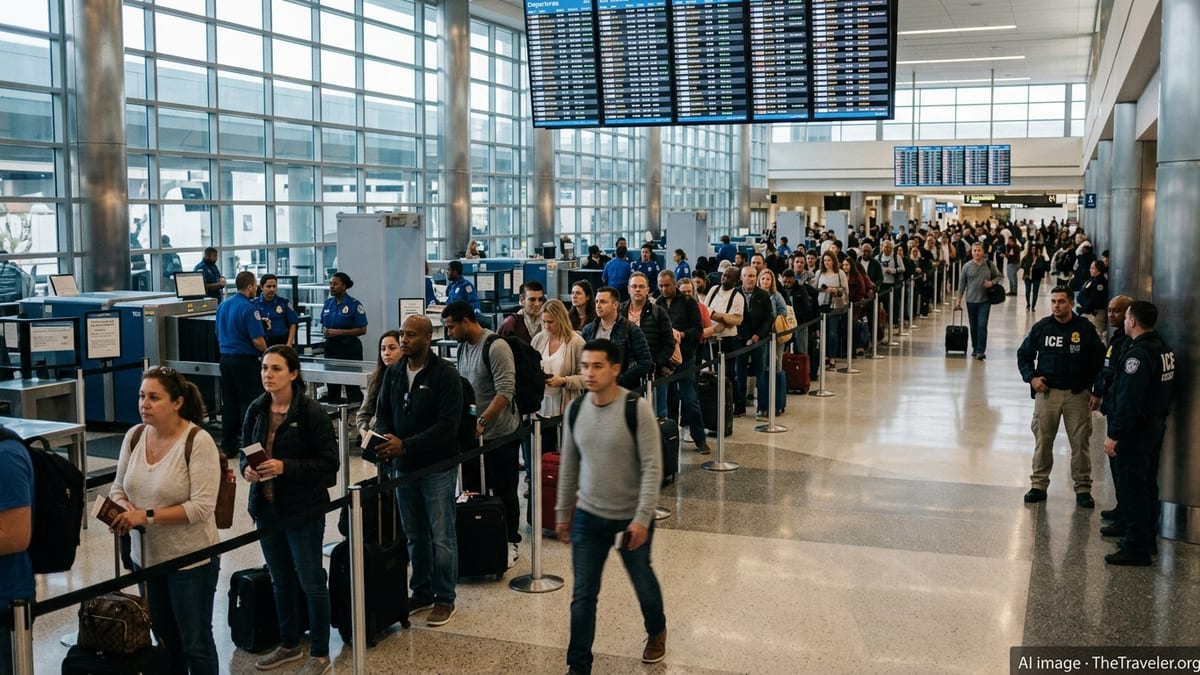
Shutdown Squeezes TSA and Air Travel Nationwide
The current federal funding lapse affecting the Department of Homeland Security has intensified pressure on the Transportation Security Administration, with officers required to work without pay and a growing number reportedly calling out or leaving their jobs. Recent national coverage describes long and unpredictable security lines at several major hubs, especially during peak hours, as staffing levels fluctuate day by day.
The travel crunch coincides with one of the busiest periods of the year for U.S. airports, amplifying concerns that even small staffing shortfalls can cascade into missed flights and rolling delays. Analyses from industry groups and academic researchers looking at recent shutdowns have linked unpaid work and elevated attrition among federal security staff to slower processing times and reduced on-time performance.
These patterns are being closely watched in South Florida, where Miami International Airport and Fort Lauderdale–Hollywood International Airport serve as major gateways for Latin America, the Caribbean and domestic leisure travel. Any prolonged instability in federal staffing at security checkpoints or control facilities has the potential to reverberate through airlines’ schedules and the wider regional economy.
Miami and Fort Lauderdale on a Federal Fault Line
Local records and recent regional reporting indicate that operations at Miami International and Fort Lauderdale–Hollywood have remained largely stable so far, even as TSA personnel there continue reporting for duty without regular paychecks. Miami-Dade County documents show airport leadership tracking absenteeism among federal partners and warning that conditions could deteriorate quickly if the shutdown extends and employee finances become more strained.
At Fort Lauderdale–Hollywood, local television coverage has highlighted the reality of screening officers working without pay while continuing to move large volumes of passengers through checkpoints. South Florida’s airports have recent experience with crisis management, from severe weather disruptions to large-scale security incidents, and have invested in training and contingency planning to keep terminals functioning under stress.
Despite those preparations, the region’s reliance on federal workers at TSA, Customs and Border Protection and the Federal Aviation Administration leaves airport operations vulnerable to decisions made in Washington. A separate Federal Aviation Administration planning document reported in local media outlined the possibility of flight reductions at Miami and Fort Lauderdale during earlier phases of shutdown-related strain, signaling that federal agencies view the South Florida airspace as a high-impact zone in any capacity-management effort.
Trump’s ICE Deployment Proposal Sparks Debate
The travel crisis took a new turn after President Donald Trump announced that he intends to direct Immigration and Customs Enforcement officers to assist with airport security if Congress does not approve new Homeland Security funding. In public remarks and social media posts from Florida, the president linked the move to broader immigration enforcement goals while suggesting that ICE personnel were ready to be deployed to airports as early as Monday.
News coverage of the proposal has pointed out that ICE officers are trained for immigration enforcement and investigations, not for passenger and baggage screening, which is the core responsibility of TSA. Commentators across outlets have questioned what, in practical terms, ICE agents would do at airport checkpoints and how their presence would interact with existing TSA procedures and union contracts.
Civil liberties advocates and some travel industry voices have also raised concerns that using an immigration enforcement agency inside security lanes could change the atmosphere at airports, particularly in international hubs such as Miami that serve large immigrant and diaspora communities. Public discussion has focused not only on operational questions, but also on the potential for increased fear among certain travelers and airport workers.
Could ICE Agents Actually Ease South Florida Delays?
For Miami and Fort Lauderdale, the central question is whether involving ICE in airport security would meaningfully reduce wait times or simply shift personnel without solving underlying staffing issues. Analysts who study aviation operations have emphasized that checkpoint throughput depends on specialized training, standardized procedures and integrated technology, all areas where TSA has specific mandates and certification processes.
Published commentary following the president’s announcement notes that ICE officers are not currently certified to operate TSA screening equipment or to carry out the layered security protocols used at passenger checkpoints. Any attempt to retrain or repurpose them would take time, potentially limiting their ability to provide immediate relief during a fast-moving shutdown crisis.
There are also practical limits on how many ICE agents could realistically be diverted to airports without affecting the agency’s existing caseload in areas such as detention management and investigative work. Publicly available staffing data show that ICE’s workforce is significantly smaller than that of TSA, suggesting that even a sizable redeployment would cover only a fraction of national checkpoint positions. For South Florida’s large and complex terminals, this raises questions about whether such a move would be more symbolic than transformative.
Travelers Face Uncertainty as Political Standoff Drags On
As debates continue in Washington over funding and enforcement priorities, travelers in and out of Miami and Fort Lauderdale are left to navigate a fluid situation. Travel forums and social media posts from recent days describe a patchwork of experiences, with some passengers passing through security in minutes and others encountering unexpectedly long lines depending on the time of day and local staffing conditions.
Travel groups and trade associations have urged passengers using heavily trafficked hubs to arrive earlier than usual, particularly during the morning and late-afternoon peaks when staffing gaps are most likely to be felt. Airlines serving Miami and Fort Lauderdale are advising customers to monitor flight status closely, noting that ground delays in other parts of the country can quickly ripple into South Florida’s flight banks.
For now, publicly available information suggests that Miami International and Fort Lauderdale–Hollywood remain operational and open, but under growing strain from a shutdown with no clear end date and a proposed ICE deployment that raises as many questions as it answers. The coming days are likely to determine whether South Florida’s airports can continue to absorb federal turbulence or become flashpoints in the broader shutdown travel crisis.