

More news on this day
America’s latest shutdown crisis is colliding with an already fragile aviation system, creating mounting disruption at U.S. airports and raising new questions about how long regular air travel can hold.
Get the latest news straight to your inbox!
Shutdown Collides With a Stressed Aviation Network
The current partial government shutdown, driven by a lapse in funding for key security and transportation agencies, is unfolding against a backdrop of long-standing strain in the U.S. aviation system. Publicly available data shows that major hubs were already managing chronic air traffic controller shortages and frequent weather-related disruptions even before the latest political standoff. Research using Bureau of Transportation Statistics data has pointed to a growing share of flight delays linked to security and national airspace system factors in the post-pandemic era, underscoring how thin the margin for error has become.
In this environment, the shutdown’s impact does not come in the form of an immediate nationwide halt, but rather through cumulative pressure points that spread across the network. Core functions at the Federal Aviation Administration and the Transportation Security Administration are continuing, but with critical personnel working without pay, hiring and training frozen, and nonessential safety and modernization programs slowed or paused. The result is a system that may still be moving most passengers, yet is increasingly vulnerable to spikes in delays, cancellations and local breakdowns.
Industry groups and aviation workforce organizations have warned for months that repeated funding lapses intensify an already serious controller staffing gap. Congressional testimony and policy papers released in late 2025 described how previous shutdowns forced the FAA to curtail safety inspections, delay certification work and rely more heavily on mandatory overtime, a pattern that can erode morale and increase fatigue among front-line staff. Those same underlying weaknesses are now being tested once again.
Security Lines Lengthen as TSA Staffing Frays
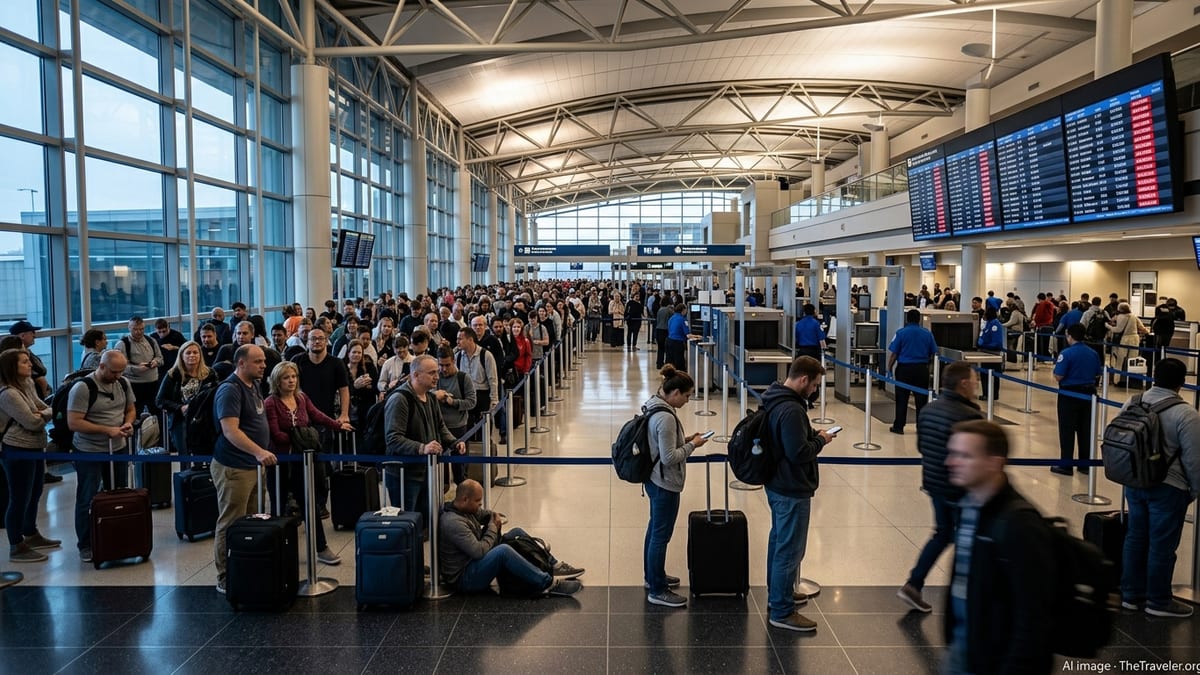
The most visible effect of the shutdown for many travelers is playing out at security checkpoints. Reports from airports in Texas, California and other large states describe three hour waits at peak times, with some passengers missing flights despite arriving well in advance of departure. Travel forums and local media coverage indicate that staffing shortages at TSA checkpoints have grown as the funding lapse stretches past the one month mark, with officers working without pay and some reportedly seeking temporary work elsewhere.
TSA has historically kept the vast majority of its workforce on the job during funding lapses under “essential” designations, but that continuity has limits. Publicly available information from recent shutdowns shows that as unpaid weeks accumulate, sick calls and attrition can rise, concentrating the impact at already busy hubs. Current reports suggest a similar pattern, with long lines repeatedly flagged at airports such as Houston’s George Bush Intercontinental and Austin Bergstrom, while other locations report relatively normal flows.
Security delays are feeding back into the broader network. Academic analyses of flight performance data over the past decade have found that security-related disruptions are now a more distinct and measurable contributor to overall delay probabilities than in the early 2010s. When screening lanes slow, boarding and pushback times slip, reducing the ability of airlines to recover from weather or airspace congestion later in the day. In a shutdown environment, that buffer narrows further, and a localized staffing problem at one checkpoint can ripple to connecting banks across the country.
Air Traffic Reductions and the Risk to Smaller Airports
While large hubs attract most of the attention, some of the most consequential shutdown-related changes are emerging at smaller airports. During the 2025 federal shutdown, the FAA ordered capacity reductions of around 10 percent at 40 high traffic airports, and later moved to curb business aviation and other discretionary flying at selected fields as staffing thinned. More recent guidance has revived similar measures, including targeted flight reductions designed to preserve safety margins where controller availability is most constrained.
Publicly available testimony from aviation associations describes how furloughs and delayed approvals during prior shutdowns hit business and general aviation particularly hard, grounding aircraft that required fresh inspections or new certifications. Those effects are now being felt again in some regional markets, where delayed approvals and limited tower staffing can reduce scheduling flexibility for both cargo and passenger operations. For communities that rely on a small number of daily flights for business travel, medical trips or tourism, even modest schedule cuts can have outsized economic impact.
Recent coverage from national outlets has highlighted another emerging risk: the potential temporary closure of certain small hub airports if TSA staffing falls below minimum thresholds. Lists circulating in industry publications point to dozens of facilities that could be vulnerable if unpaid screeners stop showing up for work. Some smaller airports use contracted security staff who are not directly affected by the current shutdown, but those that rely on federal officers face growing uncertainty about whether they will be able to maintain full screening operations in the weeks ahead.
Lessons From Past Disruptions Shape Today’s Chaos
The current turmoil is not occurring in isolation. Over the past three years, U.S. travelers have experienced a series of high profile breakdowns that have revealed how dependent modern air travel is on a tightly coupled web of technology, staffing and regulation. These range from the 2023 nationwide ground stop triggered by an FAA notice system outage to airline specific meltdowns and IT failures such as the 2024 disruption at Delta Air Lines, which led to thousands of flight cancellations in a matter of days.
Analyses of those events highlighted several common themes: aging infrastructure, limited redundancy, and staffing levels that leave little room to absorb shocks. Academic work on disruptions in the national airspace system has categorized a small but significant share of days each year as “highly disrupted,” marked by concentrated clusters of delays across key hubs. Researchers have also documented an upward trend in the frequency of such days in the post pandemic period, even before politics is added to the mix.
Against that backdrop, a prolonged funding lapse acts as a multiplier on existing vulnerabilities. When modernization projects are paused, hiring pipelines are disrupted and operational staff work extended hours without pay, the system’s resilience is gradually eroded. The shutdown is unlikely to be the sole trigger of any given day’s chaos, but it increases the probability that weather, technical glitches or localized staffing shortages will tip the network into widespread delays.
What Travelers Can Expect for Upcoming Flights
For passengers holding upcoming tickets, the central question is whether their next flight is at immediate risk. Current data from flight tracking services indicates that, despite spikes in delays on certain days, the majority of scheduled flights are still operating. Many major hubs continue to move large volumes of traffic, and some airports report minimal disruption at off peak times. However, the risk profile is changing, and travelers are being advised by industry groups and travel advisors to plan more conservatively.
Guidance published by travel associations during the shutdown urges passengers to build in additional time at the airport, particularly at large hubs and during early morning and evening peaks. Recommendations include arriving well ahead of normal check in times, keeping essential items and medications in carry on bags in case of missed connections, and closely monitoring airline and airport communications for gate changes or revised schedules. Some advisory materials also note that standard travel insurance products may not automatically cover shutdown related disruptions, meaning travelers should review policy language carefully.
Looking ahead, the trajectory of the shutdown itself remains the most important variable. If funding is restored quickly, many of the most acute problems, such as unpaid shifts and high sick leave rates among security staff, could ease within days. Yet aviation advocates caution that deeper effects, including delayed training, certification backlogs and deferred technology upgrades, will linger long after passengers stop seeing headline grabbing lines and cancellations. For now, the system remains operational but strained, and each additional day without a funding agreement increases the chances that routine trips will run into turbulence on the ground as well as in the air.