

Siem Reap is still introduced to the world as the gateway to Angkor, a service town whose fortunes rise and fall with the number of visitors passing through the temple turnstiles.
Yet on the ground, the city is quietly rewriting its own story. Beyond the moat of Angkor Wat, a different Siem Reap has emerged: a place of neighborhood markets and small farms, creative studios and coffee roasteries, lakeside villages and local start-ups all trying to build a future that is not entirely dependent on the temple economy.
From Temple Town to Regional Hub
For two decades, Siem Reap’s economic identity was almost singular. Angkor Archaeological Park drew millions of international visitors a year, and nearly every dollar that flowed through the city could be traced back to sunrise at Angkor Wat. Hotels, tuk-tuks, massage shops, ticket counters and souvenir stalls formed an ecosystem whose health depended on long-haul flights and global tour operators. The pandemic shattered that model, exposing just how vulnerable a temple-first economy could be.
The opening of the new Siem Reap Angkor International Airport in October 2023 marked the start of a new chapter. Built to handle larger aircraft and more direct international routes, the facility sits more than 40 kilometers from town and symbolically relocates the city’s economic future further from Angkor’s shadow. The airport was designed not just as a gateway to the temples but as a long-term platform for broader tourism and regional connectivity, with capacity in its first phase for millions of passengers a year and scope to grow substantially over the coming decades.
By late 2024, the airport was projected to be handling well over a million passengers annually, a modest figure by global standards but a crucial sign that Cambodia’s northwest was reconnecting to the world. Nationally, the Ministry of Tourism reported about 6.7 million foreign arrivals in 2024, a strong jump from 2023 and a lifeline for businesses that survived years of closures and layoffs. Yet talk to local entrepreneurs in Siem Reap and a consistent theme emerges: there is little appetite to return to a model where the city’s fate hinges entirely on Angkor’s visitor numbers.
This shift is not a rejection of Angkor, whose spiritual and economic importance remains immense. Rather, it is an attempt to diversify what Siem Reap offers and how it earns, to turn a transit city into a more rounded destination and a more resilient place to live. The new airport, lakes, countryside and urban neighborhoods are all part of that recalibration.
Everyday Life in a Former Boomtown
Walk a few blocks away from the souvenir shops of Old Market and Pub Street and Siem Reap quickly feels less like a tourist playground and more like a modest provincial city. The riverside promenade sees grandparents doing slow laps at dusk, teenagers sharing iced coffee on motorbikes, and workers heading home with bags of vegetables from the market. The skyline remains low, defined more by temples and mango trees than towers, and the rhythm of daily life is closer to that of a large town than a metropolis.
Morning begins early. At Phsar Leu, the city’s main local market, porters weave through aisles with crates of herbs, live fish and lotus roots. Vendors from surrounding villages arrive with baskets of mushrooms, palm sugar and seasonal fruits. Many of these traders used to sell souvenirs or snacks near Angkor but shifted to food and staples when tourist traffic collapsed. The market is a reminder that long before mass tourism, Siem Reap’s hinterland supported a dense agricultural community tied to Tonle Sap Lake and the floodplain.
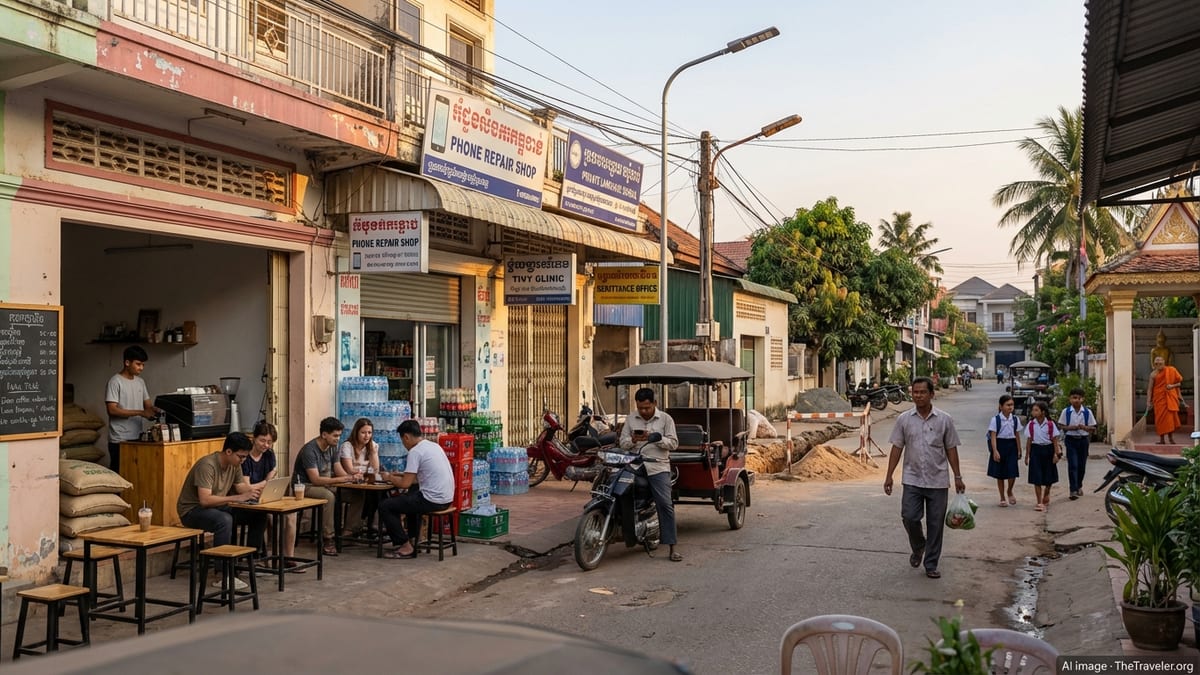
Residential neighborhoods like Salakamreuk, Svay Dangkum and Chreav are where the city’s new normal is most visible. Small convenience stores share the street with phone repair shops, private English and Korean language schools, remittance offices and clinics. Rents are lower the farther you get from the tourist core, attracting Cambodian civil servants, NGO workers and young professionals, as well as a growing number of long-staying foreign residents who came for Angkor and stayed for the slow pace of life.
Public infrastructure has struggled to keep up with this gradual expansion. Roadworks and drainage projects are a near-constant sight, a byproduct of both rapid pre-pandemic growth and flood-prone geography. The city has pushed to improve street lighting, sidewalks and riverbank landscaping, and there is a visible push to clean up the Siem Reap River corridor. Yet for many locals, the more tangible markers of progress are humbler: more reliable electricity, stronger mobile data coverage, and the appearance of modern supermarkets alongside traditional markets.
New Economies: Cafes, Creatives and Remote Work
One of the most striking changes in Siem Reap since the early 2010s is the rise of a small but energetic creative and services economy that does not revolve entirely around tour buses. Around Wat Bo Road, Taphul and the riverside, independent cafes, bakeries and roasteries have appeared, powered by young Cambodian baristas and bakers who once might have worked in hotel kitchens. Many of these venues cater as much to local residents and NGO staff as to short-stay visitors, with Khmer-language conversations dominating at midday.
The city’s affordability and gentle pace have also made it attractive to freelancers and remote workers. While Siem Reap lacks the scale of digital nomad hubs like Chiang Mai or Bali, a network of coworking-friendly cafes and small shared offices has sprung up. Reliable fiber connections and relatively low rents allow designers, writers and developers to base themselves in town, often splitting time between the city, Angkor’s forested edges and trips to Phnom Penh or Bangkok.
Parallel to this, a homegrown creative scene has taken root. Art spaces, galleries and community studios showcase contemporary Cambodian painters, sculptors and photographers whose work goes far beyond postcard images of temple spires. Performance spaces host everything from traditional dance adapted for modern audiences to experimental music nights. Many of these initiatives began as side projects by artists who returned from studying or working abroad, hoping to build something more sustainable and locally focused in Siem Reap.
Small-scale manufacturing and services have also diversified. There are craft workshops producing ceramics, textiles, natural soaps and upcycled accessories that rely on online sales and export as much as walk-in trade. Social enterprises employ landmine survivors or rural women to create products for regional and international markets. Behind the scenes, a quiet layer of logistics firms, accounting services and consulting outfits support both this new wave of entrepreneurs and the traditional hotel and tour sector.
Beyond Angkor: Lakes, Hills and Village Life
For visitors willing to look beyond sunrise at Angkor Wat, the surrounding province offers a broader picture of how Siem Reap is trying to rebalance its tourism portfolio. Tonle Sap Lake, a short drive south of town, has long been marketed for its floating villages and boat tours. Increasingly, however, there is greater emphasis on community-based tourism that highlights the environmental significance of the lake and the precariousness of life for communities whose homes rise and fall with the water level.
Villages such as Kompong Khleang and Kompong Phluk offer a very different experience from the crowded piers closer to town. Elevated wooden houses, seasonal rice paddies and flooded forests form the backdrop to day trips that increasingly include cooking lessons, homestays and conversations about fisheries, erosion and climate stress. Some local cooperatives are working to ensure that a larger share of visitor spending goes directly to residents, while tightening rules on boat traffic and waste.
To the northeast, Phnom Kulen National Park provides another outlet for an economy that does not begin and end at Angkor’s ticket booths. The sacred plateau, with its waterfalls, reclining Buddha and riverbed carvings, has become a popular weekend escape for domestic visitors from Phnom Penh and other provinces. Food stalls, guesthouses and transport services around the park largely employ local families, spreading tourism income deeper into the countryside. Careful management remains a challenge, but there is growing awareness among authorities and communities that Kulen’s forest cover and water sources are strategic assets as much as tourist backdrops.
Elsewhere, smaller attractions reflect a push toward niche and specialized tourism. The Banteay Srey Butterfly Centre, for example, operates as both a visitor site and a conservation-linked social enterprise, while various farm stays and eco-lodges experiment with organic agriculture, birdwatching, cycling and handicraft workshops. These ventures rarely draw the crowds that Angkor commands, but they attract visitors who stay longer, spend in local villages and help to diversify the skills and income streams of rural households.
Recovering from Crisis and Rethinking Risk
The shock of border closures and travel bans in 2020 and 2021 remains a vivid memory in Siem Reap. Hotels that had been full for much of the 2010s stood empty, tuk-tuk drivers sold their vehicles or returned to family farms, and thousands of workers in hospitality, retail and entertainment found themselves suddenly out of work. Some left for factory jobs near Phnom Penh or across the border, while others tried their hand at online commerce, agriculture or construction.
As international travel resumed, visitor numbers climbed back, supported in part by the new airport and aggressive marketing campaigns by the Cambodian government. Yet the recovery has been uneven. Large hotels and established tour operators regained some strength thanks to regional markets and long-term contracts. Smaller guesthouses and family-run businesses often struggled, squeezed by rising costs and changed travel patterns. Many observers note that pre-pandemic levels of mass tourism from key markets like China have not fully returned, and may not do so for some time.
This uncertainty has pushed local authorities, business associations and community leaders to talk more openly about overdependence on Angkor. There is recognition that shocks may not only come from pandemics but also from geopolitical tensions, climate impacts or shifting traveler preferences. At the same time, environmental concerns about the impact of mass tourism on the temple complex and the broader Angkor landscape have gained new weight.
In practice, diversification efforts take many forms. Some tuk-tuk drivers now split their week between temple runs, school transport services and parcel delivery. Former hotel staff have opened neighborhood restaurants that cater to local families as much as tourists. Young Cambodians, often fluent in English and increasingly in other Asian languages, are launching small travel agencies that promote countryside cycling tours, food walks and cultural workshops rather than only sunrise photo stops.
Culture, Heritage and the Weight of Angkor
Angkor itself remains the city’s gravitational center, not only economically but also culturally. For many Siem Reap residents, the temples are not simply a tourist attraction but a deeply embedded presence in daily life. They serve as a backdrop to family picnics, religious festivals and personal rituals. The old airport’s proximity to the complex sparked genuine concern that pollution and vibrations were damaging the stonework, a key argument for relocating long-haul flights to the new facility.
Inside the city, however, there is a growing desire to showcase Cambodian culture in ways that are not limited to temple iconography. Contemporary dance companies reinterpret classical forms for new audiences. Musicians blend Khmer melodies with rock and hip-hop. Street murals depict everything from apsaras to modern urban scenes. For visitors who venture beyond the main tourist streets, it is increasingly possible to encounter a living culture that is evolving in the present, not just preserving the past.
The government and local institutions have invested in museums and learning centers that contextualize Angkor within a longer, more complex narrative of Cambodian history. Exhibitions on the Khmer Rouge era, post-war reconstruction and modern social challenges sit alongside displays of ancient sculpture. This broader storytelling aligns with Siem Reap’s attempt to be understood as a real city with its own contemporary struggles and ambitions, instead of a themed resort attached to a UNESCO site.
Religion and spirituality also permeate the urban landscape in subtle ways. Pagodas double as community centers, sites of charity and informal counseling. Monks participate in environmental clean-up campaigns and youth education programs. As Siem Reap grows, tensions inevitably arise between tradition and development, yet the presence of these institutions gives the city a sense of continuity that goes beyond hotel cycles and flight schedules.
Challenges: Inequality, Environment and Overcrowding
Despite the optimism around diversification, Siem Reap faces serious and persistent challenges. Economic inequality is visible in the contrast between luxury resorts and nearby villages where families struggle with debt, underemployment and limited access to quality healthcare or education. Too often, the benefits of tourism accrue to those positioned closest to capital and decision-making, while poorer communities remain vulnerable to market downturns and land pressures.
Environmental stress is another central concern. The wider Angkor region and Tonle Sap basin are ecologically sensitive, and the combined pressures of tourism, agriculture, deforestation and climate change are significant. Dry seasons have become hotter, and rainfall patterns more erratic, disrupting rice cycles and fish migrations. On the urban fringe, rapid, unplanned development tests drainage systems and leads to flash flooding in low-lying neighborhoods after heavy storms.
Inside the temples, debates continue about carrying capacity, conservation and the balance between access and protection. Authorities have introduced various measures over the years, including restrictions on climbing certain towers and limitations on commercial activities in sensitive zones. Yet when visitor numbers surge, crowding remains an issue at iconic sites. For Siem Reap’s long-term prospects, safeguarding Angkor is not optional. The temples are both an irreplaceable cultural inheritance and the city’s single most important brand asset.
Socially, the city must navigate the tensions that come with being a global tourism destination. Young Cambodians are exposed to a rapid influx of foreign languages, lifestyles and spending power that can widen generational gaps. At the same time, sustained engagement with visitors has created space for cultural exchange, new ideas in business and education, and a stronger sense of connection between Siem Reap and the wider world.
The Takeaway
Siem Reap will likely always be synonymous with Angkor in the global imagination, but on the ground the city is engaged in a far more complex project. It is trying to remain a gateway to one of the world’s greatest archaeological sites while also becoming a livable, diversified regional hub where people can build futures that are not wholly dependent on temple ticket sales.
The opening of the new Siem Reap Angkor International Airport has helped reconnect the city to international travel and symbolized a shift away from the old model of mass tourism funneled directly to the temples. Yet the real transformation is happening at street level: in neighborhood markets that now cater to a broader base of residents, in creative studios and social enterprises, in rural homestays around Tonle Sap and Phnom Kulen, and in the decisions of families who juggle multiple small income streams instead of relying on a single tourism job.
For travelers, looking beyond Angkor means discovering a city and province shaped as much by its lake, forests and village networks as by its sandstone towers. It means engaging with local businesses that blend tradition and innovation, supporting community-led tourism projects, and recognizing the environmental and social pressures that tourism itself can generate.
For locals, the challenge is to secure a fairer share of the value that still flows through the temple economy while cultivating new sectors that can carry Siem Reap through future shocks. The story of the city today is not one of abandoning Angkor, but of learning to live with it more sustainably and imaginatively. Life beyond the temples is not a separate chapter, but part of the same narrative, written in markets, workshops, classrooms and rice fields as much as in stone.
FAQ
Q1: Is it still worth visiting Siem Reap if I have already seen Angkor Wat?
Yes. Beyond Angkor, Siem Reap offers lake and village experiences around Tonle Sap, trips to Phnom Kulen National Park, emerging art and food scenes in town, and community-based tourism that focuses on everyday Cambodian life rather than only temple visits.
Q2: How has the new Siem Reap Angkor International Airport changed travel to the city?
The new airport, which opened in October 2023, can handle larger aircraft and more passengers than the old facility, with room to expand over time. It sits farther from the temples, reducing environmental pressure on Angkor and positioning Siem Reap as a more broadly connected regional hub.
Q3: Is Siem Reap still heavily dependent on the temple economy?
Angkor remains central to the local economy, but the pandemic pushed the city to diversify. Today, more income comes from domestic tourism, creative industries, small manufacturing, services for residents and longer-stay visitors, and rural tourism that extends beyond the temple park.
Q4: What are some non-temple activities that support local communities?
Examples include visiting community-managed floating villages on Tonle Sap, staying at rural homestays, joining countryside cycling or food tours run by local cooperatives, and supporting social enterprises that employ vulnerable groups to produce crafts, textiles or food products.
Q5: Is Siem Reap a good base for remote work or longer stays?
For some travelers, yes. The city offers relatively affordable accommodation, improving internet infrastructure, a growing selection of cafes and small coworking spaces, and access to both urban comforts and nearby nature. It is quieter than major regional hubs but that slower pace appeals to many long-stayers.
Q6: How has everyday life for locals changed since before the pandemic?
Many residents who once relied almost entirely on temple tourism have shifted into mixed livelihoods, combining part-time tourism work with farming, small retail, delivery services or online business. Neighborhoods have become more self-contained, with more schools, clinics and shops serving a permanent population rather than short-term visitors.
Q7: Are there environmental concerns linked to tourism in Siem Reap?
Yes. Key issues include pressure on Angkor’s structures, deforestation and water stress in the wider region, and pollution affecting Tonle Sap and urban waterways. Authorities and communities are experimenting with rules on visitor flows, waste management and more responsible tourism practices, though challenges remain.
Q8: What role do arts and culture play in Siem Reap today?
Arts and culture are central to the city’s identity beyond Angkor. Contemporary galleries, performance spaces and festivals showcase work by Cambodian artists who blend traditional forms with modern influences. These venues provide income, education and alternative narratives that present Cambodia as a living culture, not only an ancient civilization.
Q9: Is Siem Reap safe and suitable for family travel?
Siem Reap is generally considered safe and welcoming for families. The compact city center, abundance of family-friendly guesthouses and attractions such as butterfly centers, markets and gentle countryside outings make it easy to travel with children, provided usual precautions are taken with traffic, sun and food hygiene.
Q10: How can visitors contribute positively to Siem Reap’s future beyond Angkor?
Travelers can spread their spending beyond the main tourist streets, choose locally owned businesses, support community-led tours and homestays, respect environmental guidelines at natural and cultural sites, and take time to learn about contemporary Cambodian life. Small choices, multiplied across thousands of visitors, help sustain a more balanced and resilient city.