

More news on this day
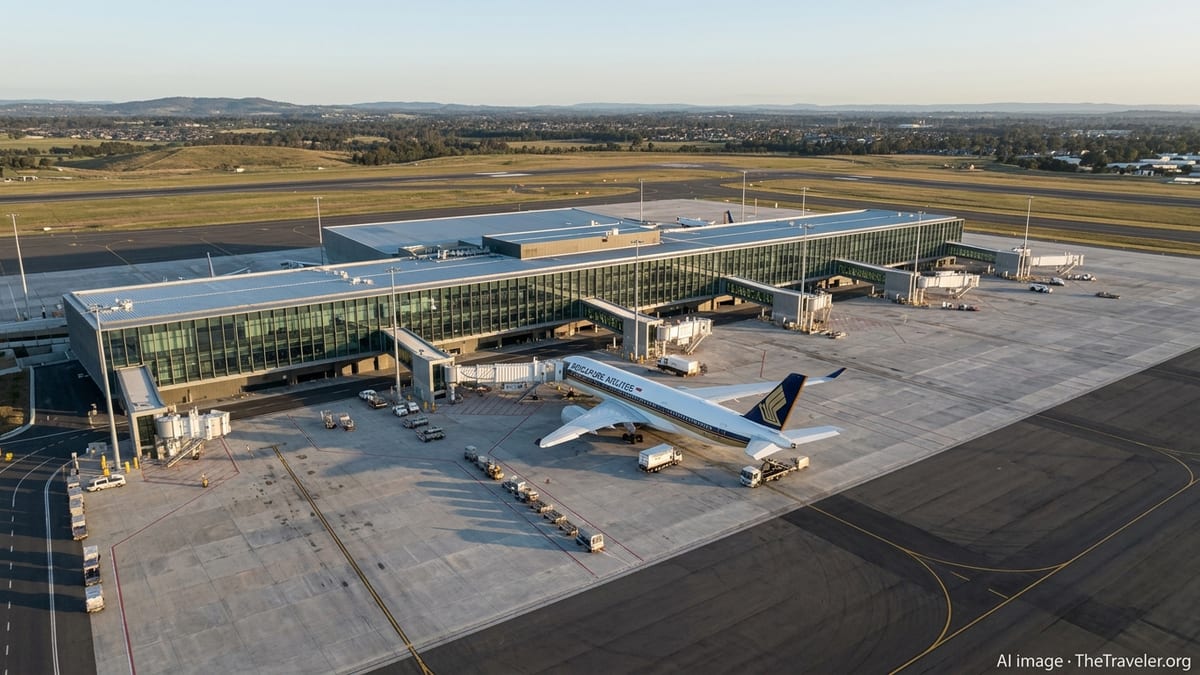
Australia’s emerging Western Sydney International Airport is preparing for a major boost in global connectivity, as Singapore Airlines confirms plans to launch Airbus A350 services linking the new 24-hour hub with Singapore once the airport opens in late 2026.
Get the latest news straight to your inbox!
A New International Gateway for Western Sydney
Western Sydney International Airport, officially known as Western Sydney International (Nancy-Bird Walton), is on track to open for passenger and cargo operations in late 2026. The greenfield hub has been designed as a 24-hour airport to relieve pressure on Sydney’s existing Kingsford Smith Airport and to serve one of Australia’s fastest-growing population corridors.
Publicly available information from airport planners and government agencies describes Western Sydney International as a key piece of national infrastructure intended to support long-term aviation growth, regional development and improved access to global markets. The airport’s curfew-free status and modern airfield layout are positioned as central advantages, particularly for long-haul services into Asia, Europe and North America.
Recent updates from project stakeholders indicate that major construction milestones, including the terminal structure and runway works, are substantially advanced, with the airport targeting an October 2026 launch. Master planning documents outline expectations for strong demand from Western Sydney residents who currently travel long distances across the metropolitan area to access international flights.
Alongside domestic carriers Qantas and Jetstar, Singapore Airlines has emerged as a cornerstone international partner for the new airport, with Air New Zealand also signalling plans to operate there. Together, these launch airlines are expected to anchor Western Sydney International’s initial global network.
Singapore Airlines Confirms A350 Services to the New Hub
Singapore Airlines was the first international carrier to confirm its intention to operate from Western Sydney International, following a memorandum of understanding signed in 2023 and a formal commitment announced in August 2024. Subsequent industry commentary and airport publications describe the tie-up as a foundational partnership for the new airport’s long-haul offering.
The airline has indicated that it will deploy Airbus A350 aircraft on services between Singapore Changi Airport and Western Sydney International. Public information on the carrier’s fleet profile shows that the A350-900 family forms the backbone of Singapore Airlines’ medium and long-haul network, offering a mix of business, premium economy and economy cabins designed for regional and intercontinental routes.
Aviation sector analysis suggests that the A350 is well suited to Western Sydney International’s launch phase, balancing range, fuel efficiency and capacity for a new long-haul market. The aircraft’s lower noise footprint compared with older widebody types is also seen as an advantage for a 24-hour airport operating in a densely populated region.
While detailed schedules and flight numbers have not yet been widely published, industry reporting and airport communications point to daily or near-daily frequencies being considered to align with connecting banks at Singapore Changi. The timing of the launch is expected to coincide closely with the commencement of commercial operations at Western Sydney International in late 2026.
What A350 Flights Mean for Passengers and Businesses
The Singapore Airlines link from Western Sydney International to Changi is expected to provide Western Sydney residents with a direct premium option to one of Asia’s most important aviation hubs. From Singapore, travellers gain one-stop connectivity to Europe, India, Southeast Asia, North Asia and North America, opening a wide range of itinerary options without crossing the city to Sydney’s existing airport.
For business travellers, published commentary from tourism and economic development agencies highlights the appeal of late-night departures and early-morning arrivals made possible by the new airport’s 24-hour operating model. Such timings allow passengers to complete a full working day in Sydney, connect onto overnight flights from Singapore, and arrive in key Asian or European cities in time for morning meetings.
The A350 onboard product is also a selling point. Publicly available fleet information describes Singapore Airlines’ A350 cabins as featuring lie-flat business class seats, dedicated premium economy sections and modern in-flight entertainment across all classes. These features are likely to resonate with corporate travellers, visiting friends and relatives traffic and leisure passengers heading to Southeast Asia and beyond.
For exporters and importers, the arrival of widebody passenger services also brings additional belly-hold cargo capacity into Western Sydney. Logistics and supply chain reports indicate that freight operators view Western Sydney International as a strategic site for time-sensitive and high-value goods, with the Singapore connection offering fast access to major Asian distribution hubs.
Economic and Tourism Impact for New South Wales
Government and industry analyses frame the Singapore Airlines partnership as a significant economic catalyst for Western Sydney and New South Wales. Expectations outlined in planning documents and public briefings include new jobs in aviation, hospitality, logistics, retail and tourism, both at the airport precinct and across the broader region.
Tourism authorities have emphasised that direct international connectivity into Western Sydney is likely to diversify visitor flows, encouraging travellers to spend more time in the region’s cultural, culinary and nature-based attractions rather than transiting immediately into central Sydney. The airport’s proximity to destinations such as the Blue Mountains is seen as a particular strength.
The Singapore Airlines A350 service is also expected to underpin two-way tourism growth. For Australian residents, Singapore remains a popular short-break and stopover destination, while one-stop itineraries through Changi will open up competitive fares and journey times to Europe and Asia. For inbound visitors from Asia and further afield, the new route offers a fresh entry point into Australia with easy access to both Western Sydney and the broader New South Wales network.
Economic modelling referenced in public reporting suggests that early commitments by carriers such as Singapore Airlines provide confidence for private-sector investment in hotels, conference facilities, logistics parks and retail developments around the airport precinct. In turn, these projects are expected to reinforce Western Sydney International’s role as a long-term economic engine for the state.
A Strategic Step in Australia–Singapore Aviation Ties
The upcoming A350 flights between Singapore and Western Sydney International represent a new chapter in the aviation relationship between Australia and Singapore. Singapore Airlines already operates multiple daily services to Australia’s major cities, and the addition of Western Sydney extends that footprint into a new catchment with distinct demographics and travel patterns.
Transport and trade analysts describe the Western Sydney route as complementary rather than purely competitive with existing Sydney services, spreading demand more evenly across the metropolitan area and offering additional choice for travellers. The connection is also viewed as reinforcing Singapore’s role as a gateway for Australian exports into Southeast Asia and beyond.
For Australia, the partnership aligns with broader goals to diversify global aviation links, enhance resilience in air connectivity and support regional growth corridors outside traditional central business districts. For Singapore, the Western Sydney link strengthens its position as a hub for long-haul traffic to and from the South Pacific, building on a network strategy that increasingly focuses on efficient, next-generation widebody aircraft such as the A350.
As Western Sydney International moves closer to opening, the Singapore Airlines A350 service stands out as a flagship example of how new infrastructure, advanced aircraft technology and evolving travel demand are reshaping the region’s aviation landscape. Further details on schedules, frequencies and commercial offerings are expected to emerge as the airport’s late-2026 launch date approaches.