

More news on this day
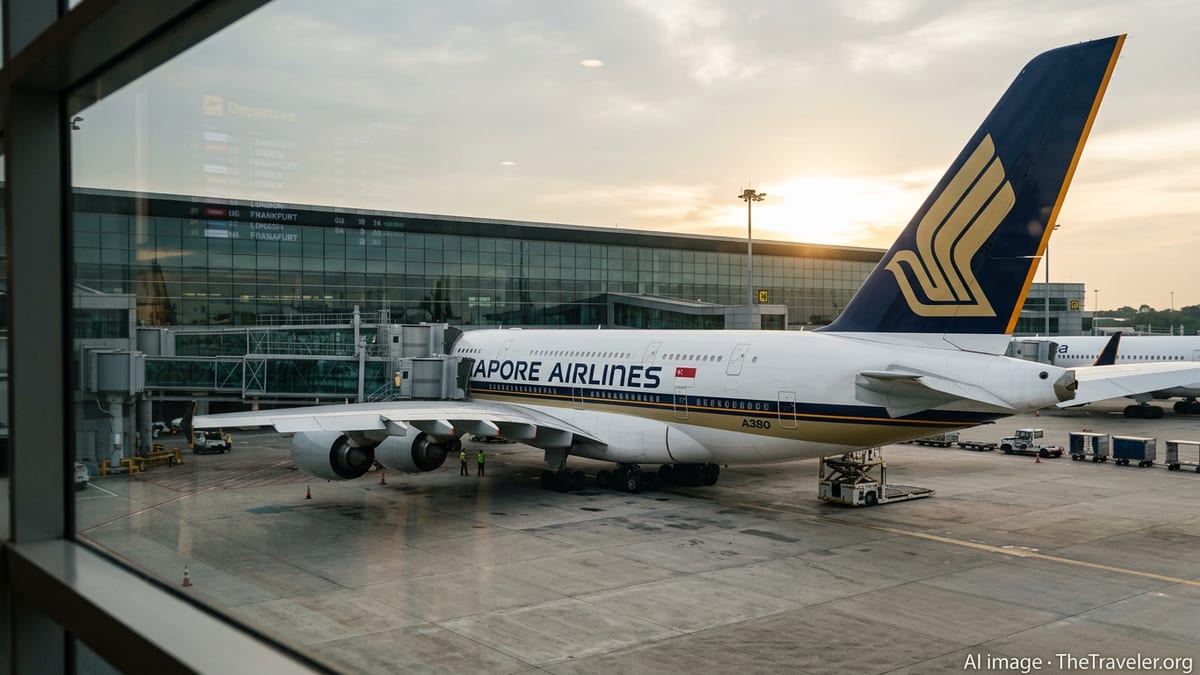
Singapore Airlines is adding more seats on its London and Frankfurt routes as travelers increasingly seek to bypass traditional Middle East hubs, with rerouted traffic and resilient demand between Europe and Asia driving fresh capacity into two of the carrier’s most strategically important markets.
Get the latest news straight to your inbox!
Middle East Conflict Reshapes Europe–Asia Traffic
Disruptions and heightened risk perceptions in parts of Middle East airspace have led to longer routings, schedule changes and reduced frequencies for several Gulf carriers. Publicly available flight-tracking data and traveler accounts indicate that airlines operating via hubs such as Dubai, Doha and Abu Dhabi have faced intermittent suspensions, diversions and more circuitous flight paths, particularly on Europe–Asia services.
As a result, passengers are increasingly shifting to itineraries that avoid Middle Eastern transit points altogether. Online discussions and booking trends highlighted in recent coverage show travelers rebooking away from Gulf stopovers toward one-stop connections over Europe or Asia, even when that means longer journey times or higher fares.
This shift is particularly visible on trunk routes linking major European hubs with Southeast Asia, where non-stop services are perceived as more predictable amid airspace closures and rapidly changing overflight permissions. For Singapore Airlines, which already operates extensive non-stop links to Europe, the situation has reinforced the strategic value of its Singapore hub and nonstop connections to cities such as London and Frankfurt.
More Seats to London to Capture Diverted Demand
London has long been one of Singapore Airlines’ most lucrative destinations, and recent schedule information shows the carrier maintaining robust capacity into the UK capital. Coverage of the airline’s northern summer 2025 schedule indicates that Singapore Airlines is operating four daily flights to London Heathrow, supplemented by a separate daily service to London Gatwick, for a total of five daily links between Singapore and the city.
This expanded operation effectively adds more daily seats into the London market compared with the period when only Heathrow was served. Industry analysis notes that Heathrow remains heavily slot-constrained and highly prized, so incremental growth has largely come through the additional Gatwick service and upgauging on selected flights, including continued deployment of the Airbus A380 on key rotations.
Reports on traveler behavior suggest that London is benefiting from passengers who might previously have routed to Europe via Middle East hubs. Instead, they are opting for non-stop services between Singapore and London, sometimes pairing them with intra-European connections on separate tickets. This behavior supports high load factors on Singapore Airlines’ UK services and underpins the case for sustaining, and where possible increasing, capacity into both Heathrow and Gatwick during the current period of geopolitical uncertainty.
Frankfurt Frequencies Bolstered as a Continental Gateway
Frankfurt is another critical node in Singapore Airlines’ European network, serving both local traffic and connections across continental Europe. Network updates and specialist aviation analysis show that the airline has recently used a mix of aircraft changes and additional frequencies to sustain overall capacity on the Singapore–Frankfurt route.
In earlier schedule periods, Singapore Airlines temporarily replaced an Airbus A380 on the Frankfurt service with a Boeing 777 while supplementing the route with an additional near-daily Airbus A350 flight. More recent internal trade communications for the German-speaking market highlight an extra Frankfurt–Singapore rotation operating six days a week over the first quarter of 2026, further increasing available seats during a traditionally busy travel window for both business and leisure segments.
These adjustments have coincided with broader disruptions to itineraries that relied on Middle East connections between Europe and Asia. With some Gulf carriers cutting or rerouting services, Frankfurt’s role as a stable, high-frequency gateway into Asia via Singapore has strengthened. Singapore Airlines’ decision to layer in more capacity on Frankfurt is consistent with this demand shift, enabling the carrier to attract passengers seeking a reliable one-stop option to Southeast Asia, Australia and New Zealand without crossing the most volatile airspace.
Operational Challenges of Avoiding Conflict Zones
While demand on London and Frankfurt routes remains firm, operating them during a regional conflict presents its own challenges. Historical examples from earlier tensions in the Middle East and surrounding regions show that when airlines avoid certain countries’ airspace, flight times between Singapore and Europe can lengthen by an hour or more, increasing fuel burn and raising operating costs.
Recent public commentary from travelers and flight-tracking insights suggest that some Europe–Asia services are now routed farther south or via Central Asia and the Caucasus, depending on the precise configuration of closed or restricted airspace at any given time. For carriers like Singapore Airlines, which run ultra-long-haul flights to Europe, these detours must be carefully balanced against payload limits, crew duty times and the need to maintain schedule reliability.
To date, public flight boards and user reports indicate that Singapore–London and Singapore–Frankfurt services have largely continued to operate despite the more complex routings, though with occasional aircraft swaps and schedule fine-tuning. The airline’s ability to keep these key services running consistently, even as other corridors experience suspensions or rolling cancellations, has likely reinforced passenger confidence in using Singapore as a primary transit hub.
Competitive Landscape and Pricing Pressures
The reshaping of air corridors due to the Middle East conflict is also shifting competitive dynamics on Europe–Asia routes. When some carriers are forced to cut frequencies, others with more direct or flexible routings are in a position to capture additional demand and potentially command higher yields. Industry coverage on international capacity trends describes how airlines are carefully reallocating aircraft to routes showing the strongest demand and revenue potential.
For Singapore Airlines, additional capacity to London and Frankfurt fits this pattern. Both markets combine strong point-to-point demand with significant connecting flows to and from Australia, New Zealand and Southeast Asia. As rerouted travelers seek alternatives to Middle East transits, Singapore Airlines can leverage its existing network, product reputation and hub connectivity to consolidate its position, even as it contends with higher fuel and operating costs arising from longer diversions.
At the same time, analysts caution that airlines must calibrate capacity growth carefully. Prolonged conflict and elevated fares could eventually dampen demand, especially among more price-sensitive leisure travelers. For now, however, the balance of publicly available data suggests that non-stop and one-stop routes avoiding the most affected airspace remain resilient, providing a window for carriers such as Singapore Airlines to strengthen their foothold on strategic corridors like London and Frankfurt.