

More news on this day
Singapore Airlines is reinforcing its nonstop links between Asia and Europe, expanding direct services to London and Frankfurt just as escalating tensions and airspace closures across the Middle East disrupt traditional Gulf hub routes.
Get the latest news straight to your inbox!
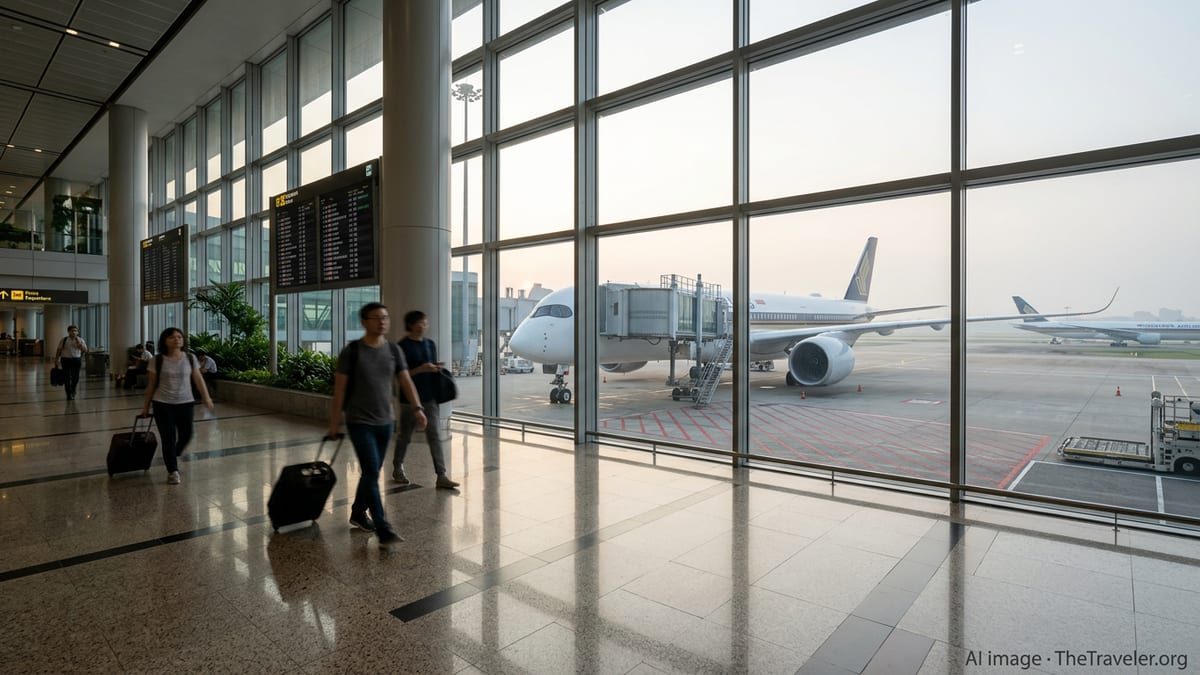
Middle East Tensions Reshape Europe–Asia Flight Paths
Escalating conflict in the Middle East in early 2026 has led to widespread airspace restrictions across Iran, Iraq, Israel, Jordan, and several Gulf states. Publicly available aviation tracking and industry analysis indicate that these closures are forcing many airlines to abandon well-established corridors between Europe and Asia and to adopt longer, more northerly or southerly routings.
Reports on recent operations show that flights which previously transited Iran and neighboring flight information regions are now detouring via the Caucasus, Central Asia, or over Egypt and the Arabian Sea. These changes can add two to five hours to typical itineraries between major European cities and destinations in South and Southeast Asia, driving up fuel burn, crew costs, and scheduling complexity.
Gulf-based carriers, whose business models depend heavily on funneling Europe–Asia traffic through hubs such as Dubai, Doha, and Abu Dhabi, appear to be among the most affected. Published coverage describes waves of cancellations and extended flight times from these hubs, leaving many connecting passengers scrambling for alternatives and raising questions about the resilience of current global routing patterns.
Against this backdrop, airlines that can offer long-range, nonstop services avoiding the most heavily restricted zones are relatively well positioned. Singapore Airlines, which already operates one of the world’s densest networks of ultra-long-haul routes, is emerging as a beneficiary of these shifting dynamics.
Singapore Airlines Steps Up Direct Capacity to London
Singapore Airlines has been steadily building up its presence in the United Kingdom’s capital over the past year. According to the carrier’s published network plans for the 2025 northern summer season, services to London Gatwick are moving from five times weekly to daily, complementing four daily flights to London Heathrow. Together, these schedules give Singapore Airlines up to five daily nonstops between Singapore and London.
The expansion comes at a moment when some European and Gulf airlines are trimming or reshaping Middle East schedules and redeploying long-haul aircraft to more resilient corridors. Industry reports highlight that demand for direct Europe–Asia connectivity remains robust, especially among travelers who wish to avoid transits through conflict-adjacent regions or who have experienced recent disruption at Gulf hubs.
For passengers in Southeast Asia, Australia, and parts of East Asia, the strengthened London offering provides a one-stop option via Singapore that bypasses Middle Eastern airspace altogether. Network data and route-mapping tools show that Singapore–London flights can be routed either over the Indian Ocean and southern Europe or via Central Asia and the Caucasus, depending on daily advisories and restrictions, without relying on currently constrained Gulf flight information regions.
Travel agents and online booking platforms already indicate a noticeable shift in search patterns toward carriers offering such direct or single-stop options through non-Gulf hubs. As airlines adjust pricing to account for longer detours elsewhere, nonstop flights that avoid the most heavily disrupted corridors may become increasingly attractive, even at a fare premium.
Frankfurt Services Offer a Stable Continental Gateway
Frankfurt remains one of Singapore Airlines’ most important continental European gateways, linking Southeast Asia to Germany’s financial center and to an extensive rail and air network that spans the wider region. Public schedules show multiple weekly nonstops between Singapore and Frankfurt, often timed to support onward connections across Europe.
With many carriers in the Middle East and surrounding region still recalibrating operations, Frankfurt’s role as a stable hub gains additional importance. Travelers who previously relied on Gulf connections to reach secondary European cities are now increasingly considering routings via Frankfurt, London, or other non-Gulf hubs, particularly when these can be combined with a single long-haul sector on a carrier perceived as operating away from the most heavily impacted airspace.
Routing data indicates that Singapore–Frankfurt flights can be planned via Central Asia and Eastern Europe, remaining clear of the core Middle East conflict zone while still offering competitive block times relative to indirect options that involve lengthy detours. This makes the Frankfurt link an appealing alternative gateway for both business and leisure travelers bound for Germany, Switzerland, Austria, and neighboring markets.
In addition, Singapore Airlines’ joint ventures and interline agreements with European partners help extend the reach of its Frankfurt service. Publicly available timetables highlight coordinated connections from Frankfurt into major centers such as Munich, Vienna, and Zurich, as well as smaller cities that would otherwise require more complex routings through the Middle East.
Nonstop Strategy Gains Ground as Gulf Hubs Face Disruptions
The latest round of Middle East tensions has accelerated an industry trend that was already underway: a gradual shift from reliance on Gulf megahubs toward more nonstop and point-to-point connectivity between Europe and Asia. Aviation analysts note that long-haul aircraft such as the Airbus A350 and Boeing 787 and 777 families have made it easier for airlines like Singapore Airlines to operate economically viable nonstops over very long distances.
As a result, Europe–Asia traffic that once flowed predominantly through Dubai, Doha, and Abu Dhabi is increasingly spread across alternative hubs in Istanbul, Singapore, Bangkok, and various European capitals. Recent coverage on schedule changes shows that several European and Southeast Asian airlines are adding capacity on direct routes, seeking to capture travelers wary of potential last-minute cancellations or multi-hour diversions through volatile airspace.
Singapore Airlines’ strategy fits squarely within this broader move. By ramping up frequencies to London and maintaining strong services to Frankfurt, the carrier is positioning Singapore as a reliable bridge between Europe and the Asia-Pacific region. Public information suggests that these routes are being actively managed to steer clear of the most restrictive conflict zones while still offering competitive journey times.
For passengers, the practical outcome is a wider range of choices that trade slightly longer great-circle paths for greater operational predictability. While no route is entirely immune to airspace advisories, airlines with multiple viable corridors and proven experience operating ultra-long-haul flights appear better able to adapt quickly as conditions evolve.
What Travelers Can Expect on Upcoming Europe Flights
For travelers planning trips between Europe and Asia in the coming months, the evolving situation means that flight times and routings may remain more variable than usual. Even when booking nonstop services such as Singapore–London or Singapore–Frankfurt, passengers may notice minor changes in flight paths or scheduled block times as airlines respond to updated advisories and air traffic control constraints.
Industry guidance emphasizes the importance of allowing additional buffer time for connections, especially when separate tickets or self-transfers are involved. While direct services from Singapore to London and Frankfurt reduce dependence on Middle East hubs, knock-on effects from wider regional disruptions can still affect aircraft rotations, crew positioning, and departure slots across the global network.
Travel platforms and consumer reports also highlight a growing focus on flexibility. Many airlines are continuing to offer more accommodating rebooking and cancellation policies on affected routes, and passengers are encouraged to monitor their booking details and flight status closely in the days leading up to departure.
For now, Singapore Airlines’ strengthened European schedule provides one of the more stable options for travelers who prefer to minimize exposure to conflict-adjacent hubs. With increased nonstop capacity to London and sustained links to Frankfurt, the airline is likely to remain a key player in connecting Europe and Asia as the industry navigates an unsettled geopolitical landscape.