

More news on this day
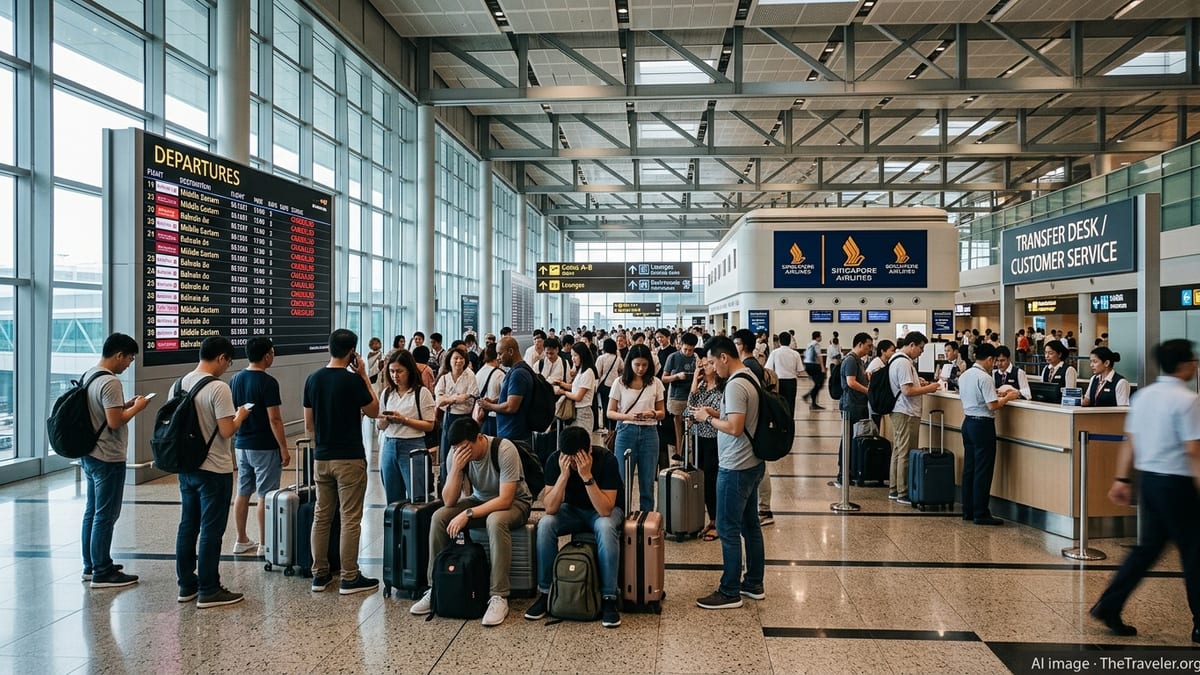
Passengers connecting through Singapore’s Changi Airport faced days of uncertainty after three key Singapore Airlines services on the Bahrain route were cancelled across consecutive days, stranding travelers in both directions and compounding wider disruption on Middle East flights.
Get the latest news straight to your inbox!
Three Bahrain Flights Pulled on Consecutive Days
Publicly available airport departure boards and airline schedule trackers show that Singapore Airlines removed three Bahrain services from its operating schedule over back-to-back days, affecting connections between Manama and Singapore. The cancellations built on a broader pattern of reduced flying across parts of the Gulf region as multiple Asian and European carriers adjusted their networks in early March 2026.
Operational data indicates that the affected flights were part of a Singapore–Bahrain pattern commonly used by business travelers and long-haul passengers transiting through Changi to Europe, Australia and Southeast Asia. With three rotations removed in quick succession, hundreds of passengers either never departed Bahrain or were left in Singapore searching for last-minute alternatives.
Published coverage from regional outlets in Bahrain has referenced a wave of cancellations by several international airlines on services to Gulf hubs, reflecting a cautious response to a mix of security concerns and airspace constraints. In this context, the temporary loss of Singapore Airlines’ Bahrain link has had an outsized impact because of its role feeding traffic into one of Asia’s busiest connecting airports.
While the airline has not issued a detailed public explanation for each Bahrain cancellation, aviation analysts quoted in open reports have pointed to a combination of operational risk assessments, evolving regional conditions and aircraft deployment priorities as likely contributing factors.
Knock-On Disruption at Singapore Changi Airport
Changi Airport, consistently ranked among the world’s leading hubs, felt the effects of the Bahrain cancellations across its terminals. Screens showing “cancelled” against Bahrain-bound departures meant not only disrupted origin-and-destination passengers but also missed onward connections for travelers who had already flown into Singapore from cities across Asia-Pacific.
Reports from passengers who were traveling through Changi describe long queues at transfer counters as travelers sought rerouting options, with some being offered later Singapore Airlines departures via alternative Middle East or European gateways. Others turned to partner or competing carriers to salvage itineraries that included time-sensitive events, cruises or business meetings.
The situation unfolded at a time when Changi is already handling increased traffic amid a busy late-winter and early-spring travel period. Published traffic statistics for the airport show recovering volumes close to, or exceeding, pre-pandemic levels, which can limit spare capacity when multiple long-haul flights are removed from the schedule without much notice.
Travel advisors monitoring the disruption note that cancellations on a single regional route can ripple across a global hub like Changi. Missed Bahrain connections affected not just Singapore–Gulf itineraries but also complex multi-sector journeys linking Oceania and Southeast Asia with Europe via Singapore.
Impact on Passengers and Typical Rebooking Options
For passengers booked on the cancelled Bahrain services, the immediate challenge was securing alternative transport while understanding their rights under airline policies and local regulations. Public explanations and consumer-facing guidance from aviation agencies generally state that when an airline cancels a flight, affected customers are typically entitled to rebooking on the next available service or a refund, although specific rules vary by jurisdiction and ticket type.
Travel forums and independent consumer guides tracking Singapore Airlines disruptions in 2026 outline common patterns. Many passengers are first notified through airline apps or email, with digital tools offering automated rebooking on later services where seats exist. When entire city pairs are affected on consecutive days, however, options on the same carrier can quickly become limited, especially in premium cabins and during school holiday periods.
In these cases, travelers often report being moved to different routings via other Middle East or European hubs, or being advised to accept a full refund and rebook themselves on an alternative airline. Some long-haul passengers connecting through Singapore have indicated that securing hotel accommodation during extended layovers can be difficult when disruption cascades across multiple flights.
Consumer advocates recommend that passengers hit by cancellations on routes such as Bahrain–Singapore keep all documentation, including notifications, boarding passes and receipts for additional expenses. This paperwork can be important later when seeking reimbursements or clarifying eligibility for care, such as meals and accommodation, which can differ depending on whether disruption is categorized as operational, weather-related or linked to external events.
Regional Context: Wider Middle East Flight Disruptions
The Bahrain cancellations are taking place against a wider backdrop of volatility in Middle East aviation. In recent weeks, major carriers from Europe and Asia have announced suspensions or reductions on flights to several Gulf and Levant destinations, citing elevated regional tensions, changing airspace advisories and logistical challenges at some airports.
Publicly available reports highlight that airlines including British and European flag carriers have halted or reduced services to cities such as Dubai, Abu Dhabi, Amman, Doha and Bahrain for parts of March 2026. Singapore Airlines has already curtailed its scheduled flights to Dubai over a similar timeframe, leaving many travelers to replan journeys that previously relied on seamless connections through Gulf hubs.
Aviation analysts note that when multiple airlines simultaneously pull capacity from the same region, passengers can face a scarcity of seats not only on the cancelled routes but also on adjacent sectors. As demand is pushed onto remaining services, prices often rise and economy cabins sell out quickly, leaving stranded travelers with limited affordable alternatives.
The Bahrain route’s role as a spoke feeding into Singapore’s global hub means its temporary interruption adds another stress point to an already constrained regional network. Travelers from Bahrain who would typically connect via Singapore to long-haul destinations may now have to consider rerouting via other hubs such as Doha, Istanbul or European gateways, subject to availability and evolving advisory notices.
What Travelers Should Watch for in the Coming Days
With three key Bahrain flights already cancelled and uncertainty over the near-term schedule, passengers are being advised by travel agents and independent experts to monitor airline channels and airport information closely. Flight-status tools, mobile apps and updated timetables generally provide the earliest public indication of whether additional cancellations or reinstatements are planned.
Those planning to travel between Singapore and Bahrain over the next several weeks are encouraged to build additional buffer time into itineraries, particularly if they are connecting onward to cruises, tours or separate tickets on other airlines. Travel insurance policies that include disruption and missed connection coverage may offer some financial protection, but benefits differ widely between providers.
Observers of the region’s aviation sector point out that airlines will continue to recalibrate schedules as conditions evolve. If regional tensions ease and operational confidence improves, carriers may progressively restore capacity to affected cities, although that process can lag behind demand while aircraft and crews are reassigned.
Until greater clarity emerges, Singapore–Bahrain passengers transiting through Changi remain in a holding pattern. The recent string of cancellations serves as a reminder that even in an era of sophisticated planning tools, air travel in geopolitically sensitive regions can still be vulnerable to sudden changes that leave travelers stranded far from home.