

More news on this day
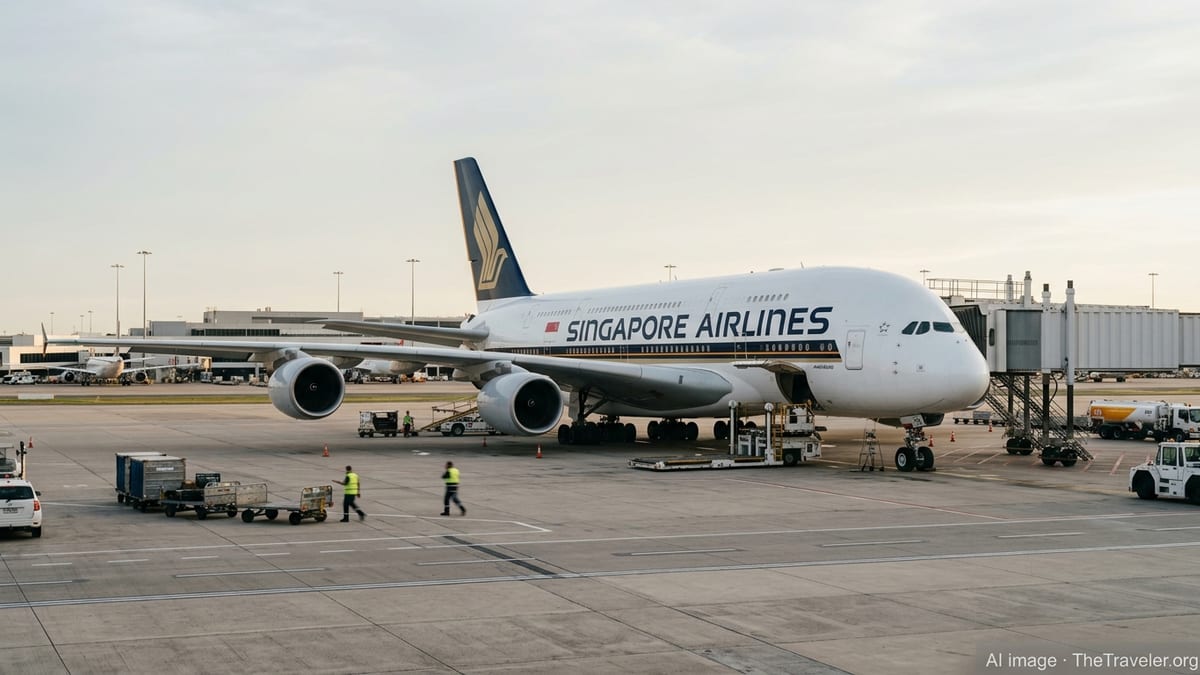
Singapore Airlines is returning the Airbus A380 to its Singapore–Melbourne route for the Northern Summer 2026 season, a move that industry observers view as a strategic response to shifting travel patterns and disruptions affecting key Middle East corridors.
Get the latest news straight to your inbox!
A380 Returns to a Core Australian Gateway
Publicly available schedule data and specialist aviation coverage indicate that Singapore Airlines will reintroduce the double deck Airbus A380 on select Singapore–Melbourne rotations from late March 2026, coinciding with the start of the Northern Summer timetable. The aircraft, which had previously been withdrawn in favor of Airbus A350-900 services, will provide a notable increase in daily seat capacity on one of the carrier’s most important Australia routes.
The reinstatement follows a period in which Melbourne was largely served by A350-900 long haul and medium haul variants, as the airline rebuilt its Australian network and incrementally restored pre-pandemic frequencies. Earlier corporate updates highlighted a broader push to return Australian services, including Melbourne, to or beyond 2019 capacity levels, using a mix of widebody types to match demand.
For passengers, the return of the A380 means the reappearance of Singapore Airlines’ flagship premium cabins on at least one of the daily Melbourne flights, including the well-known upper deck business class product and a larger premium economy and economy footprint. Booking displays shared across frequent flyer communities in recent days show a reclassification of certain Melbourne services from A350 to A380 equipment for travel between late March and late October 2026.
While the carrier has not foregrounded Melbourne alone in its recent official network statements, the adjustment aligns with a pattern of deploying the A380 selectively on routes that blend strong business travel demand, premium leisure traffic, and tight slot or runway constraints at key airports.
Middle East Disruptions Reshape Long-Haul Traffic
The timing of the A380’s return to Melbourne coincides with continuing disruptions and volatility affecting several Middle East hubs, where a mix of operational constraints, regional tensions, and airspace restrictions has complicated long-haul planning. International news reports over recent weeks describe schedule adjustments, temporary suspensions, and rerouted services by a range of global carriers operating via Gulf and nearby airports.
Although Singapore Airlines has maintained its own presence in the region and is due to upgauge Dubai to A380 service for the Northern Summer 2026 period according to published investor and network materials, the wider turbulence has altered traveler preferences. Many Australia–Europe and Australia–Asia passengers are again weighing alternative connection points, with Southeast Asian hubs such as Singapore positioned as attractive options when itineraries via the Middle East become less predictable.
Demand data summarized in airline industry commentary suggests that one-stop itineraries via Singapore, rather than Gulf hubs, have gained share on certain flows, including premium leisure traffic from Australia to Europe. By reinforcing capacity into Melbourne with its largest aircraft, Singapore Airlines appears to be securing a greater portion of this traffic, particularly among travelers who value the stability of a large, established hub and the continuity of a single-carrier experience across both legs.
The move also provides flexibility should Middle East capacity remain constrained or uneven across the 2026 summer period. With the A380 on Melbourne and Dubai routes, Singapore Airlines can channel more connecting passengers through Changi Airport while preserving schedule resilience if onward routings through the Gulf are affected by further disruptions.
Capacity Realignment Across the A380 Network
The redeployment of the A380 to Melbourne fits within a broader reshuffle of the type across the airline’s network. Public filings and fleet summaries show that Singapore Airlines currently operates a dozen A380-800s, with the type concentrated on a handful of high-volume destinations such as London and Sydney. Over the past two years, the carrier has alternated between upgauging and downgauging routes like Frankfurt, Auckland, and North Asian cities as demand patterns evolved.
Recent community analyses of schedule feeds and fare class availability suggest that some traditional A380 routes in Europe have seen frequencies adjusted or aircraft swapped to A350-900 long haul, freeing widebody capacity for redeployment to markets where demand and yields are stronger. Melbourne’s reinstatement into the A380 rotation appears to benefit directly from this recalibration, as capacity is shifted from certain European trunk routes to deep South Pacific markets.
Industry observers note that the airline has repeatedly used the A380 as a flexible tool rather than a permanently fixed assignment to a small set of cities. In some cases, reduced A380 flying on one route has been partially offset by additional frequencies with smaller aircraft, maintaining or even growing overall capacity while releasing the double deck jets for other opportunities. Melbourne now joins the list of beneficiaries of this dynamic approach.
From an operational viewpoint, concentrating more A380 flying within the Asia–Pacific region during a period of Middle East uncertainty may also simplify network planning and maintenance rotations. Shorter sector lengths compared with ultra-long haul Europe services can improve aircraft utilization while keeping the fleet closer to its Singapore base.
Implications for Melbourne, Changi, and Competing Hubs
For Melbourne Airport, the return of regular A380 service by Singapore Airlines reinforces the city’s role as a key long-haul gateway and underlines the importance of Southeast Asian connections for Victoria’s inbound and outbound tourism markets. The increased seat capacity is expected to support both leisure travel and business links with Southeast Asia, Europe, and North Asia, as well as feed regional connections operated by partners and other carriers.
At Singapore Changi Airport, the A380’s redeployment strengthens the position of the hub in a competitive landscape where Gulf and other Asian airports vie for sixth freedom traffic. Travel trade commentary suggests that agencies and corporate travel managers are watching route stability closely, with some preferring routings that avoid airspace or airports affected by the latest Middle East-related uncertainties. More A380 capacity on Melbourne–Singapore services gives Changi a larger pool of passengers to feed into European and Asian banks of departures.
Competing hubs in the Gulf are meanwhile contending with route adjustments, altered flight times, or capacity shifts related to regional developments. While the major Middle Eastern carriers continue to operate extensive Australia–Europe networks, any prolonged disruptions or reroutings can erode some of their schedule advantages. Singapore Airlines’ decision to bolster Melbourne with its largest aircraft positions it to capture travelers who might otherwise have transited via Middle East hubs.
Analysts also point to the symbolic value of the A380. Its presence in Melbourne signals a vote of confidence in the market’s medium-term strength and in the city’s role within the airline’s global network, even as individual flight numbers and equipment on other routes are fine-tuned in response to changing conditions.
What Passengers Can Expect on the Renewed Service
For travelers, the most immediate impact of the A380’s return will be felt onboard. The aircraft offers Singapore Airlines’ latest-generation suites and business class seats on selected configurations, along with a dedicated premium economy cabin and a high-density yet relatively spacious economy section. Passenger reports from other A380 routes highlight the quietness of the upper deck, generous storage, and the appeal of the wide main deck cabin on long overnight sectors.
The larger aircraft typically brings higher availability of premium seats compared with smaller widebodies, which may provide more choice for business and frequent travelers booking closer to departure. At the same time, the overall increase in capacity could help moderate fares at the margins on certain travel dates, particularly during shoulder periods between peak Australian school holidays and major events in Europe and Asia.
Airport-side, the return of the A380 may influence gate assignments, boarding procedures, and ground handling patterns at Melbourne, with peak departure periods adjusted to accommodate the higher passenger volumes of a double deck aircraft. Changi is already well adapted to handling large A380 movements, and the Melbourne change is expected to integrate into existing terminal and lounge operations there with minimal disruption.
As global airlines continue to navigate the ripple effects of Middle East travel disruptions, Singapore Airlines’ decision to put its largest passenger aircraft back on the Melbourne route underscores how capacity, network strategy, and traveler sentiment are increasingly intertwined. The coming months of Northern Summer 2026 will test whether the A380’s renewed presence can capture shifting demand while reinforcing Singapore’s role as a stable, high-capacity transit hub for Australia and beyond.