

More news on this day
Singapore Airlines is emerging as a central force in Asia’s race to decarbonise aviation, catalysing new alliances on sustainable aviation fuel, cross-border policy efforts and fleet upgrades to help the region’s airlines meet the global goal of net-zero emissions by 2050.
Regional Flag Carriers Align Around a Net-Zero Goal
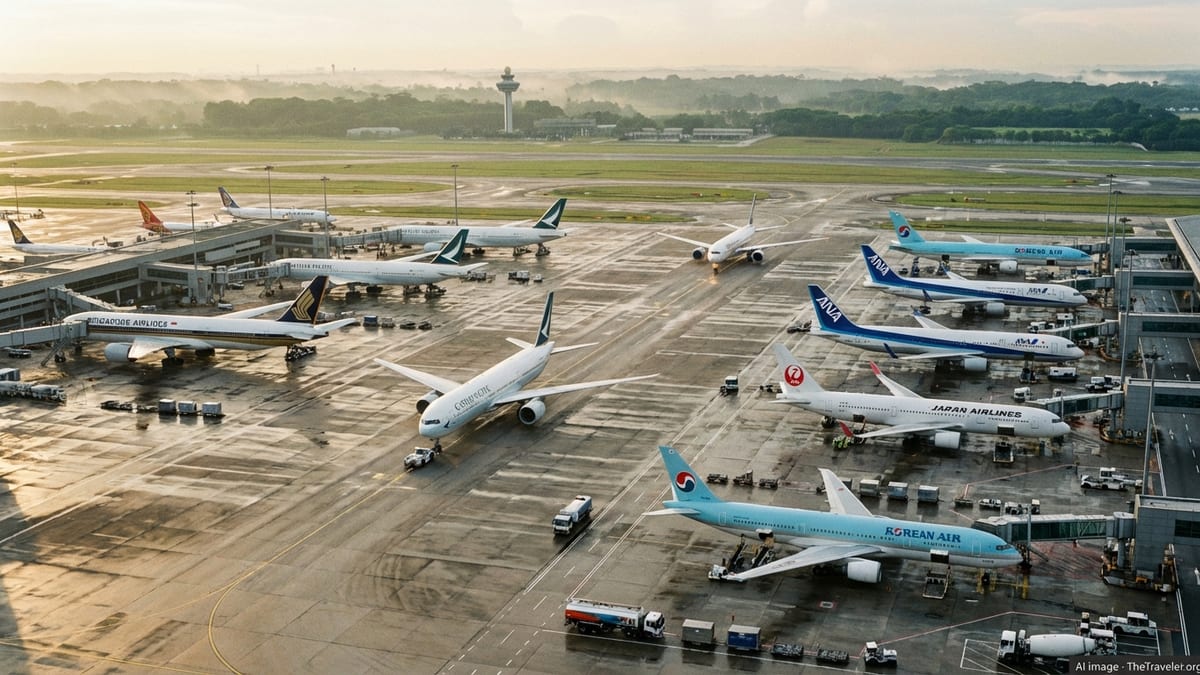
Across Asia, leading airlines including Singapore Airlines, Cathay Pacific, All Nippon Airways, Japan Airlines and Korean Air are accelerating climate initiatives as global pressure mounts to cut aviation emissions. While each carrier has its own roadmap, they are converging on a shared target of net-zero emissions by 2050, with sustainable aviation fuel, or SAF, at the core of their strategies.
Singapore Airlines and its low-cost arm Scoot have set one of the region’s most detailed decarbonisation plans, combining higher SAF use, new-generation aircraft and operational efficiencies. The group has committed to net-zero emissions by mid-century and an interim goal that at least 5 percent of its total fuel uplift will be SAF by 2030, positioning Changi Airport as a key test bed for low-carbon aviation solutions.
Other Asian carriers are moving in parallel. Cathay Pacific, which also targets net-zero by 2050, has been scaling corporate SAF programmes from its Hong Kong hub, while Japan’s ANA and JAL are integrating SAF into scheduled flights from major airports such as Haneda and Narita. Korean Air is pairing fleet renewal with data-driven fuel management to cut emissions, reporting hundreds of thousands of tonnes of carbon savings from efficiency initiatives in 2025 alone.
Industry analysts say the region’s heavyweight carriers are increasingly coordinating through working groups, joint ventures and multi-stakeholder platforms, helping to align technical standards and commercial models for low-carbon fuels across borders. That collaboration is gradually shifting the conversation from small pilot projects to long-term market development.
Singapore’s SAF Ecosystem Sets a Regional Benchmark
Singapore has moved quickly to establish itself as a sustainable aviation fuel hub for Asia, underpinned by a combination of policy signals, refinery capacity and airline demand. The city-state hosts one of the world’s largest SAF production facilities, while its regulators are phasing in policies designed to secure a reliable supply of low-carbon fuel for airlines operating at Changi.
Singapore Airlines has been an early customer of this emerging ecosystem. Recent agreements with major producers have secured neat SAF volumes that are blended and delivered at Changi, alongside purchases of SAF certificates using book-and-claim systems. Together, these transactions are projected to cut thousands of tonnes of carbon dioxide, and they give the group vital operational experience with different sourcing and certification models.
The government is reinforcing this trajectory with economic signals. From 2026, a dedicated green levy on departing passengers will help cover the cost premium of SAF over conventional jet fuel and support an initial blending mandate. The Civil Aviation Authority has framed the levy as a pragmatic step toward building long-term demand for lower-carbon fuels, while keeping the surcharge relatively modest for most economy-class travellers.
Singapore-based initiatives are also feeding into regional coalitions. The launch of the Asia Sustainable Aviation Fuel Association in 2024, headquartered in Singapore, sought to harmonise policies and mobilise investment across key markets including Southeast Asia, Japan and South Korea. With Korean Air among its pioneer airline members, the association has become a focal point for airlines, fuel suppliers and financiers working to scale up SAF production at commercial level.
Asian Carriers Double Down on Sustainable Aviation Fuel
While SAF currently accounts for a small fraction of global jet fuel consumption, Asian airlines are beginning to commit to multi-year volumes that can underpin new production plants. Cathay Pacific reported another record year in 2025 for its Corporate SAF Programme, with commitments more than doubling compared with 2024 as multinational customers sought to cut the footprint of business travel and air freight.
Japan Airlines has been expanding scheduled services powered in part by SAF from Tokyo’s Haneda Airport and other hubs, paired with investments in domestic supply chains. One flagship project in Japan is focused on converting local forest resources into woody biomass bioethanol, which can be upgraded into aviation fuel, illustrating how airlines are looking beyond imports to homegrown solutions.
All Nippon Airways has pursued similar pathways, working with Japanese energy companies and industrial partners to secure SAF from a mix of domestic and overseas producers. Both JAL and ANA see SAF as crucial not only for meeting climate targets but also for preserving Japan’s extensive long-haul network as global regulators tighten carbon constraints on international routes.
In South Korea, Korean Air has been active on two fronts: renewing its fleet with more efficient aircraft and preparing to integrate greater volumes of alternative fuels as they become available. The carrier’s use of new-generation widebodies and single-aisle jets now accounts for a substantial share of its operations, providing an immediate reduction in fuel burn per seat while the SAF market matures.
From Pilot Projects to Scalable Supply Across Asia
Underlying these airline-led efforts is a broader shift in Asia’s energy and agricultural sectors. Research commissioned by regional institutions has highlighted Southeast Asia’s potential to become a global hub for SAF, drawing on agricultural residues and other waste as feedstock. Such projects envisage new value chains that span smallholder farmers, processing firms and advanced refineries.
The technical appeal of SAF lies in its compatibility with today’s aircraft and airport fuel systems. Approved blends can be used as drop-in fuel without engine modifications, enabling airlines to cut life-cycle emissions by up to around 80 percent, depending on the feedstock and production pathway. That compatibility reduces operational risk and allows carriers to scale usage as supply and policy support expand.
However, the challenge remains cost and availability. Current SAF prices are typically several times higher than conventional jet fuel, which is why airlines and governments are experimenting with mechanisms such as levies, corporate partnerships and green premium programmes. By locking in demand through long-term offtake agreements and involving corporate travellers, carriers hope to give investors the confidence needed to finance new plants.
Analysts expect that as early production ramps up in Singapore, Japan, South Korea and parts of Southeast Asia, economies of scale and technology learning should bring costs down. In turn, that could allow regulators to tighten blending requirements and move from voluntary schemes toward more structured mandates aligned with 2030 and 2050 climate milestones.
Implications for Travelers and the Future of Asian Aviation
For passengers, the transition to low-carbon aviation in Asia will be gradual but increasingly visible. Ticket prices are likely to incorporate transparent green surcharges in key hubs like Singapore, while some airlines already offer options for travellers and corporate clients to pay extra to support SAF use on specific flights.
Cabin experience itself is unlikely to change dramatically, as SAF blends do not alter aircraft performance or safety standards. Instead, the main differences will sit behind the scenes, in how airlines plan routes, refresh fleets and source fuel. Travellers may notice more communications about emissions on booking platforms and boarding passes, alongside voluntary schemes for offsetting or contributing to SAF purchases.
Industry observers say that the coordinated push by Singapore Airlines, Cathay Pacific, ANA, JAL, Korean Air and other regional players could accelerate the tipping point at which SAF shifts from niche to mainstream in Asia. If successful, their collective efforts could define how a fast-growing aviation market balances connectivity with climate responsibility.
With Asia expected to drive a large share of global air traffic growth over the next two decades, the stakes are high. The choices these carriers make on fuel, technology and policy engagement in the coming years will help determine whether the industry can keep expanding while staying within a rapidly tightening global carbon budget.