

More news on this day
Singapore Airlines is reshaping parts of its global network as the Iran war continues to disrupt Middle East airspace, with route changes and schedule adjustments now affecting services to the United Arab Emirates, Qatar, London and Frankfurt. Publicly available data and industry reports indicate that the carrier is avoiding affected skies, rerouting long-haul flights and temporarily limiting some Gulf operations as governments restrict access to air corridors across Iran and neighboring states.
Get the latest news straight to your inbox!
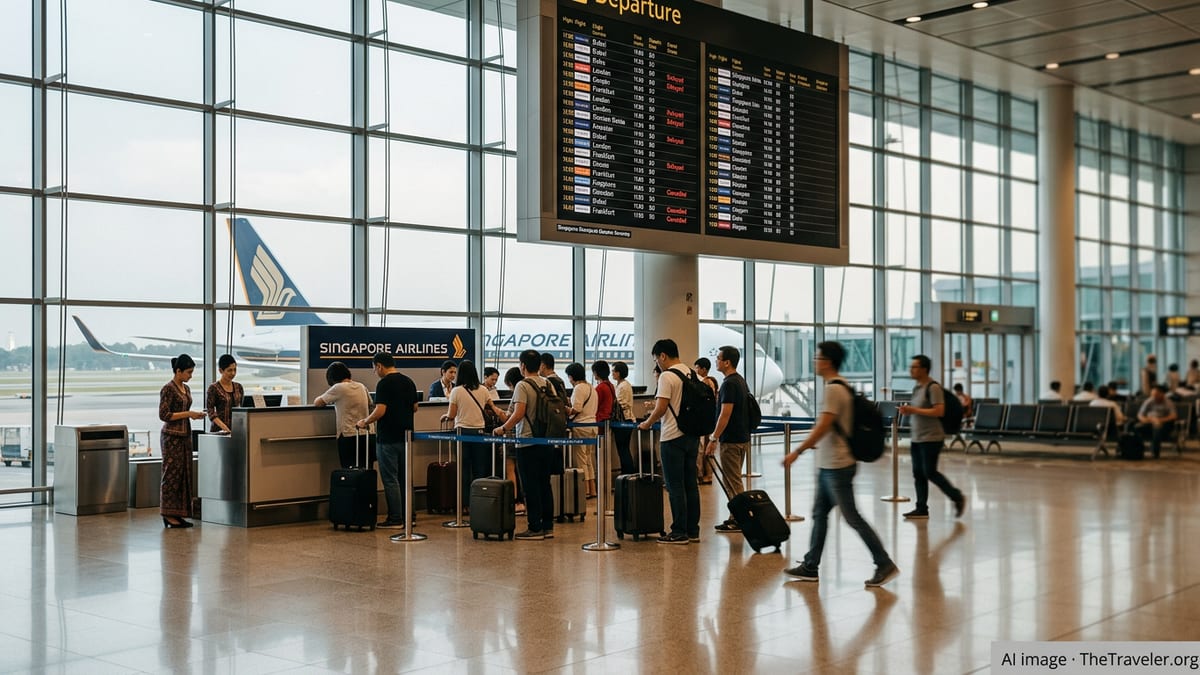
Why Middle East Airspace Has Become a Global Bottleneck
The outbreak of full-scale conflict involving Iran in early 2026 has triggered a cascade of airspace closures and restrictions across parts of the Middle East. Aviation authorities in several countries have limited or shut key flight information regions, including large portions of airspace over Iran, Iraq and the Gulf, creating a chokepoint for traffic between Asia, the Gulf and Europe. Published overflight data and tracking services show commercial carriers shifting away from traditional high-altitude corridors that once offered some of the most direct paths between Southeast Asia and European hubs.
For airlines such as Singapore Airlines, which rely on efficient long-haul routing to remain competitive, the closure or partial closure of these air routes has immediate operational consequences. Flights that previously crossed Iranian or nearby airspace now require longer, more northerly or southerly detours, adding time, fuel burn and operational complexity. These changes reverberate through schedules, fleet deployment and crew planning, prompting network adjustments that are being felt by travelers far beyond the Middle East.
Industry coverage of the conflict highlights that the disruption is not limited to point-to-point Middle East services. The region sits beneath many of the great-circle tracks that link Asia and Europe, so any prolonged conflict in or around Iran can force wholesale replanning of how carriers connect major hubs such as Singapore, London and Frankfurt.
Impact on Singapore Airlines Flights to the UAE and Qatar
Singapore Airlines’ links to Gulf gateways, particularly in the United Arab Emirates and Qatar, have been among the most exposed to the conflict. Publicly available flight schedules and airport departure boards in recent weeks show repeated cancellations and reductions on Singapore services to Dubai and Abu Dhabi, with some days seeing no operation on routes that previously supported regular daily flights. Similar pressure is evident on itineraries that would normally see passengers connect via Doha using codeshare or alliance partners.
Reports from travelers and aviation watchers indicate that some passengers ticketed on Singapore Airlines for Gulf destinations have been rebooked through alternative routings that avoid the most heavily impacted airspace. In some cases, this involves connecting through South or Southeast Asian hubs and then continuing to the Gulf on partner airlines that are operating limited services around the conflict zone. On other itineraries, customers are being offered rerouting via European or South Asian cities where airspace remains open, albeit with significantly longer total journey times.
Operational adjustments of this kind are typical during major regional conflicts, but the current situation has particular significance because both the UAE and Qatar serve as major transit points for Asia–Europe and Asia–Africa traffic. Reduced Singapore Airlines capacity into these markets not only affects point-to-point travelers between Singapore and the Gulf but also those using Dubai, Abu Dhabi or Doha as onward connection points to Africa, Europe and North America.
Longer Journeys on Singapore–London and Singapore–Frankfurt Routes
While flights between Singapore and key European hubs such as London Heathrow and Frankfurt continue to operate, their routings have changed noticeably as the conflict has evolved. Flight-tracking data shows Singapore–Europe services taking more northerly paths that arc across Central Asia, the Caucasus or Eastern Europe rather than the more direct tracks over Iran and the northern Gulf that were commonly used before the latest hostilities. These diversions translate into longer flight times, sometimes by up to an hour or more depending on winds and traffic flows.
For passengers, the immediate impact is often felt as altered departure and arrival times, tighter or re-timed connections in London or Frankfurt, and more fatigue on already long-haul flights. According to published analyses of global schedules, carriers are padding block times to reflect the longer routes, which can result in early gate closures, shifted connection windows and adjusted minimum connection times on multi-segment itineraries.
The operational strain is also visible in how aircraft are rotated across the network. When a London or Frankfurt rotation takes longer due to detours, the aircraft and crew may arrive back in Singapore later than scheduled, reducing the margin for on-time departures on subsequent flights. To maintain reliability, airlines can respond by building in additional ground time, swapping aircraft types or, in some cases, trimming frequencies. Network data suggests that Singapore Airlines is focusing on preserving core daily links to its biggest European hubs while using schedule tweaks rather than widespread cancellations to manage the additional flight time.
What Travelers Should Expect in the Weeks Ahead
For travelers booked on Singapore Airlines services touching the Middle East, London or Frankfurt in the near term, the dominant theme is likely to be unpredictability around schedules rather than outright loss of connectivity. Public timetable updates and booking engines show most Europe-bound flights still on sale, but with revised timings and, in some cases, longer advertised durations. Journeys involving the UAE or Qatar may face more significant disruption, with some dates showing limited or no availability on certain direct Singapore-operated services.
Passengers should be prepared for last-minute aircraft swaps, minor departure delays and revised routing that may cause longer periods in the air than originally expected. Travel industry advisories recommend allowing generous buffer times for onward connections, particularly when itineraries involve multiple carriers or separate tickets. It is also prudent for travelers to monitor their bookings closely in the days before departure using airline apps or reservation tools, as day-of-operation changes are more common in volatile airspace conditions.
Fare patterns are also evolving as capacity shifts. With some Gulf services reduced and detours making operations more expensive, price pressure is emerging on popular travel dates between Singapore, the Gulf and Europe. Travelers with flexible plans may find better value by considering shoulder-season dates or by routing through alternative hubs in East or South Asia that are less affected by current airspace restrictions.
Practical Tips for Planning Future Trips via Singapore
Looking beyond immediate disruptions, the conflict has underlined how quickly geopolitics can reshape global flight networks. For travelers who routinely use Singapore as a hub to reach the Gulf or Europe, it may be wise to plan with built-in resilience. That can include selecting itineraries with longer connection times, favoring single-ticket journeys on one airline group, and being willing to accept routings that add an hour or two in exchange for a higher likelihood of operating as planned.
Travel experts note that published coverage of earlier regional crises shows airlines often maintain a core skeleton of long-haul routes, even when they must detour around conflict zones. Singapore Airlines’ continued operation of its Singapore–London and Singapore–Frankfurt services, despite longer routings, suggests a similar strategy: preserve strategic trunk routes while trimming or rerouting flights that are most exposed to operational risk.
Ultimately, how long today’s route changes remain in place will depend on the evolution of the conflict and the pace at which aviation regulators reopen closed airspace. Until then, passengers booking Singapore Airlines flights that touch the Middle East or Europe should assume that schedules are subject to change, keep contact details updated in their reservations and review travel insurance coverage that addresses delays or rerouting related to geopolitical events.