

More news on this day
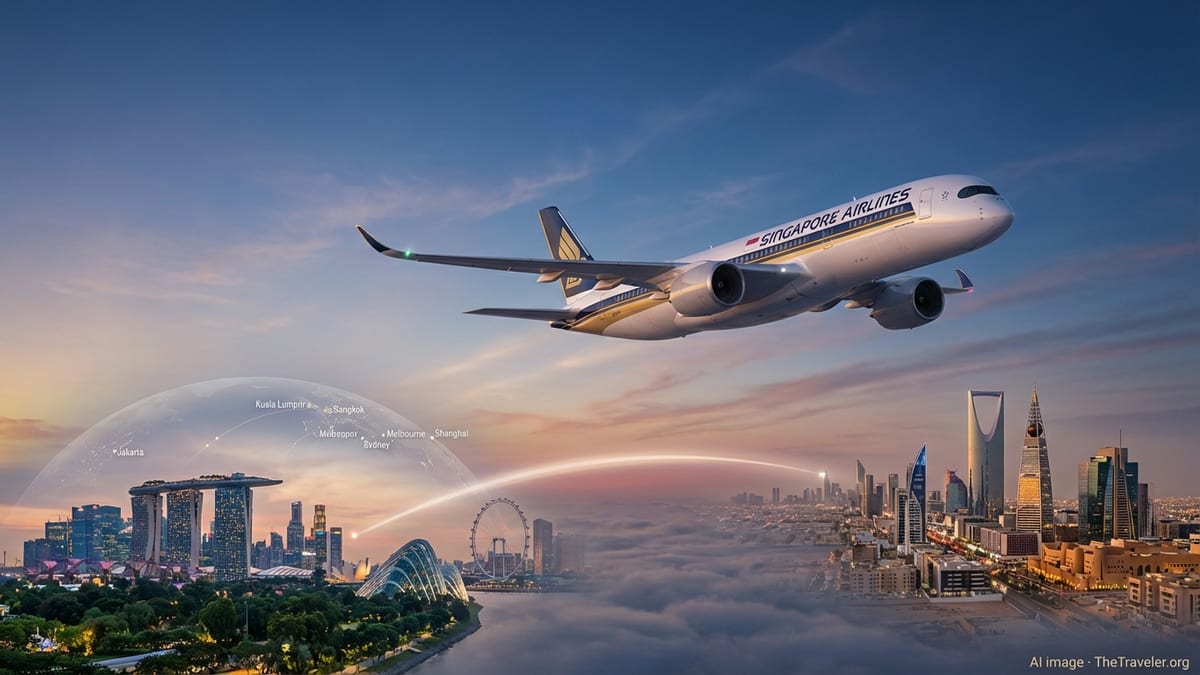
Singapore Airlines will restore non stop flights between Singapore and Riyadh from June 2026, reactivating a key air corridor between Southeast Asia and the Gulf after more than a decade and sharpening competition on one of the region’s most closely watched emerging routes.
More News
- TSA Rolls Out $45 ConfirmID Fee for Travelers Without REAL ID at Security
- Flying Blue Launches February 25% Promo Rewards on Transatlantic and Regional Routes
- United Fast-Tracks Starlink Wi‑Fi Across Fleet, Free for MileagePlus Members
Route details and launch timeline
The carrier has confirmed that it will operate four weekly non stop services between Singapore Changi Airport and Riyadh’s King Khalid International Airport, with flights scheduled to begin in early June 2026. Industry releases indicate a planned launch on 2 June, subject to regulatory approvals in both Singapore and Saudi Arabia.
The new service will operate on Tuesdays, Thursdays, Saturdays and Sundays. Outbound flights are scheduled to leave Singapore in the early evening and arrive in Riyadh later the same night, while return services will depart the Saudi capital late in the evening and reach Singapore the following day around midday. The timings are designed to maximise connectivity to Singapore Airlines’ wider network across Asia Pacific.
Singapore Airlines will deploy the medium haul variant of its Airbus A350 900 aircraft on the route. The twin engine widebody will be configured with 303 seats in a two class layout, featuring 40 seats in business class and 263 in economy. The aircraft’s range and fuel efficiency make it well suited to the roughly eight and a half hour sector between the two cities.
According to schedules disclosed by industry publications, the summer timetable from June to late October 2026 will see flight SQ498 depart Singapore at 18:20 and arrive in Riyadh at 21:45, with the return SQ499 leaving Riyadh at 23:00 and landing in Singapore at 12:15 the following day. A slightly adjusted winter schedule from late October to March 2027 is expected to bring minor changes in departure times while maintaining the four times weekly pattern.
Return to Riyadh after a 12 year gap
The move marks Singapore Airlines’ return to the Saudi capital after an absence of more than a decade. The airline last served Riyadh in 2014, having previously operated a Singapore Riyadh Jeddah routing that struggled to deliver sustained commercial returns in a softer demand environment.
Since that withdrawal, air travel patterns between Southeast Asia and the Gulf have shifted significantly. The growth of Saudi Arabia’s economy, the acceleration of large scale development projects in and around Riyadh, and a wave of reforms aimed at opening the kingdom to international visitors have all lifted premium and leisure demand. At the same time, Singapore has consolidated its role as a regional financial and aviation hub, creating a deeper base of two way corporate, government and tourism traffic.
Singapore Airlines executives have framed the Riyadh relaunch as a response to these structural changes. In recent comments carried by aviation trade outlets, the airline’s commercial leadership described Riyadh as one of the Middle East’s most dynamic cities, pointing to its ambitious development agenda and increasingly diversified business landscape as compelling factors behind the decision to return.
The restoration of non stop links also reflects a broader recalibration of the carrier’s Middle East strategy. Rather than operating multi stop routings as in the past, Singapore Airlines is now leveraging newer generation aircraft to support point to point connectivity into key regional hubs, complementing the wider group network and cooperating airlines.
Strategic significance for Singapore and Saudi Arabia
For Singapore, the new service strengthens Changi Airport’s position as a connecting hub for traffic flows between Southeast Asia, Australia, North Asia and the Middle East. The evening departure and midday arrival pattern from Riyadh is expected to feed into onward services across the Singapore Airlines network, including markets such as Jakarta, Kuala Lumpur, Bangkok, Sydney, Melbourne, Tokyo and Shanghai.
For Saudi Arabia, direct connectivity to Singapore aligns with the kingdom’s Vision 2030 goals of diversifying the economy, boosting foreign investment and expanding the tourism sector. Riyadh is investing heavily in infrastructure, hospitality and events, with the aim of positioning itself as a global business, technology and lifestyle centre. Enhanced links to Asian financial and innovation hubs such as Singapore are seen as critical to that ambition.
Trade and investment flows between the two countries have been gradually deepening, particularly in sectors such as energy transition, logistics, technology and financial services. Non stop flights are likely to support further growth in corporate travel, as executives and project teams seek faster, more predictable itineraries that avoid en route connections in third country hubs.
The route may also play a role in facilitating religious and cultural travel. While Jeddah and Medina remain the primary gateways for pilgrim traffic, improved access to Riyadh could support dispersed itineraries that combine business, tourism and spiritual journeys, especially for travellers originating in Southeast Asia and Australasia.
Network expansion and partnerships in the Middle East
The Singapore Riyadh link will become the Singapore Airlines Group’s second destination in Saudi Arabia. Low cost subsidiary Scoot currently operates four weekly flights to Jeddah, providing lower fare options and capturing a different segment of the market. Together, the two routes expand the group’s footprint in the kingdom and diversify its access to key population and economic centres.
Singapore Airlines has also been deepening partnerships with regional carriers. In mid 2024, the airline signed a cooperation agreement with Saudi startup Riyadh Air, covering potential areas such as interline connectivity, codeshare arrangements, cargo collaboration and loyalty programme ties. Non stop services into Riyadh provide a platform on which those partnerships can be built, creating additional one stop options from Southeast Asia into secondary Saudi and wider Middle East destinations.
The direct Riyadh flights arrive at a time when Gulf carriers continue to operate extensive one stop services from Southeast Asia via their respective hubs. By offering a non stop alternative into the Saudi capital, Singapore Airlines is seeking to capture travellers who value shorter journey times and the ability to connect through Changi rather than via the Gulf.
From a competitive standpoint, the move underscores the increasing interplay between Asia based network carriers and Middle Eastern airlines, as both sides adjust their schedules and partnerships to secure a share of growing traffic flows between Asia, the Gulf and Europe.
Onboard product and passenger experience
The choice of the Airbus A350 900 medium haul variant underlines Singapore Airlines’ focus on product consistency and fuel efficiency. The aircraft is already deployed on several regional and medium long haul routes, and is equipped with cabins designed to deliver many of the carrier’s long haul comforts on slightly shorter sectors.
In business class, passengers can expect a 1 2 1 seating arrangement with direct aisle access, lie flat beds and in flight entertainment screens, alongside the airline’s premium dining and beverage offering. The 40 seat cabin is aimed squarely at corporate and government travellers, many of whom are likely to be commuting between project sites, headquarters and regional offices in both Singapore and Riyadh.
Economy class will offer 263 seats in a 3 3 3 configuration, with adjustable headrests, in seat power and on demand entertainment. The relatively low density layout for a widebody of this size is expected to appeal to leisure passengers as well as price conscious business travellers seeking a full service experience.
The evening departure times out of Singapore and late night returns from Riyadh are intended to make productive use of the working day and enable sleep on board. The schedule also allows convenient same day connections into and out of other Asian cities, reducing total travel time for connecting passengers who might otherwise have routed via a Gulf hub.
Economic and tourism implications
Tourism officials and industry analysts expect the Singapore Riyadh service to deliver a measurable boost to visitor numbers in both directions once it is fully established. Riyadh’s ongoing transformation, including the development of large scale entertainment, cultural and sporting venues, is already drawing increased international attention. Direct flights from Singapore will make it easier for travellers from Southeast Asia, Australia and New Zealand to include the Saudi capital in their itineraries.
Conversely, Singapore stands to gain from rising outbound travel from Saudi Arabia and the wider Gulf. The city state remains a popular destination for family holidays, medical tourism, education and shopping, and serves as a springboard to beaches and resort destinations in Indonesia, Malaysia and Thailand.
Business travel is likely to be an especially important driver in the early stages of the route. Ongoing collaboration in areas such as port and logistics development, smart city solutions, fintech, clean energy and infrastructure finance is already generating frequent trips between the two countries. A faster, non stop link could encourage companies to base more regional roles in Singapore or Riyadh, knowing that executives can travel between the cities with relative ease.
In the longer term, additional cargo capacity on the A350 900 services may support trade in high value and time sensitive goods, including electronics, pharmaceuticals and perishables. While freight yields on passenger flights are typically a secondary consideration, they can contribute to overall route viability and help justify future increases in frequency if demand warrants.
Market outlook and potential for growth
Industry observers view the relaunch as a measured yet confident step into a market that has evolved substantially since Singapore Airlines last served Riyadh. By starting with four weekly flights rather than a daily schedule, the airline preserves flexibility to adjust capacity while still offering a consistent product to travellers.
If load factors and yields prove robust, there is scope for additional frequencies or seasonal adjustments in subsequent years. The use of a flexible, multi role aircraft such as the A350 900 gives the airline options to tweak deployment across its network as demand shifts between regions.
The timing of the launch, coinciding with the middle of the decade, positions Singapore Airlines to capitalise on infrastructure and tourism milestones in both countries. Changi Airport continues to expand its facilities and passenger handling capabilities, while Riyadh is moving ahead with airport upgrades and city level projects intended to accommodate larger numbers of visitors.
At the same time, the emergence of Riyadh Air and the ongoing growth of established Gulf carriers ensure that competitive pressures will remain intense. Singapore Airlines’ focus on its premium brand, reliability and the attractiveness of Singapore as a transfer hub will be central to sustaining the route beyond its introductory phase.
FAQ
Q1. When will Singapore Airlines start non stop flights between Singapore and Riyadh?
The airline plans to begin non stop services in early June 2026, with industry schedules indicating a target launch date of 2 June, subject to regulatory approvals.
Q2. How often will the Singapore Riyadh flights operate?
Singapore Airlines will operate the route four times per week, with services on Tuesdays, Thursdays, Saturdays and Sundays.
Q3. Which aircraft will Singapore Airlines use on the Singapore Riyadh route?
The carrier will deploy the medium haul variant of the Airbus A350 900, a twin engine widebody configured for 303 passengers across business and economy cabins.
Q4. What is the seating configuration on the new flights?
The A350 900 serving this route will offer 40 seats in business class and 263 seats in economy class, reflecting a focus on both premium corporate travel and broader leisure demand.
Q5. What are the planned flight numbers and timings?
The service is expected to operate as SQ498 from Singapore to Riyadh and SQ499 on the return. Indicative schedules show evening departures from Singapore and late night departures from Riyadh, with flight times of around eight to nine hours depending on the season.
Q6. Why is Singapore Airlines returning to Riyadh after previously withdrawing?
The airline last served Riyadh in 2014 but suspended the route amid weaker demand. It is now returning in response to stronger business, tourism and cultural ties between Southeast Asia and Saudi Arabia, and the rapid development of Riyadh as a regional hub.
Q7. How does this route fit into Singapore Airlines’ broader Middle East strategy?
The new non stop service complements existing group operations to Jeddah via Scoot and aligns with partnership initiatives in the region, including cooperation with Riyadh based carriers to expand connectivity beyond Saudi Arabia.
Q8. Will the new flights offer good connections beyond Singapore?
Yes. The evening arrival from Riyadh and evening departure from Singapore are scheduled to connect with a wide range of Singapore Airlines flights across Southeast Asia, North Asia and the South West Pacific.
Q9. What kinds of travellers is Singapore Airlines targeting with this route?
The airline is targeting a mix of corporate and government travellers, project teams, tourists, expatriates and visiting friends and relatives traffic, supported by a two class cabin layout and schedule suited to both business and leisure trips.
Q10. Could the Singapore Riyadh route be expanded in the future?
If demand proves strong and the route performs well financially, Singapore Airlines could consider increasing frequency, adjusting capacity or enhancing partnership links, though any such changes would depend on market conditions and strategic priorities.