

More news on this day
Singapore Airlines and its low-cost arm Scoot have extended cancellations on major Middle East routes, including Dubai and Jeddah, through March 15 as escalating conflict and airspace closures trigger fresh travel disruption for passengers across Asia, Europe and the Gulf.
Key Routes Suspended as Conflict Shuts Down Airspace
In updated travel advisories issued this week, Singapore Airlines confirmed that its twice-daily services between Singapore and Dubai, SQ494 and SQ495, remain suspended until March 15, stretching a disruption that began on February 28. The decision follows a series of military strikes and retaliatory attacks linked to Iran that have sharply curtailed commercial air traffic across the region.
Scoot, the group’s budget subsidiary, has also widened its cancellations on the Singapore–Jeddah route. Flights TR596 and TR597, which had already been scrubbed on multiple dates since February 28, are now cancelled on additional March departures, effectively pausing regular Jeddah operations through at least the middle of the month.
The extended suspensions come as aviation authorities and carriers contend with volatile airspace conditions over parts of the Gulf and broader Middle East. Airlines that continue to operate in the region are rerouting around affected zones, adding time, fuel burn and cost to long-haul journeys.
For Singapore’s flag carrier, Dubai and Jeddah are strategic links: Dubai as a key Gulf hub feeding Europe and Africa, and Jeddah as a critical gateway for religious travel to Saudi Arabia. Their temporary loss is rippling through network schedules and connecting itineraries worldwide.
Thousands of Travelers Scramble for Alternatives
The cancellations have left passengers with March travel plans facing an increasingly narrow set of options. Travelers booked on Singapore–Dubai flights report last-minute itinerary changes, with some being re-accommodated via other Asian or European hubs, while others are seeking refunds to piece together their own alternative routes that avoid the Middle East altogether.
For those headed to or from Jeddah, the impact is particularly acute. The city serves as a primary entry point for pilgrims traveling to the holy cities of Makkah and Madinah, and the suspension arrives just as many regional and Southeast Asian travelers gear up for peak religious travel in the coming months. Some tour operators in Singapore and Malaysia have begun warning clients of likely schedule changes and possible overland transfers within Saudi Arabia.
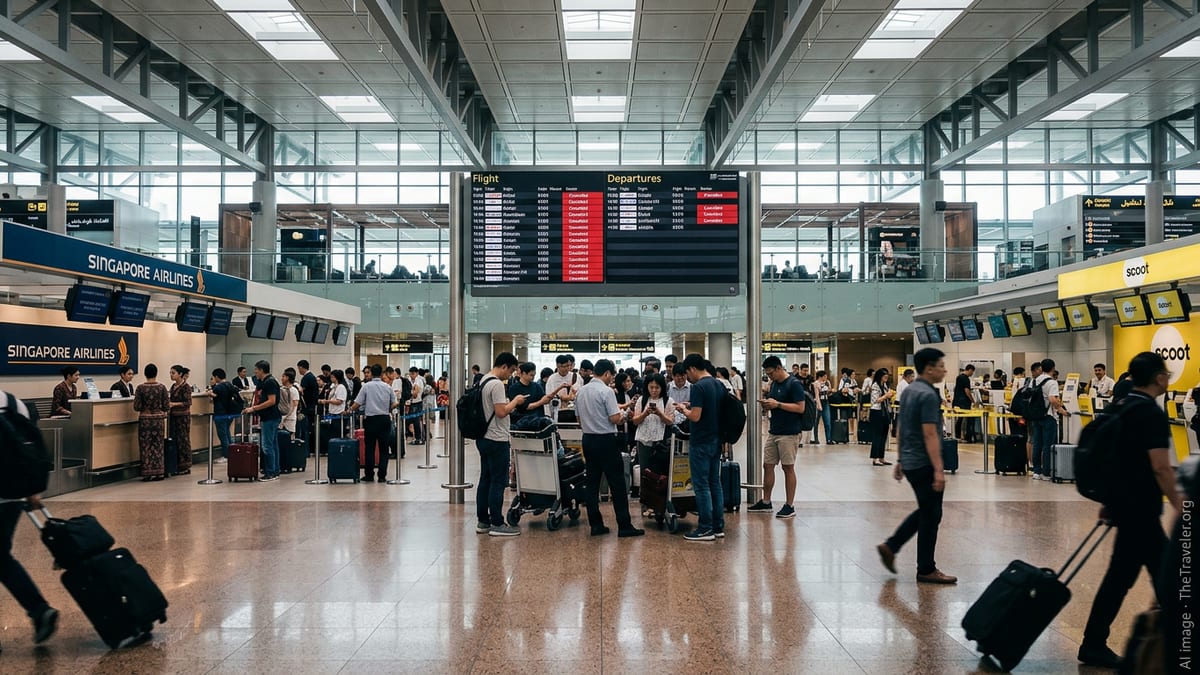
At Singapore’s Changi Airport, departure boards over the past week have shown a growing cluster of cancelled services linking the city-state to Gulf hubs. Aviation data providers report that thousands of flights across the wider Middle East have been delayed, diverted or cancelled outright since the latest round of strikes began, affecting not only Singapore Airlines and Scoot but also carriers based in the Gulf and Europe.
Travel agents say demand has spiked for itineraries that bypass the Middle East entirely, with some long-haul passengers opting to connect via East Asia or through secondary European gateways rather than risk transiting through Dubai, Doha or other Gulf airports in the short term.
What Affected Passengers Need to Know Right Now
Singapore Airlines has advised customers booked on the cancelled Dubai services to monitor their booking through the airline’s website or mobile app, where rebooking and refund options are being processed. Those who purchased tickets through travel agents or partner airlines are being directed back to their original point of sale for assistance with alternative routing or compensation.
For Scoot customers on the affected Jeddah flights, options typically include rebooking on later services once operations resume, credit vouchers or refunds subject to fare conditions. With no firm guarantee that flights will restart immediately after March 15, passengers with time-sensitive journeys are being urged to consider rerouting via alternative gateways in the region once those are confirmed safe and operational.
All travelers scheduled to fly to or through the Middle East in the coming days are being strongly encouraged to check their flight status repeatedly in the 24 hours before departure, as schedules remain fluid and subject to rapid overnight changes. Even flights that appear on airport boards as "scheduled" may later be converted into one-off repatriation services or removed from public sale if conditions deteriorate.
Travel insurance policies may offer limited protection, but coverage varies widely. Many standard policies treat armed conflict and government airspace closures as excluded events, meaning travelers could be left bearing significant out-of-pocket costs if they choose to reroute on their own. Policyholders are being told to read the fine print and seek written confirmation from insurers before making expensive new bookings.
Knock-on Effects Across Asia, Europe and the Gulf
The suspension of Singapore–Dubai and Singapore–Jeddah flights is contributing to a broader reshaping of long-haul connectivity between Asia, the Gulf and Europe. With one of Southeast Asia’s largest carriers temporarily out of key Middle East markets, competition for remaining seats on alternate routes has intensified, pushing up fares on some Asia–Europe and Asia–Africa itineraries.
Other airlines in the region have responded by trimming or rerouting their own Middle East services, particularly those overflying affected conflict zones. Extended routings that detour well south or north of the Gulf can add hours to flying time, compressing aircraft and crew availability and further limiting capacity on already busy corridors.
The disruptions have also complicated logistics for cargo operations. Bellyhold freight normally carried on passenger flights between Singapore, the Gulf and onward markets now faces delays or diversions to freighter services, affecting time-sensitive shipments and increasing costs for exporters and importers relying on Middle East hubs as transshipment points.
Industry analysts note that if the current conflict and airspace restrictions persist beyond mid-March, airlines may be forced to make deeper structural adjustments to their schedules, including extended route suspensions or seasonal capacity redeployments away from the Middle East toward more stable markets.
How Long Could the Turbulence Last for Travelers?
While the latest advisories from Singapore Airlines and Scoot set March 15 as the current end date for Dubai and Jeddah cancellations, aviation experts caution that this is best viewed as a planning marker rather than a firm guarantee of normal service resumption. Much will depend on the security picture in the Middle East, the status of key airways and any further guidance from aviation regulators.
Past conflicts in the region have shown that even after active hostilities cool, airlines may take a cautious approach to reopening routes and overflight corridors, particularly where missile or drone activity has recently been reported. Safety departments must complete detailed risk assessments and, in many cases, secure new approvals from insurers and national authorities before restoring operations.
For travelers, that means building flexibility into upcoming itineraries. Experts recommend avoiding tight, same-day interline connections that rely on Middle East hubs, and instead allowing longer layovers or overnight stops on more stable routings. Booking directly with airlines rather than third-party platforms can also simplify rebooking if schedules change at short notice.
As the situation evolves, Singapore Airlines, Scoot and other affected carriers are expected to issue rolling updates on their websites and official social media channels. For now, the message to passengers is clear: if your journey touches Dubai, Jeddah or nearby airspace before or around March 15, assume disruption is likely and plan accordingly.