

More news on this day
Sydney’s long-awaited Western Sydney International (Nancy-Bird Walton) Airport is preparing to step onto the global stage in late 2026, with Singapore Airlines poised to connect the new 24-hour hub directly to Changi Airport and beyond.
Get the latest news straight to your inbox!
A New Global Gateway for Australia’s Largest City
Western Sydney International, located at Badgerys Creek in Sydney’s fast-growing western corridor, is entering the final phase before opening, with major construction works reported as substantially complete and operational preparations now in focus. Publicly available information from government and airport updates indicates the airport is on track to start passenger operations in late 2026, offering international, domestic and air cargo services around the clock.
The new airport is designed to relieve capacity constraints at Sydney Kingsford Smith Airport and to serve the broader Western Sydney region, which has been one of Australia’s fastest-growing population and employment centres. Early planning documents and recent progress reports describe a full‑service airport capable of handling up to 10 million passengers annually in its initial phase, with provision for staged expansion over the following decades.
Unlike Sydney’s existing airport, which operates under a night-time curfew, Western Sydney International will run 24 hours a day. Aviation and infrastructure analysts note that this curfew-free status is central to the airport’s value proposition, allowing airlines to schedule late-night and early-morning departures and arrivals that are difficult to accommodate at the existing gateway.
Reports on the Western Sydney infrastructure program highlight that the airport is being integrated with new road and rail connections, including the M12 Motorway and the Sydney Metro Western Sydney Airport line. These links are intended to draw passengers not only from nearby suburbs but across greater Sydney and regional New South Wales.
Singapore Airlines Becomes First International Carrier
Singapore Airlines was the first international airline to formally commit to operating from Western Sydney International, with the partnership initially announced in August 2024. Subsequent industry coverage and airline-focused reporting in early 2026 indicate that the carrier is now preparing to begin daily flights between Western Sydney and Singapore in November 2026, aligning closely with the airport’s planned opening window.
While specific schedules and flight numbers are still being refined, publicly circulated details suggest a daily service linking Western Sydney International to Singapore Changi Airport, complementing Singapore Airlines’ existing operations at Sydney’s current airport. Aviation observers note that this will give Sydney residents two distinct Singapore Airlines gateways in the same metropolitan area for the first time.
Industry commentary points out that the Singapore Airlines partnership is strategically significant for the new airport. Singapore Airlines is widely regarded as a premium full‑service carrier with an extensive global network, and its early commitment has been interpreted as a vote of confidence in the long‑term viability of Western Sydney International as a second international gateway for the city.
Government and airport reporting shows that Singapore Airlines is part of a group of “launch partner” airlines for Western Sydney International, along with Qantas, Jetstar and Air New Zealand. Together, these carriers are expected to anchor the airport’s inaugural schedule and help establish Western Sydney on global aviation maps from its first season of operations.
Redefining Travel Through Changi’s Global Hub
The launch of direct services between Western Sydney International and Singapore Changi is expected to open up a web of new one‑stop connections across Asia, Europe and North America. Changi Airport serves as Singapore Airlines’ primary hub, with an expansive network spanning more than 120 destinations, and travel industry analysis suggests Western Sydney travellers will gain streamlined access to many of these routes via coordinated schedules and through‑ticketing.
For Western Sydney residents, the new flights could significantly reduce travel time to long‑haul destinations. Instead of commuting across the city to access international services, many passengers will have a closer option that connects them to the same global network. Travel experts note that this may be particularly attractive for families and business travellers based in western and south‑western suburbs, as well as for regional New South Wales residents who drive into Sydney for flights.
The curfew-free nature of the new airport will also allow Singapore Airlines to deploy timing patterns that are not possible at the existing Sydney airport, where operations are restricted overnight. Airline watchers report that the carrier has long sought a late‑evening or near‑midnight departure from Sydney to better align with Changi’s overnight connecting bank, a configuration that could now be realised at Western Sydney International.
Industry discussion further highlights that the Western Sydney route will sit alongside Singapore Airlines’ existing Sydney services, rather than replacing them. This dual‑airport strategy mirrors arrangements in some other large cities where carriers operate from multiple gateways, offering passengers a choice based on location, departure time and connectivity.
Boost for Western Sydney Economy and Tourism
Economic assessments published by Australian authorities and aviation bodies project that Western Sydney International will be a major catalyst for jobs, investment and tourism across the region. The airport precinct is already framed as the centrepiece of the broader Western Parkland City vision, which aims to create a new employment and innovation hub anchored by advanced manufacturing, logistics and aerotropolis-style development.
The arrival of Singapore Airlines is expected to accelerate these trends by providing direct connectivity to one of Asia’s leading financial and tourism centres. Tourism operators anticipate that improved access to Western Sydney’s visitor attractions, including nearby national parks and the Blue Mountains region, will encourage travellers to explore beyond central Sydney and stay longer in the area.
Freight and logistics operators are also watching the route closely. Singapore’s status as a major cargo and trans‑shipment hub, combined with Western Sydney International’s integrated freight facilities, points to expanded opportunities for exporters and importers in New South Wales. Supply-chain analysts suggest that the new services could streamline movements of high‑value and time-sensitive goods, from perishables to technology products.
Local councils and business groups within Western Sydney have consistently highlighted that the airport’s success depends on high‑quality international links. The confirmation of Singapore Airlines services has therefore been widely interpreted, in public commentary and business reporting, as a foundational step in positioning the new airport as a serious contender on the regional aviation stage.
What Travellers Can Expect in 2026
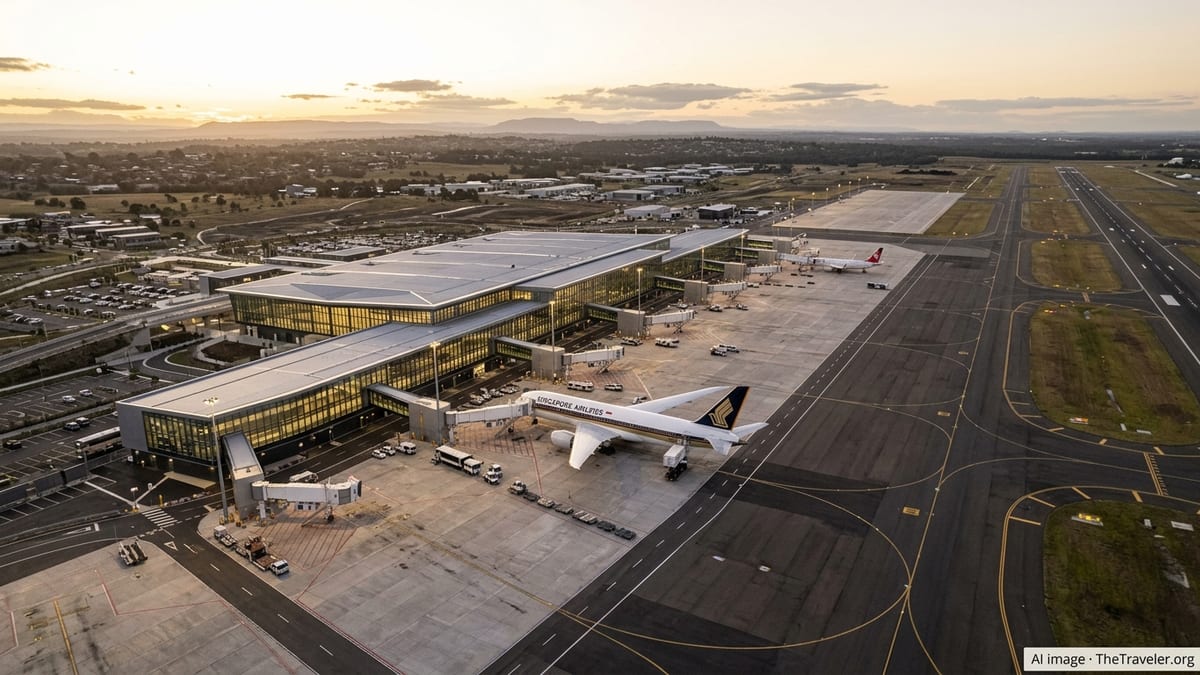
As Western Sydney International moves toward operational readiness, more details are emerging about the passenger experience and how Singapore Airlines’ services will fit within it. Visualisations and recently released images of the terminal show a contemporary design with expansive glass, natural light and an emphasis on efficient passenger flows, supported by modern security and check‑in technology.
Travel industry coverage indicates that Singapore Airlines is expected to deploy wide‑body aircraft on the Western Sydney route, in line with its broader Australian network strategy. While final aircraft types and onboard products are yet to be fully confirmed in public schedules, observers anticipate a mix of premium cabins and economy seating, along with the airline’s established inflight service standards.
Connectivity to and from the new airport will be a central factor in its appeal. The completion of the M12 Motorway and progress on the Sydney Metro Western Sydney Airport line are described in infrastructure updates as key milestones in ensuring that passengers can reach the terminal efficiently from across the metropolitan area. Planning materials suggest that travel times from key Western Sydney centres will be significantly shorter than the drive to the existing airport, reshaping how many locals plan their international trips.
With ticket sales expected to ramp up as the airport’s opening date draws closer, passengers will be watching for pricing, schedules and frequent-flyer redemption options on the new Western Sydney–Singapore route. For now, public information points to late 2026 as the moment when Sydney’s new mega airport finally goes global, with Singapore Airlines at the forefront of a transformation in how the city connects with the world.