

More news on this day
Singapore Airlines and Hong Kong’s Cathay Pacific are emerging as short-term winners from the sudden shutdown of Gulf aviation hubs, capturing diverted long-haul traffic even as the deepening Middle East crisis raises costs and clouds the global outlook for air travel.
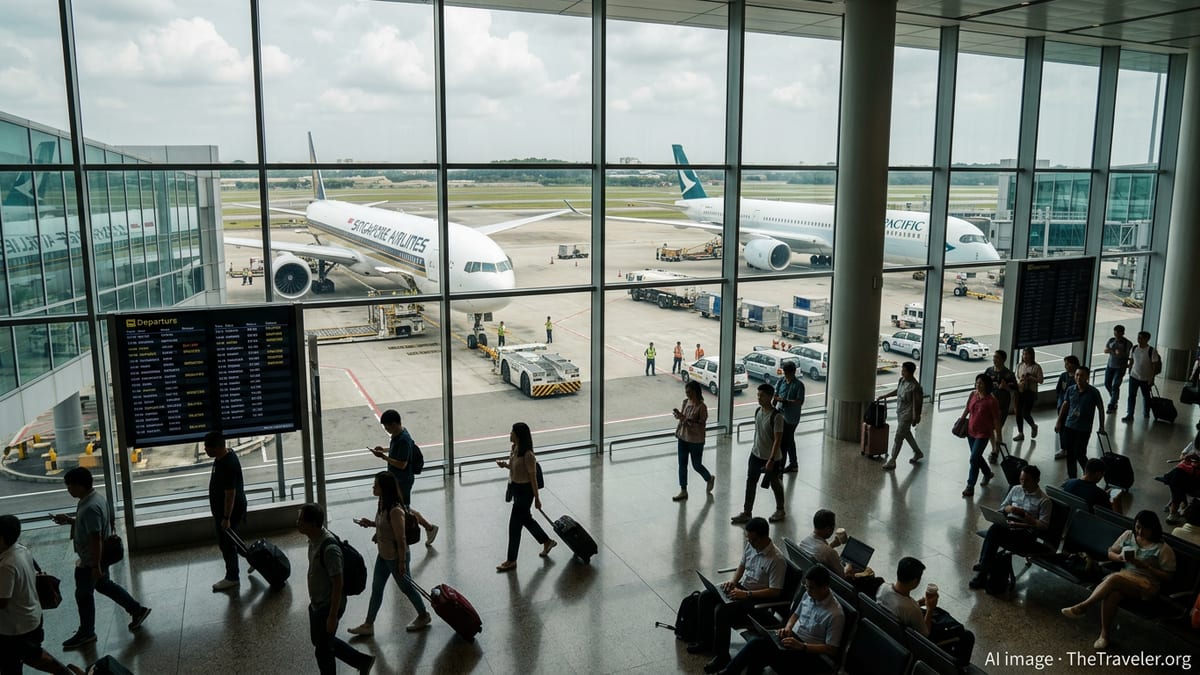
Gulf Gridlock Pushes Traffic Toward Asian Gateways
The abrupt closure of airspace over Iran, Iraq, Israel, the United Arab Emirates and several neighboring states at the end of February has effectively frozen the Gulf’s role as the world’s key east–west aviation bridge. With Dubai, Abu Dhabi and Doha operating at a fraction of normal capacity, airlines have been forced to redraw route maps in a matter of hours.
Carriers that traditionally funnel Europe–Asia and North America–Asia traffic through Gulf megahubs are cancelling or curtailing services as missile exchanges and military overflights make core corridors unsafe. Flight tracking data over recent days shows a sharp drop in movements through the Gulf and a corresponding rise in traffic over alternate paths through South and Southeast Asia.
That shift is creating an opening for Singapore Changi and Hong Kong International Airport, both of which sit astride major north–south and east–west lanes but are well clear of the immediate conflict zone. Airlines and corporate travel planners scrambling to keep passengers and cargo moving are increasingly routing itineraries through these Asian hubs instead of the Gulf.
While some Middle Eastern airspace has begun to reopen on a limited basis, safety advisories and insurance constraints mean a rapid return to business as usual is unlikely. Analysts say that keeps Singapore and Hong Kong in a strong position to absorb displaced flows over at least the next several weeks.
Singapore Airlines Balances Cancellations and Opportunity
Singapore Airlines has not escaped the turmoil. The carrier has cancelled services on its Singapore–Dubai route through at least March 7 and is warning that other flights could yet be affected as the situation evolves. Disruption at Changi has already been visible, with dozens of delayed departures and a handful of cancellations rippling through the schedule in recent days.
Investors initially reacted nervously. Singapore Airlines shares slid more than 5 percent on March 2 as markets priced in higher fuel bills, complex rerouting and softer demand on affected sectors. Yet network planners and aviation consultants note that the airline’s relatively modest exposure to the Gulf, compared with regional rivals, is turning into a competitive advantage.
Instead of relying on a single hub at the edge of the conflict zone, Singapore Airlines has long focused on nonstop links from its home base to Europe, North America and key Asian capitals. As European and Middle Eastern carriers pare back frequencies or add hours of detour flying to avoid closed airspace, some corporate clients are shifting premium traffic onto Singapore’s existing long-haul services.
Changi’s reputation for operational resilience is also proving helpful. Although the airport has logged significant delays linked to congestion and knock-on crew shortages, ground operations and passenger processing have so far remained orderly compared with the crowded scenes reported at several Gulf hubs.
Cathay Pacific Repositions as Gulf Connectors Stall
Hong Kong’s Cathay Pacific is seeing a similar, if complex, mix of risk and opportunity. The airline had already been rebuilding long-haul capacity after years of pandemic-era restrictions and lingering geopolitical headwinds. The Gulf crisis gives it a fresh opening to position Hong Kong as an alternative bridge between Asia and Europe.
With Russian airspace still closed to many Western carriers, options for efficient Europe–Asia routings were already constrained before the Middle East conflict escalated. Now, with core Gulf corridors compromised, traffic managers are combing schedules for viable alternatives that keep flying times and fuel consumption within acceptable bounds. Routes that step through Hong Kong on the way from Europe to Southeast Asia or Australia are seeing renewed interest.
Cathay Pacific has scope to add capacity on select sectors, either by upgauging aircraft or activating underutilised wide-bodies as demand shifts. Aviation data over the first days of March points to an uptick in long-haul departures from Hong Kong to key European gateways, even as Gulf carriers temporarily trim frequencies.
Industry analysts caution that Cathay’s gains are likely to be tactical rather than transformational. Hong Kong remains sensitive to any broader downturn in global trade flows, and the airline must manage its own exposure to longer routings and higher fuel costs. Still, in a congested and fragmented airspace environment, its geographic position far from the front lines is an immediate selling point.
Higher Costs and Longer Routes Temper the Upside
The short-term boost in connecting traffic for Singapore and Hong Kong comes with a significant caveat: almost every alternative routing now being used between Europe and Asia is longer, more fuel intensive and more complex to operate than the once-routine tracks through the Gulf. Airlines are diverting aircraft south over the Arabian Sea or north through the Caucasus and Central Asia, adding hundreds of nautical miles to typical journeys.
For twin-aisle jets operating ultra-long sectors, that can translate into an extra hour or more of flying, thousands of kilograms of additional fuel burn and the need for augmented crew complements on some routes. Carriers are also paying higher overflight and navigation charges to states that have suddenly found themselves on the front line of global detours.
Singapore Airlines and Cathay Pacific are not immune. Even as they pick up stranded passengers and new bookings, both carriers must refile flight plans, juggle duty-time limits for pilots and cabin crew, and absorb the cost of repositioning aircraft. Yield management teams are racing to adjust fares, with early signs that premium cabins on select Europe–Asia sectors via Singapore and Hong Kong are tightening in availability.
Travel management companies report that some corporate clients are willing to pay higher fares to avoid routings that transit near the conflict zone, boosting near-term revenue for the safest and most stable alternatives. But if elevated fuel prices persist and detours remain in place, margins could quickly compress, turning today’s traffic windfall into a tougher profitability challenge.
Short-Term Gains, Strategic Repercussions
How long the current pattern endures depends on both the military trajectory of the Iran conflict and how quickly regional regulators are willing to reopen contested skies to civilian traffic. Even if limited corridors through the Gulf are restored in the coming weeks, airlines may be slow to return in force while memories of mass cancellations and high-profile diversions remain fresh.
That hesitation could cement a more prominent role for Singapore and Hong Kong in global network planning. Some European and Asian carriers are already exploring additional codeshares and schedule coordination with Singapore Airlines and Cathay Pacific to build redundancy into their long-haul offerings, reducing sole reliance on Gulf transfers.
Airport authorities in both cities are watching the developments closely. Any sustained uptick in transfer volumes will test terminal capacity, runway utilisation and air traffic control systems that have only recently climbed back to pre-pandemic levels. It will also feed into longer-term investment decisions on gates, lounges and cargo handling tailored to a more diversified flow of passengers and freight.
For now, the crisis underscores how quickly the balance of power in global aviation can tilt when a vital corridor is knocked offline. As Gulf hubs count the cost of shuttered runways and stranded fleets, Singapore and Hong Kong are seizing a rare window to reinforce their status as safe, reliable gateways between East and West, even as they brace for a turbulent and uncertain year ahead.