

More news on this day
Singapore is fast emerging as a frictionless playground for India’s outbound travellers, as fresh payment innovation, tourism campaigns and digital links with Visa’s Singapore hub converge to make cross-border journeys smoother and more cash-light than ever.
Get the latest news straight to your inbox!
Visa’s Singapore Hub Positions City-State as Payment Powerhouse
Visa’s decision to anchor a major innovation centre in Singapore has solidified the city-state’s status as a regional test bed for next-generation payments. Publicly available information on Visa’s Singapore operations highlights a focus on biometric, contactless and real-time digital transactions designed for high-volume travel corridors across Asia Pacific.
The Singapore innovation hub is framed as a platform for co-developing new payment experiences with banks, fintech firms, transit operators and travel-sector partners. For Indian travellers, that means many of the tap-to-pay, tokenised and mobile-first solutions they already use at home are increasingly available in a familiar form when they land at Changi Airport or board a metro, bus or taxi in Singapore.
Industry analyses indicate that this strategy aligns closely with India’s rapid adoption of digital payments and card usage abroad. As more Indian consumers carry internationally enabled Visa cards, Singapore’s role as a live laboratory for the network’s latest technologies effectively turns the destination into an early-access gateway for seamless global spending.
The result is a reinforcing loop: as Visa deepens its Singapore footprint, local merchants gain more sophisticated acceptance infrastructure, which in turn encourages higher-spending, digitally savvy visitors from India and other key markets.
UPI, PayNow and QR Links Create a Cash-Light Travel Corridor
Alongside card-based innovation, India and Singapore have spent the past few years knitting together their instant payment systems. Public data on the linkage between India’s Unified Payments Interface and Singapore’s PayNow highlights a focus on faster, cheaper cross-border transfers for individuals, students and workers, but travel is emerging as a major beneficiary.
Singapore’s domestic QR ecosystem, anchored by SGQR and PayNow, is being connected step by step with Indian rails and schemes. Reports on partnerships between India’s NPCI International, Singapore payment firms and acquirers describe pilots that allow Indian visitors to scan QR codes and pay directly from rupee accounts at selected merchants in Singapore.
Analysts note that these developments complement existing card rails from networks such as Visa rather than replacing them. For higher-value purchases, hotel stays and airfares, international cards remain the primary tool, while small-ticket spends in hawker centres, neighborhood shops and attractions increasingly flow over low-cost QR payments. For Indian travellers used to hopping between UPI and cards at home, this blended model feels familiar.
Policy commentary from central banks and multilateral bodies also points to Singapore and India as early movers in wider projects to interlink fast payment systems across Asia. As more countries join such frameworks, the Singapore India corridor is expected to serve as a template for QR-based travel spending that feels almost local, even when abroad.
Tourism Campaigns Target India’s Expanding Middle-Class Flyers
Payment innovation is only part of the story. Singapore’s tourism authorities and industry operators have stepped up targeted marketing in India, treating frictionless payments as a core pillar of the destination pitch rather than a back-end detail.
Recent coverage of Singapore tourism campaigns describes partnerships with airports, resort operators and Indian digital platforms aimed at positioning the city-state as an easy, weekend-friendly escape for families and young professionals. These initiatives often highlight simplified e-visa procedures, frequent direct flights from Indian cities and the ability to pay in Singapore using the same digital habits that travellers have at home.
Travel industry reports show that India has become one of Singapore’s largest and fastest-growing source markets, with visitor numbers recovering strongly and surpassing pre-pandemic benchmarks. Analysts attribute much of that growth to rising disposable incomes among India’s urban middle class, a segment that is highly comfortable with online booking, mobile banking and contactless payments.
By aligning marketing pushes with concrete improvements in payment acceptance, Singapore aims not just to attract first-time Indian visitors but to convert them into repeat customers who treat the city as a default hub for short breaks, events and onward regional connections.
From Airport to MRT: A Seamless Spend Journey on the Ground
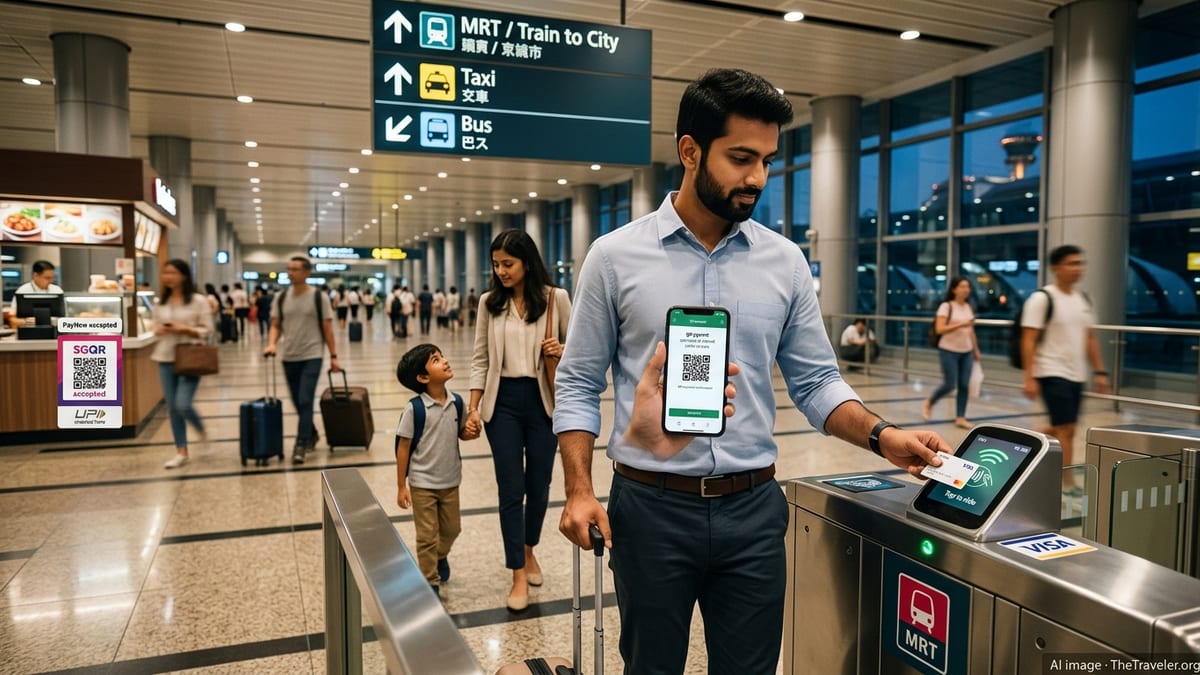
On the ground in Singapore, the payment experience for Indian visitors is increasingly consistent from the moment they step off the plane. Changi Airport’s retail zones, duty-free shops, transport counters and self-service kiosks are widely equipped for international card acceptance, particularly for networks such as Visa, making it easy to settle large purchases without currency exchanges.
Publicly available consumer accounts and transport operator information also point to growing contactless acceptance on Singapore’s metro and buses. Travellers can tap in and out using compatible Visa cards or mobile wallets, in many cases without purchasing a separate transit card. This kind of frictionless movement is especially attractive to short-stay visitors who want to avoid queues, top-ups and unfamiliar ticketing systems.
Across the city, malls, attractions and dining precincts mirror this experience. The combination of card terminals, QR codes and mobile wallet options means that an Indian visitor can rely on a mix of instruments, choosing what feels most convenient and cost-effective for each transaction. For many, this reduces the need to carry large amounts of Singapore dollars in cash, lowering both logistical and perceived safety concerns.
Travel analysts argue that such consistency matters as much as any single technological breakthrough. When every step of a trip, from airport transfers to coffee purchases, feels like a familiar, one-tap interaction, visitors are more inclined to explore, spend and recommend the destination to others.
Singapore and Visa Look Ahead to a More Connected Region
Looking forward, the partnership between Singapore and Visa sits within a broader regional push to improve cross-border payments. Commentaries from financial institutions and multilateral organisations describe Southeast Asia as a testing ground for interoperable systems that can eventually link India not just to Singapore, but to a wider network of destinations where digital travel spending feels effortless.
Visa’s Singapore innovation activities are expected to keep evolving in step with these trends, from biometric authentication and tokenised credentials to deeper integration with local real-time payment schemes. For Indian travellers, this could translate into even smoother experiences, such as transit gates, hotel check-ins and attraction entries that recognise both their identity and preferred payment method in a single gesture.
At the same time, public data on regulatory initiatives in India and Singapore underscores an emphasis on safety, consumer protection and financial stability. The challenge for both sides will be to maintain robust safeguards while continuing to remove friction for legitimate travellers who simply want their money to work wherever they go.
For now, industry watchers see Singapore as a vivid example of how a focused payment and tourism strategy, backed by global networks like Visa and by interoperable public infrastructure, can redefine what it feels like for Indians to travel abroad. In this emerging era, the journey is not just about where passengers fly, but how seamlessly their digital wallets come along for the ride.