

More news on this day
Passengers at Singapore Changi Airport are confronting a new wave of schedule turmoil as Qatar Airways, Qantas, Gulf Air, Thai Wings and other carriers cancel or trim services on key routes to Doha, Sydney, Bahrain, Jeddah, Jakarta and Bali, following rolling airspace restrictions across the Gulf and wider Middle East.
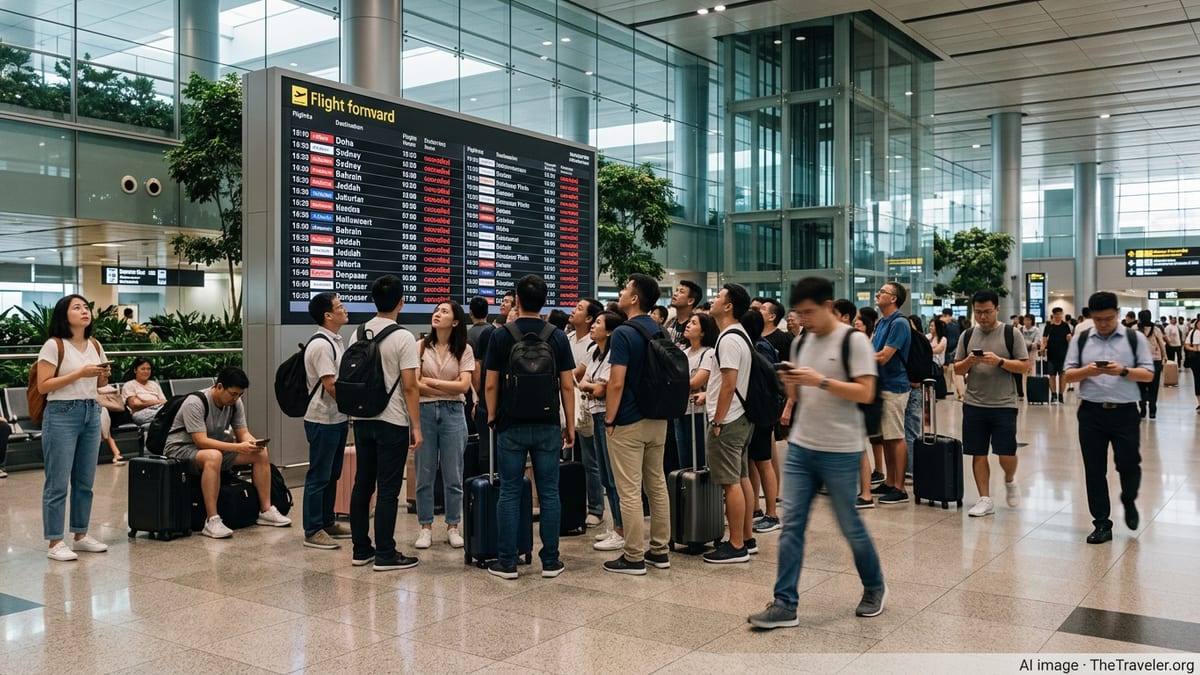
Middle East Airspace Crisis Ripples Into Southeast Asia
The latest disruption at Changi is the clearest sign yet that the Middle East airspace shutdown, triggered by escalating tensions and strikes around Qatar and neighbouring states, has shifted from a short-term shock to a sustained crisis for Asian hubs. Airlines that rely on Doha and other Gulf cities as transfer points are now juggling rolling cancellations, last-minute schedule changes and complex diversions.
Qatar Airways, whose global network depends on funneling traffic through Doha’s Hamad International Airport, has been operating on a sharply reduced schedule since Qatari airspace was closed at the end of February. While the carrier has begun flying a limited slate of repatriation and trunk services to and from Doha, including select frequencies to Jeddah and major European and Asian cities, most regular commercial operations remain suspended.
That squeeze on capacity is hitting Singapore-bound and Singapore-origin passengers particularly hard. Changi’s role as a major Asia-Pacific transfer point means any reduction in Gulf connectivity quickly cascades into missed onward flights, overbooked alternatives and extended airport stays for travelers who were expecting seamless one-stop links to Europe, the Middle East and Africa.
Airport data over recent days shows cancellations and significant delays clustering around services to Doha and other Gulf hubs, with knock-on effects on Southeast Asian feeder routes. Industry analysts say the pattern is consistent with carriers prioritising long-haul repatriation and essential links while placing lower-yield regional flights under review day by day.
Qatar Airways Cuts Changi–Doha While Running Skeleton Global Network
At the heart of the disruption is Qatar Airways’ Changi–Doha corridor, a critical link for business and leisure travelers heading from Southeast Asia to Europe and the Middle East. With Qatari airspace partially closed and access tightly controlled, the airline has been forced to ground most commercial services and use the limited operating corridor for selected flights only.
In its latest updates, Qatar Airways outlines a rolling list of destinations it can serve between March 9 and March 11, focusing on major capitals such as London, Paris, Madrid, Rome, Delhi and Jeddah. Singapore does not feature on that priority list, leaving many Changi-based passengers holding tickets for flights that have either vanished from schedules or remain technically “confirmed” but are unlikely to operate.
Travel agents report a surge in calls from Singapore-based customers who booked Qatar itineraries to Europe, the Middle East and Africa with onward connections to or from Doha. Many are being rebooked days later on the limited flights that do operate, while others are being steered to alternate routings on partner or competing carriers via Bangkok, Kuala Lumpur or European gateways. For now, the airline’s message remains that only passengers with a newly confirmed seat on a specific flight should present at the airport.
For Qatar Airways frequent flyers, the disruption is especially painful, as premium-cabin and status advantages offer little protection when sheer airport capacity and regulatory constraints dictate which aircraft can move. With further updates promised daily, uncertainty is set to linger for at least the rest of March.
Qantas, Gulf Air and Thai Wings Trim Services to Sydney, Bahrain and Beyond
Qatar Airways is not alone in pruning its Singapore schedules. Qantas has joined the list of carriers cutting services at Changi, particularly on routes entangled in the Gulf corridor and onward connections to Europe. While the airline continues to operate core non-stop links such as Singapore–Sydney, several flights tied to disrupted Middle East partners or overflight routes have been pulled or consolidated, leaving passengers facing aircraft swaps, schedule changes and downgrades.
For travelers on the flagship Sydney route, this can mean being moved from a preferred departure to a less convenient time, or being rebooked onto alternative days entirely. With March traditionally a busy shoulder season for Australia–Asia travel, even modest capacity cuts quickly translate into fuller cabins, fewer redemption seats and shrinking options for last-minute changes.
Gulf Air, Bahrain’s national carrier, has also scaled back its operations through Singapore, reflecting the broader uncertainty in Gulf-region air traffic. Services linking Changi with Bahrain and onward to Jeddah and other Saudi cities have been subject to cancellations or extended ground times as the airline navigates detours and revised flight permissions. Passengers heading to religious and business destinations in Saudi Arabia are among the most affected, with some forced to piece together journeys via multiple third-country stops.
Regional operator Thai Wings, along with several smaller Asian carriers that feed Gulf networks, has quietly removed or reduced flights from Singapore to Jakarta, Bali and secondary Southeast Asian destinations. These flights often carry passengers booked on through itineraries to Doha or other Gulf hubs, so when the long-haul legs vanish, the short-haul feeders become economically and operationally difficult to justify.
Key Routes Impacted: Doha, Sydney, Bahrain, Jeddah, Jakarta and Bali
For travelers trying to make sense of the disruption, several routes stand out as high-risk in the current environment. Any itinerary involving Singapore–Doha on Qatar Airways remains highly uncertain, whether used as a direct trip to Qatar or as a connection point onward to Europe, Africa or the Americas. Even tickets that still show as active in airline apps may be subject to last-minute cancellation as authorities update airspace permissions.
Singapore–Sydney services, particularly those tied to alliance or codeshare connections through the Gulf, are also under pressure. While non-stop flights continue, the frequency and timing of some departures have shifted as Qantas and its partners juggle aircraft and crew availability. Travelers relying on tight same-day connections in either direction should build in additional buffers or request rebooking onto more robust routings.
On the Middle East side, flights linking Changi with Bahrain and Jeddah are among the most disrupted, reflecting both direct airspace limits and the heavier-than-usual demand from stranded passengers seeking any available seat in or out of the region. These routes are seeing not only cancellations but also frequent equipment changes, with widebodies swapped for smaller jets and vice versa at short notice.
Closer to home, regional hops from Singapore to Jakarta and Bali that traditionally connect onto Gulf long-haul services are increasingly vulnerable to consolidation. Some departures have been removed from schedules entirely, while others operate with altered timings that complicate same-day onward connections. Travelers using Changi as a bridge between Indonesia and Europe or the Middle East via Gulf hubs should be prepared for multi-stop alternatives through Bangkok, Kuala Lumpur or direct European gateways instead.
What Passengers at Changi Should Do Right Now
For those booked to travel in the coming days, the strongest advice from airlines and airport authorities is simple: do not go to the airport unless your flight shows as operating and you hold a reconfirmed booking on that specific service. With Qatar Airways and its regional peers updating schedules day by day, turning up based on an older itinerary risks long waits in terminal queues with little chance of same-day departure.
Instead, passengers are urged to monitor their reservations closely via airline apps and to sign up for text or email alerts where available. If a flight is cancelled, most carriers are currently offering fee-free date changes within a defined window or full refunds for itineraries directly affected by airspace closures. Those who booked through online travel agencies may need to work through the intermediary, which can add processing time but should still unlock the same flexibility.
Travelers already stranded in Singapore or at intermediate points should document all expenses and keep boarding passes, booking confirmations and receipts in case they are eligible for reimbursement under airline policies or, for certain departures, consumer-protection rules in other jurisdictions. In practice, hotels and meal vouchers are being granted on a case-by-case basis, with priority for families, elderly passengers and those on overnight layovers created by same-day cancellations.
Looking ahead, industry watchers expect sporadic disruption at Changi to continue until there is a clear and sustained reopening of Gulf airspace. For now, anyone planning new trips that would route through Doha, Bahrain or other Middle Eastern hubs should weigh alternative paths and build in extra time, recognising that schedules across the Singapore network remain subject to rapid change.