

More news on this day
Singapore’s Changi Airport has surged back to the top of global rankings, overtaking long-time powerhouses in Canada, France, Japan, Turkey, South Korea and Germany to emerge as the clearest benchmark for airport standards worldwide.
Get the latest news straight to your inbox!
Fresh Global Rankings Confirm Changi’s Dominance
Recent international rankings place Singapore Changi Airport firmly at the front of the global pack, with the latest Skytrax World Airport Awards naming it the World’s Best Airport for 2025. The recognition, presented at Passenger Terminal EXPO in Madrid, underscores how the airport has reclaimed and consolidated a position it has held more often than any other hub.
Publicly available information from Skytrax and other industry trackers indicates that Changi has now collected the World’s Best Airport title a record 13 times, a streak unmatched by any rival in North America, Europe or Asia. In the 2025 list, Changi leads a field that still includes heavyweights such as Tokyo Haneda, Seoul Incheon, Istanbul, Munich and Vancouver, but the Singapore hub is increasingly seen as setting the pace rather than merely competing in a crowded top tier.
Changi’s dominance is not confined to a single title. The airport has also secured category awards such as Best Airport in Asia, Best Airport Dining and the first-ever World’s Best Airport Washrooms, reflecting a holistic approach to the passenger experience that stretches from basic cleanliness and comfort to food quality and service design.
Reports on passenger traffic show that Changi handled close to 70 million travelers in 2025, returning to and slightly surpassing pre-pandemic volumes. This recovery, combined with the latest awards, is being viewed in the industry as a decisive moment that cements Singapore’s lead at a time when many competitors are still smoothing out operational strains.
How Singapore Pulled Ahead of Global Rivals
Changi’s climb back to the top comes against competition from airports in countries that have traditionally dominated aviation benchmarks, including Canada, France, Japan, Turkey, South Korea and Germany. Hubs such as Vancouver, Paris Charles de Gaulle, Tokyo Haneda, Istanbul, Seoul Incheon and Munich continue to rank highly in various surveys, yet recent award cycles show Singapore edging past them across multiple performance indicators.
Industry analyses of the 2025 rankings highlight how Changi’s blend of efficiency, intuitive passenger flows and continually refreshed amenities has widened the gap. While many major airports have invested heavily in terminals and retail, reports indicate that Changi’s execution of automation, wayfinding and security processes has translated more directly into shorter queues, smoother transfers and higher satisfaction scores.
In Europe, large hubs face ongoing challenges tied to congestion and legacy infrastructure. In Asia, fast-growing rivals such as Istanbul and Incheon are expanding rapidly, but publicly available rankings still show them sitting behind Singapore in overall satisfaction and service quality. Observers point to Changi’s long-standing focus on customer-centric design and incremental upgrades as a key factor in its ability to stay ahead.
Comparative league tables compiled from Skytrax and other award programs for 2024 and 2025 consistently position Changi as the reference point against which other airports are measured. Even in categories where competitors excel, such as family facilities in South Korea or design innovation in Turkey and Qatar, Singapore’s airport remains within the top few positions, reinforcing its status as the most balanced performer worldwide.
Facilities That Turn a Transit Hub Into a Destination
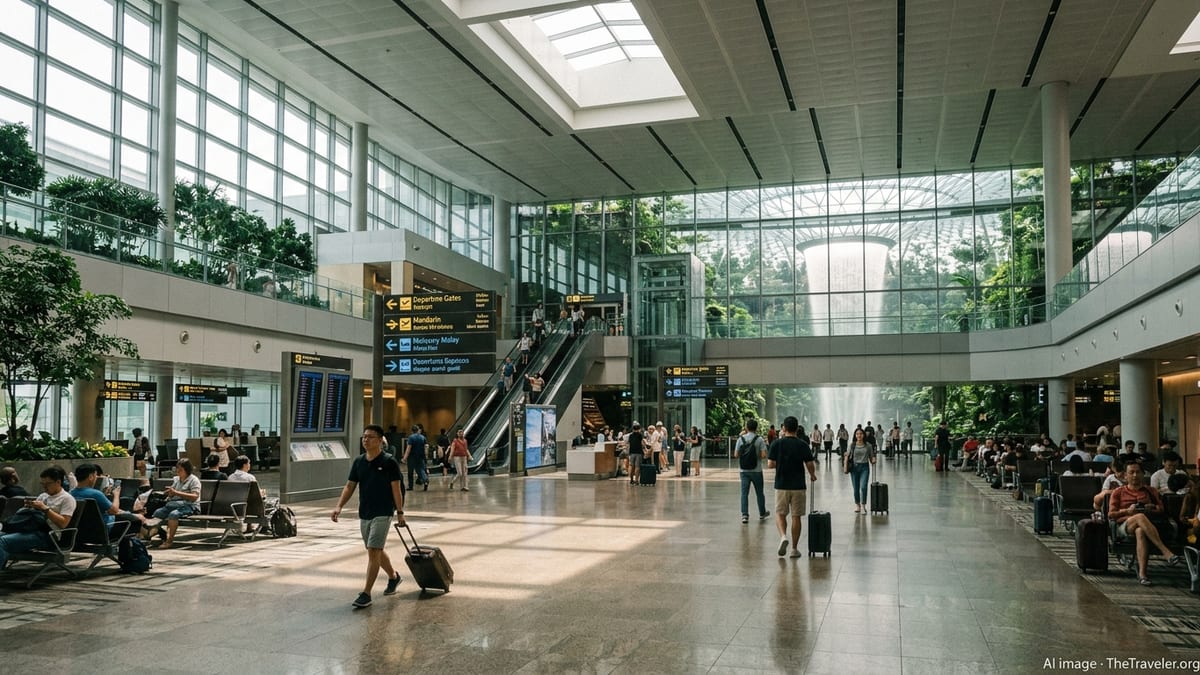
Changi’s physical environment remains central to its reputation. Terminals are known for abundant natural light, indoor gardens and curated art, along with a mix of quiet seating zones and activity areas that aim to absorb crowds without sacrificing comfort. The connected Jewel complex, with its signature indoor waterfall and multi-level retail and dining, functions as both a public attraction and an extension of the airport experience.
The airport has continued to refresh its offerings, adding wellness zones, children’s play spaces and new retail concepts as travel has rebounded. Recent developments include dedicated areas designed to combat travel fatigue, expanded dining options that reflect regional food culture and upgraded lounges and rest zones for long-haul passengers. These additions support Changi’s strategy of encouraging travelers to arrive early or schedule longer connections in order to spend more time on-site.
Beyond signature attractions, attention to smaller details has helped Changi stand out from peers. Clean, well-maintained washrooms, extensive charging points, clear multi-language signage and a consistent visual identity across terminals contribute to the sense of calm that many travelers report. Industry commentary often notes that these less glamorous elements are where even high-profile airports in Europe and North America can fall short, giving Changi a competitive edge in day-to-day usability.
For airlines and tourism authorities, the airport’s status as a destination in its own right has become a marketing asset. Travel media increasingly frame stopovers in Singapore as an opportunity to experience the airport’s amenities alongside the city’s urban attractions, blurring the line between transit point and gateway experience.
Technology, Operations and a New Benchmark for Service
Behind the public-facing amenities, technology and operational design are playing a growing role in Changi’s leadership. Published coverage of the 2025 rankings highlights how advances in automation, biometric processing and real-time data management have allowed the airport to move more passengers through its facilities without eroding comfort or service standards.
Self-service check-in, automated baggage drops and passport-free lanes in selected areas have become common features, while digital wayfinding tools and flight information systems help distribute foot traffic more evenly across terminals. These systems have been introduced in phases over several years, allowing staff training and passenger education to keep pace with the technology.
Observers note that many airports worldwide are pursuing similar tools, but differences in implementation are becoming more visible. At Changi, process design appears to prioritize simplicity and redundancy, reducing bottlenecks during peak periods. This is reflected in high rankings not only for overall satisfaction, but also for specific categories such as immigration, cleanliness and transit experience.
Industry commentary suggests that Changi’s model is shifting expectations for what a leading airport should provide. Rather than focusing solely on iconic architecture or premium lounges, the new benchmark emphasizes reliability, intuitive design and services that work equally well for business travelers, families and infrequent flyers.
What Changi’s Lead Means for Global Airport Standards
Singapore’s latest victory is reverberating across the aviation sector, as planners and airport operators study how Changi has managed to consolidate its lead over a diverse field of competitors. The fact that it is outpacing hubs in advanced markets such as Canada, France, Japan, Turkey, South Korea and Germany suggests that investment alone is not enough; execution and consistency appear to be just as critical.
Analysts tracking global infrastructure trends note that passengers are increasingly judging airports on reliability, cleanliness and ease of use rather than on size or traffic alone. In this environment, Changi’s long-term strategy of prioritizing passenger experience at every stage of the journey is turning into a competitive advantage that others are now under pressure to match.
For travelers, the implications are tangible. As more airports benchmark themselves against Singapore’s performance, features such as intuitive terminal layouts, efficient security screening, high-quality washrooms and varied dining options are likely to become more common globally. Changi’s lead is effectively raising the floor of what passengers expect from major international hubs.
With expansion plans and further upgrades already underway, Singapore’s flagship airport appears poised to defend its position at the top of global rankings in the years ahead. For now, its latest slate of awards and strong traffic figures have cemented its status as the clearest reference point for airport standards worldwide.