

More news on this day
Singapore’s move to delay a new sustainable aviation fuel levy, amid renewed instability in the Middle East and volatile oil markets, is reshaping the cost dynamics of flying across Southeast Asia and on long haul routes that many travelers use to reach Europe and North America.
Get the latest news straight to your inbox!
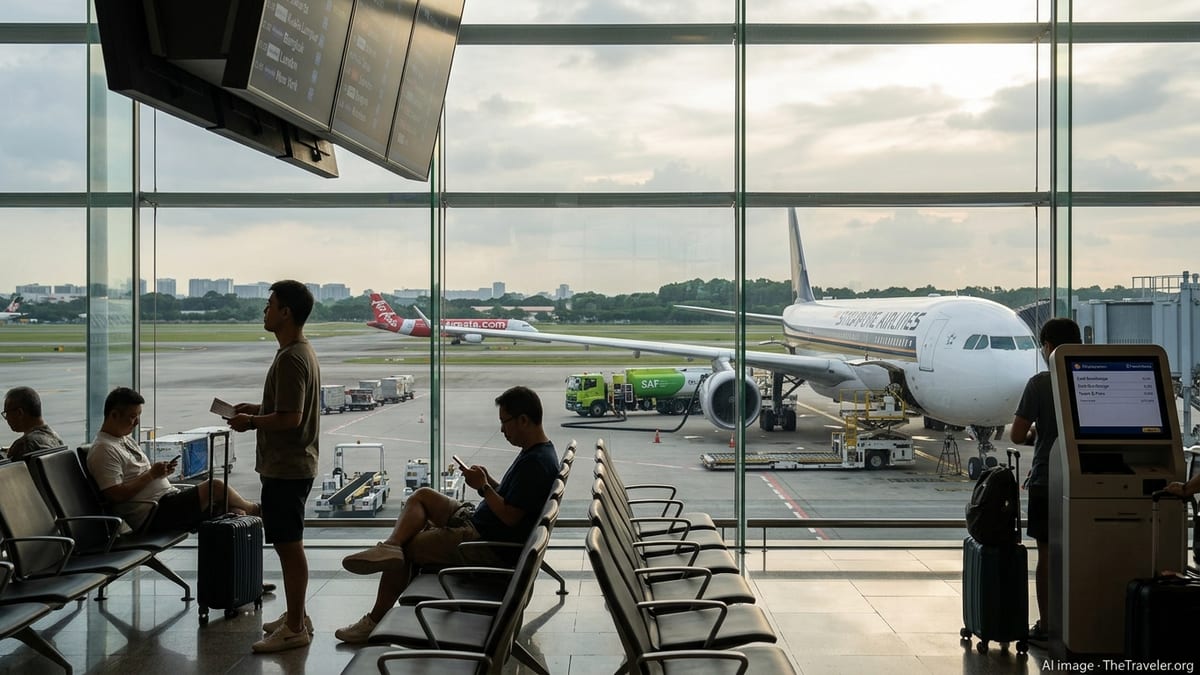
What Changed in Singapore’s Eco-Aviation Plan
Singapore has been preparing to introduce a mandatory Sustainable Aviation Fuel (SAF) charge on all passengers departing its airports, with early plans indicating that tickets issued from April 1, 2026, would start to show the new fee and that uplift of greener fuel would become compulsory from October 1, 2026. Publicly available information from the Civil Aviation Authority of Singapore describes a tiered levy, ranging from a low single-digit Singapore dollar amount on short flights in economy to more than S$40 for premium cabins on long haul sectors.
The policy is designed to help pay the higher cost of SAF, which is typically produced from used cooking oil and agricultural waste and is significantly more expensive than conventional jet fuel. Singapore’s goal is to grow SAF to at least 1 per cent of total jet fuel use at Changi and Seletar in 2026, with a further ramp up toward 2030 as supply expands.
In recent days, however, reports circulating in local media and online forums indicate that the planned April 2026 introduction of the fee on tickets has been pushed back. The adjustment comes at a time when regional carriers and policymakers are grappling with sharply higher fuel and insurance costs linked to conflict in the Middle East, and when many airlines are already adding or increasing fuel surcharges.
For travelers, the deferral means that, for now, the specific SAF line on tickets out of Singapore will not appear as soon as previously expected, even though the long term policy direction toward greener aviation has not changed.
Middle East Instability and Airline Cost Pressures
Singapore’s decision sits against a backdrop of heightened geopolitical risk in the Gulf region, where recent attacks and disruption around key chokepoints have driven a spike in global energy prices and war risk premiums for airlines. Industry commentary suggests that insurance costs for operating in or near Gulf airspace have risen steeply, while some major carriers have cut or rerouted services to Middle Eastern hubs.
These shifts are feeding through into airline operating costs worldwide, including in Asia. Several well known carriers in the region and in Europe have announced increases in fuel surcharges on long haul tickets as jet fuel benchmarks climb. At the same time, governments, including Singapore’s, are warning that higher energy prices are likely to affect everything from power generation to transport.
In this environment, adding a new environmental fee on top of already rising fares risks appearing at odds with efforts to keep travel affordable and sustain passenger demand. Delaying the rollout of Singapore’s SAF levy gives authorities room to watch how the conflict and energy markets evolve before locking in an additional fixed charge on every departing passenger.
For individual travelers, the distinction between a fuel surcharge and an eco-levy may be academic. Both appear as separate lines in fare breakdowns and both add to the total cost of a ticket. However, one is tied to day to day fuel price movements and insurance risk, while the other is aimed at funding a long term structural shift in how aviation is powered.
Impact on Fares to Indonesia, Malaysia and Thailand
Singapore functions as a major gateway and transfer point for short haul flights around Southeast Asia, particularly to neighboring Indonesia, Malaysia and Thailand. Under the planned levy structure, economy class travelers on routes such as Singapore to Jakarta, Kuala Lumpur or Bangkok were initially expected to see only a modest increase per ticket, with early estimates of a few Singapore dollars per sector.
The postponement of the SAF fee means that, for now, outbound tickets on these popular regional links will not carry that additional environmental line item. This is notable because many travelers on these routes are price sensitive leisure passengers or cross border workers who already face rising base fares as demand recovers and fuel costs fluctuate.
Airlines operating in these markets still face higher fuel and insurance bills linked to the Middle East situation, and may continue to adjust fares or fuel surcharges independently of Singapore’s eco-levy. Budget carriers, which dominate a large share of travel between Singapore and its neighbors, also compete intensely on price and ancillary fees, so any delayed government charge can make a visible difference to headline ticket prices in the near term.
For travelers planning multi-country itineraries across Indonesia, Malaysia and Thailand with a Singapore stop, the key takeaway is that any future SAF charge will apply only to sectors departing from Singapore and not to purely domestic or non-Singapore segments. Monitoring fare breakdowns over the coming months can help distinguish between market driven fuel surcharges and any eventual reintroduction of a dedicated green fee.
Long Haul Connections and the Role of Singapore as a Hub
Beyond Southeast Asia, Singapore is a crucial hub for long haul traffic to Europe, North America and parts of Africa and the Middle East. Earlier public estimates indicated that, once implemented, the SAF levy could add more than S$15 to an economy ticket on routes comparable to London and more than S$40 for business or first class seats on ultra long haul flights to the Americas.
In normal times, this scale of increase is relatively modest in the context of a multi-thousand dollar premium cabin ticket, but it is more noticeable for economy passengers who carefully compare fares between hubs such as Singapore, Bangkok, Kuala Lumpur and Doha. The current deferral may help Changi remain competitive as airlines and travelers reassess routings to avoid conflict zones and manage higher fuel costs.
Some carriers are already shifting capacity and connecting flows away from affected Middle Eastern airports, adding frequencies through alternative hubs in Asia and Europe. For long haul travelers who traditionally route through the Gulf, Singapore is one of the main alternatives alongside other Asian gateways. Keeping additional government imposed charges on hold could help sustain that role while the conflict and associated risks persist.
Travelers booking long haul journeys that include Singapore should be aware that, once the levy eventually starts, it will apply only to the segment departing from Singapore, not to the entire journey. Those comparing itineraries with different stopover points may find that the timing of SAF levies at each hub becomes another factor in choosing between one routing and another.
What Travelers Should Watch Over the Next Year
For the average traveler, the policy details can be confusing, especially when environmental fees, fuel surcharges and airport taxes are all increasing or changing at roughly the same time. A useful starting point is to look carefully at the tax and surcharge breakdown on any ticket departing Singapore. At present, these lines mostly reflect existing airport charges and carrier-specific fuel surcharges, not a dedicated SAF levy.
As the situation in the Middle East evolves, airlines may adjust schedules, routings and surcharges several times over the course of a year. Singapore’s authorities have signaled a long term commitment to sustainable aviation, so an eco-levy is unlikely to disappear altogether. Instead, travelers can expect further updates on when and how the charge will be introduced once energy markets stabilize and more data is available on SAF pricing and supply.
Passengers planning trips between Singapore and nearby destinations such as Jakarta, Bali, Kuala Lumpur, Penang, Bangkok or Phuket should anticipate that market driven fare changes linked to fuel prices may appear before any new environmental fee. Those arranging complex, long haul itineraries that use Singapore as a hub may want to monitor comparative pricing across hubs and consider whether booking earlier or later could help avoid sudden surcharge changes.
The broader trend is clear: flying is set to include more explicit environmental and fuel related charges in the years ahead. Singapore’s temporary step back on eco-aviation fees, prompted by a period of heightened instability in global energy markets, does not change that trajectory. It does, however, give travelers a brief window in which to reassess their plans, understand the components of their ticket price, and make more informed choices about when and how they fly through one of Asia’s most important aviation gateways.