

More news on this day
Singapore’s plans to roll out new climate levies and cleaner fuel requirements for air and sea travel have been pushed back, signalling a cautious reset in the city-state’s green transition just as global regulators intensify pressure on transport emissions.
Get the latest news straight to your inbox!
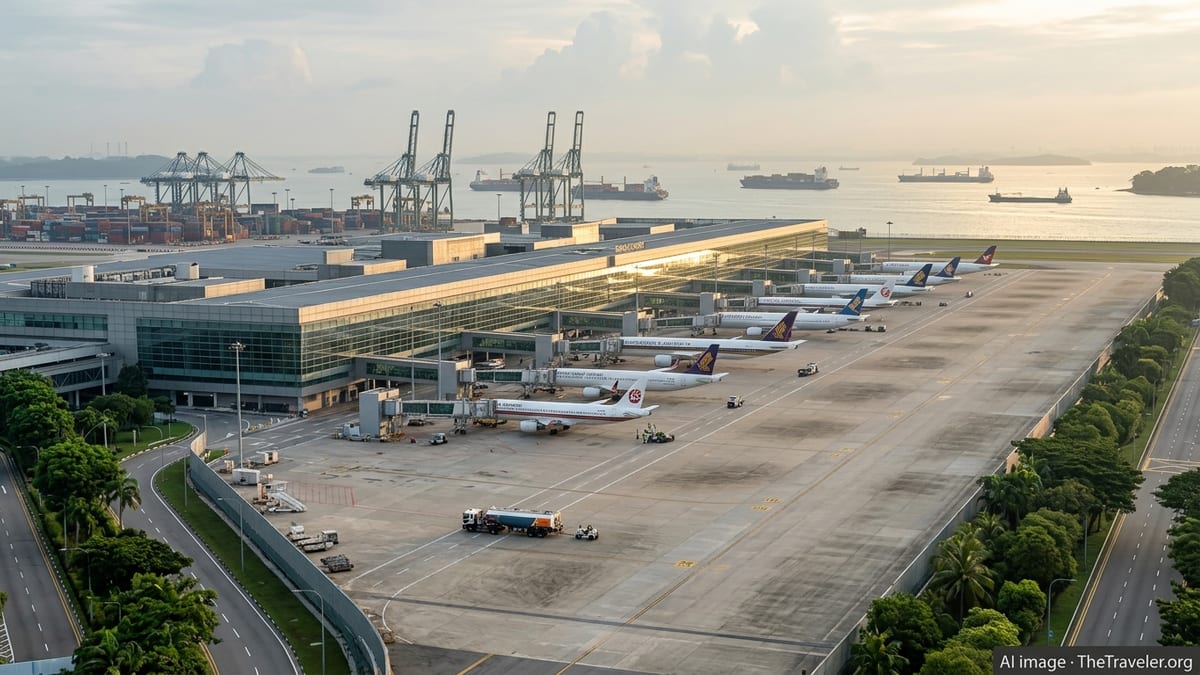
Shift in Timelines for Sustainable Aviation Fuel Plans
Singapore has been preparing a sustainable aviation fuel framework that combines a passenger-facing climate levy with a mandate for airlines to blend low carbon fuels into jets departing Changi Airport. Earlier guidance and policy papers outlined a starting mandate of around 1 per cent sustainable aviation fuel from 2026, rising toward 3 to 5 per cent by 2030, funded in part by a per-ticket levy. Recent industry commentary and legal analysis of Singapore’s 2025 climate policy package indicate that this schedule is now being reconsidered, with implementation likely to proceed more slowly than first envisaged.
Publicly available documents suggest that regulators and policymakers are responding to concerns from airlines and travel stakeholders about cost pass-through and fuel availability. Sustainable aviation fuel remains significantly more expensive than conventional jet fuel, and large-scale supply in the Asia Pacific region is still in its infancy. By slowing the introduction of a binding blend requirement and associated levy, Singapore appears to be prioritising near-term air hub competitiveness while keeping its long-run decarbonisation objectives intact.
For travellers, the pause on a firm climate levy and binding fuel mandate could delay expected increases in ticket prices that had been linked to the cost of procuring cleaner fuel. For airlines operating out of Singapore, the adjustment offers breathing room to secure longer term supply contracts, explore offtake agreements, and align fleet planning with evolving global standards such as the aviation sector’s net zero commitments for 2050.
At the same time, the decision underlines an emerging reality in aviation decarbonisation: while sustainable fuels are central to long-haul climate strategies, governments face delicate trade-offs between adopting ambitious timelines and maintaining the competitiveness of key transport hubs.
Maritime Climate Levies and Cleaner Fuel Targets Eased Back
Shipping has been another focal point of Singapore’s climate policy discussions. As the world’s largest bunkering hub and a leading maritime centre, Singapore has examined options ranging from greenhouse gas linked levies on marine fuels to incentives and potential mandates for low or zero carbon alternatives such as methanol and ammonia. Regional and international coverage of recent regulatory talks indicates that initial ideas for a domestically applied emissions levy and fast-tracked cleaner fuel requirements have not advanced as quickly as advocates had hoped.
The backdrop is a rapidly changing international regime. The International Maritime Organization has adopted tighter greenhouse gas intensity targets and is pursuing global pricing mechanisms, while the European Union has brought shipping into its emissions trading system. Industry groups have argued that any Singapore-specific levy or mandate introduced too early, or at levels significantly above emerging international benchmarks, could divert ships to alternative bunkering ports and erode the city-state’s maritime market share.
Singapore’s current approach relies more heavily on incentives, pilots and voluntary schemes. The Maritime and Port Authority has introduced enhanced green ship programmes, offering benefits to vessels that adopt energy efficient designs or are equipped to use low carbon fuels. Technical standards under Singapore’s sustainable finance taxonomy now reference lifecycle emissions benchmarks for marine fuels, signalling the desired trajectory without immediately imposing sweeping new price instruments at the bunker point.
Delaying a formal climate levy or hard cleaner fuel mandate for ocean-going vessels buys time for the shipping industry to respond to international rules first, then align local measures. For cargo owners and logistics providers, this means Singapore remains a relatively predictable bunkering and transhipment hub in the short term, even as global rules tighten.
Economic Pressures, Competitiveness and Industry Pushback
The recalibration of both aviation and maritime measures is taking place against a backdrop of uncertain global growth, volatile fuel markets and heightened competition between transport hubs. Airlines and shipping lines are emerging from several disruptive years that included pandemic-era travel restrictions, supply chain bottlenecks and new compliance costs tied to overseas carbon pricing schemes. Introducing substantial levies on top of these pressures risked accelerating route changes, capacity shifts and cost-cutting in ways that might not favour Singapore.
Business groups and transport operators have highlighted the risk that climate levies imposed ahead of competing hubs could see price-sensitive passengers and cargo rerouted through alternative gateways. In aviation, regional rivals are also exploring sustainable fuel incentives, but few have moved decisively to mandate substantial blend levels within the same timeframe. In shipping, fuel suppliers and carriers are still testing new propulsion technologies and green fuel chains, making firm investment decisions difficult under uncertain policy and demand signals.
By slowing its timetable, Singapore may be seeking to remain aligned with global trends without over-extending its first-mover position. The city-state already operates a carbon tax that is scheduled to rise over time, and this broad-based instrument provides a parallel signal for emissions reduction that applies across sectors. Additional, highly targeted levies on specific travel activities could be layered on later, once there is clearer international convergence on prices and standards.
Nevertheless, the pause carries reputational implications. Environmental groups and some climate policy analysts have argued that delaying strong price signals risks locking in high-emission practices and infrastructure, particularly in long-lived assets like aircraft and ships. For a country that positions itself as a forward-looking green finance and innovation hub, the perception of slowing momentum may need to be managed carefully.
Implications for Travellers, Tourism and the Wider Region
In the near term, the cooling of climate levy and cleaner fuel timelines is likely to be greeted with quiet relief across parts of the travel and logistics chain. Airlines have more time to adjust pricing structures, consider fare classes that reflect different emissions profiles, and incorporate sustainable fuel options into premium products rather than across-the-board mandates. Cruise operators and cargo carriers calling at Singapore may also avoid the immediate complexity of port-specific greenhouse gas charges layered on top of international schemes.
For tourists and business travellers, the financial impact of the pause may be subtle but real. Earlier projections linked the sustainable aviation fuel levy to a modest per-passenger surcharge on tickets out of Singapore, which would have been more visible on short-haul fares. Delaying or softening that levy keeps overall travel costs down at a time when inflation and currency shifts have already made many popular destinations more expensive.
The decision also sends a signal across Southeast Asia, where several countries are evaluating their own aviation and maritime climate frameworks. Singapore’s more measured rollout underscores the complexity of designing levies and mandates in an interconnected region, where fuel uplift choices and route structures can shift rapidly in response to even small price differentials. Neighbouring states are likely to watch closely how Singapore eventually implements its revised policies, particularly once global aviation and maritime climate negotiations yield clearer benchmarks.
From a traveller’s perspective, the main visible changes over the next few years may come less from levies and more from incremental shifts in equipment and services: carriers promoting more efficient fleet types on popular routes, ports piloting green harbour craft and bunkering demonstrator projects, and travel platforms providing clearer emissions information at the point of booking.
Balancing Net Zero Ambitions with Pragmatic Transition
Despite the slowdown in specific levies and mandates, Singapore’s broader climate and energy strategy continues to point toward net zero emissions around mid-century. The country is expanding its carbon tax, exploring large-scale imports of low carbon electricity, and promoting cleaner vehicles on its roads. Air and sea transport remain challenging pieces of this puzzle because of technological constraints and the global nature of both industries.
Policymakers appear to be betting that a mix of targeted incentives, international coordination and gradually tightening standards can eventually deliver substantial emissions cuts without undermining the very connectivity on which Singapore’s economy depends. In this view, slamming the brakes on near-term travel-focused levies does not necessarily mean abandoning climate goals, but rather reshaping the path by which they are reached.
For now, the recalibrated trajectory leaves open questions. How quickly will sustainable aviation fuel costs fall as production scales up. Will global shipping regulators agree on a unified greenhouse gas levy that reduces the need for port-level charges. And can travellers be persuaded to support greener options voluntarily in the absence of strong price signals.
The answers will shape not only Singapore’s standing as an aviation and maritime hub, but also the wider evolution of climate policy in international travel. As governments search for credible ways to decarbonise cross-border movement without choking off economic activity, Singapore’s experience in pausing, rethinking and potentially relaunching its climate levy and cleaner fuel plans is likely to become a closely watched case study.