

More news on this day
Singapore is grappling with fresh travel disruption after TransNusa Airlines and Thai VietJet abruptly cancelled five newly launched services linking Changi Airport with Jakarta and Bangkok, stranding passengers and raising new concerns over the reliability of regional connections.
New Routes Pulled Just Weeks After Launch
The five affected flights were part of recent schedule expansions designed to tap strong demand on the busy Singapore to Jakarta and Singapore to Bangkok corridors. Aviation schedules and airport operations data indicate that TransNusa had added new frequencies on the Singapore–Jakarta route while Thai VietJet bolstered capacity between Singapore and Bangkok, positioning both carriers to compete more aggressively with full-service rivals and low-cost incumbents.
Instead, travelers arriving at Changi in recent days found departure boards flashing cancellations for several of these new services, with airline staff citing “operational reasons” and “fleet availability constraints.” Industry observers say the wording points to a mix of aircraft utilisation issues, crew rostering challenges and softer-than-expected advance bookings on specific rotations.
The cancellations are particularly striking because they come amid a broader regional recovery in air travel, with carriers in Southeast Asia rebuilding networks and adding new point-to-point routes. For Singapore, which has invested heavily in cementing its role as a premium regional hub, the removal of fresh capacity on two of its most important short-haul markets is an unwelcome setback.
Neither TransNusa nor Thai VietJet has provided a detailed public timeline for when, or if, the cancelled flights might return to the schedule, leaving both passengers and travel agents in limbo as they attempt to plan trips for the coming weeks.
Stranded Passengers Confront Long Queues and Limited Options
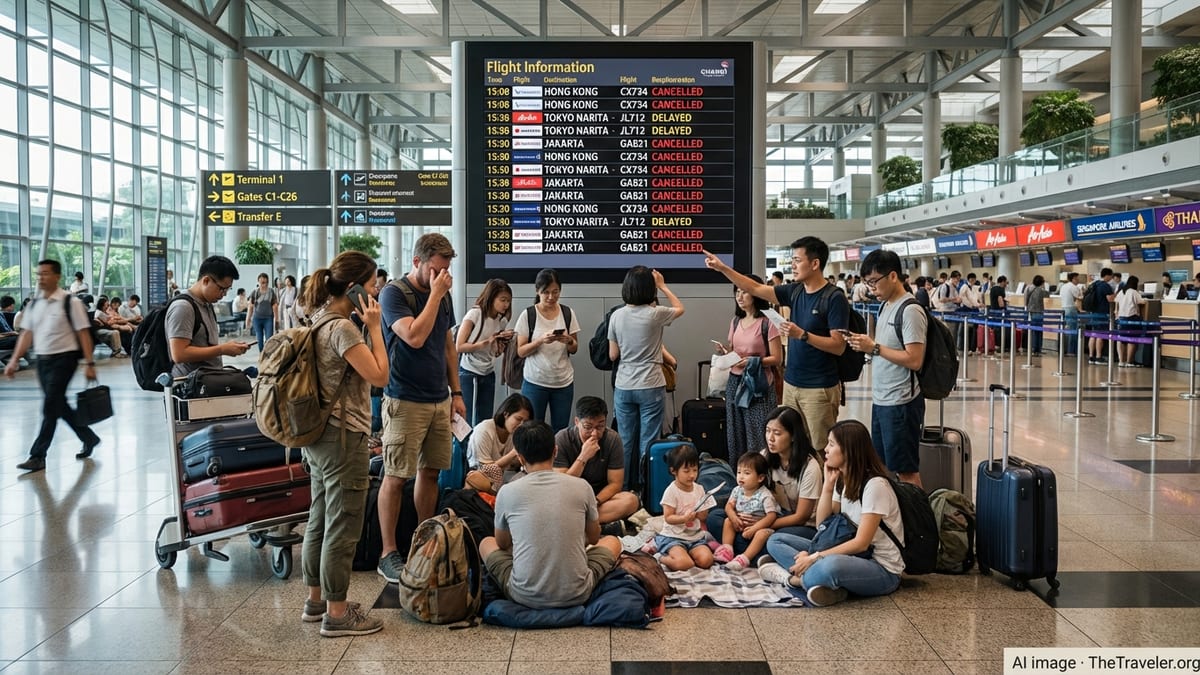
The immediate impact of the cancellations has been felt most acutely by passengers booked on the affected services, many of whom arrived at Changi Airport only to discover that their flights were no longer operating. Airport witnesses described snaking lines at customer service counters and groups of travelers seated on the terminal floor, surrounded by luggage as they waited for rebooking assistance.
Standard practice requires airlines to offer re-accommodation on the next available flight or refunds, but constrained capacity on peak-time services to Jakarta and Bangkok made same-day alternatives difficult to secure. Some travelers reported being rebooked on late-night or next-day flights on other carriers, while others opted to abandon their trips altogether in favor of refunds and future credit.
Families with connecting itineraries were among the hardest hit. Passengers bound for onward flights from Jakarta and Bangkok described a scramble to rearrange hotel reservations and ground transport at short notice. Business travelers, meanwhile, spoke of missed meetings and lost workdays as they attempted to reconfigure tight schedules around the cancellations.
Ground staff at Changi were left to manage frayed tempers and mounting frustration. With passenger volumes already elevated due to strong travel demand across Asia, the sudden withdrawal of multiple flights on the same city pairs compounded pressure on check-in halls, security lanes and airline service desks.
Hub Reputation Tested as Disruptions Mount
The episode is the latest in a series of air travel disruptions across Asia that have periodically rippled through Singapore, Bangkok and Jakarta over recent weeks. Operational issues, weather-related delays and broader scheduling adjustments have all contributed to a more volatile travel environment for passengers moving through the region’s major hubs.
For Singapore, the cancellations by TransNusa and Thai VietJet come at a sensitive time. The city-state has been actively promoting Changi Airport as a model of reliability and efficiency, supported by continued investment in infrastructure and digital systems. Flight cancellations and stranded passengers sit uncomfortably alongside that message, even when the root causes lie with individual airlines rather than the airport operator.
Regional aviation analysts note that intense competition on short-haul routes can make new services vulnerable if load factors do not ramp up as quickly as anticipated. When combined with high fuel costs and tight aircraft availability, airlines may be more inclined to pull marginal frequencies with little warning, prioritising core routes and proven time slots.
In this context, the removal of five flights may not signal structural weakness in Singapore’s position as a hub, but it does highlight how quickly passenger experience can deteriorate when multiple carriers make abrupt schedule changes. Travelers increasingly expect stability and timely communication; sudden cancellations, even on new routes, risk eroding trust.
Travel Industry Warns of Knock-On Effects
Travel agencies and corporate travel managers are now bracing for a wave of itinerary changes as clients adjust plans around the lost capacity between Singapore, Jakarta and Bangkok. Short-haul regional routes are a cornerstone of business and leisure travel in Southeast Asia, linking financial centers, manufacturing hubs and tourism gateways. Any sustained reduction in service frequency can ripple through hotel bookings, meeting schedules and tour operations.
Agents report spending hours on the phone with airline partners to secure alternative seats for affected customers, often at higher fares or on less convenient timings. Some foresee a near-term shift in demand toward carriers with larger, more stable schedules on the Singapore–Jakarta and Singapore–Bangkok routes, including full-service airlines and established low-cost operators that have maintained consistent operations through recent volatility.
Tourism stakeholders in Indonesia and Thailand are also monitoring developments closely. While the cancellation of five flights is modest in absolute terms, it removes fresh capacity that had been expected to support growing visitor flows from Singapore and beyond. If the affected services remain off the schedule for an extended period, local tourism boards may need to recalibrate their projections for arrivals routed via Singapore.
Corporate travel departments, meanwhile, are reviewing policy guidance for staff transiting through Singapore on regional hops. Some are considering recommending longer connection windows or alternative routings to reduce exposure to last-minute changes on thinner routes operated by smaller carriers.
What Passengers Should Do Now
Consumer advocates say the latest disruption underscores the importance for travelers of monitoring their bookings closely, particularly when flying on recently launched services or smaller regional carriers. Passengers booked on TransNusa or Thai VietJet flights between Singapore, Jakarta and Bangkok in the coming days have been urged to check their flight status regularly and confirm schedules directly with the airline or their travel agent.
Those whose flights have already been cancelled are generally entitled to a refund if they choose not to travel, or to rebooking on the next available service, subject to seat availability. Travelers are advised to keep records of all communication with airlines, including any out-of-pocket expenses incurred as a result of delays or missed connections, in case compensation or reimbursement options are available under the carrier’s policies.
Looking ahead, booking flexibility remains a key tool for mitigating risk. Changeable tickets, comprehensive travel insurance and itineraries that build in buffer time for connections can all help soften the impact of sudden schedule changes. While such measures cannot prevent cancellations, they can provide travelers with more room to maneuver when disruptions occur.
For now, passengers heading to Jakarta and Bangkok via Singapore face a more complicated landscape than they might have expected only weeks ago. Until airlines clarify their plans for restoring, revising or permanently withdrawing the affected services, anyone planning to transit Changi on these routes will need to factor greater uncertainty into their journeys.