

More news on this day
Singapore Airlines is preparing to restart daily flights between Singapore and Hangzhou in 2026, a move widely expected to strengthen tourism and business flows between Southeast Asia and one of China’s most dynamic cultural cities.
Get the latest news straight to your inbox!
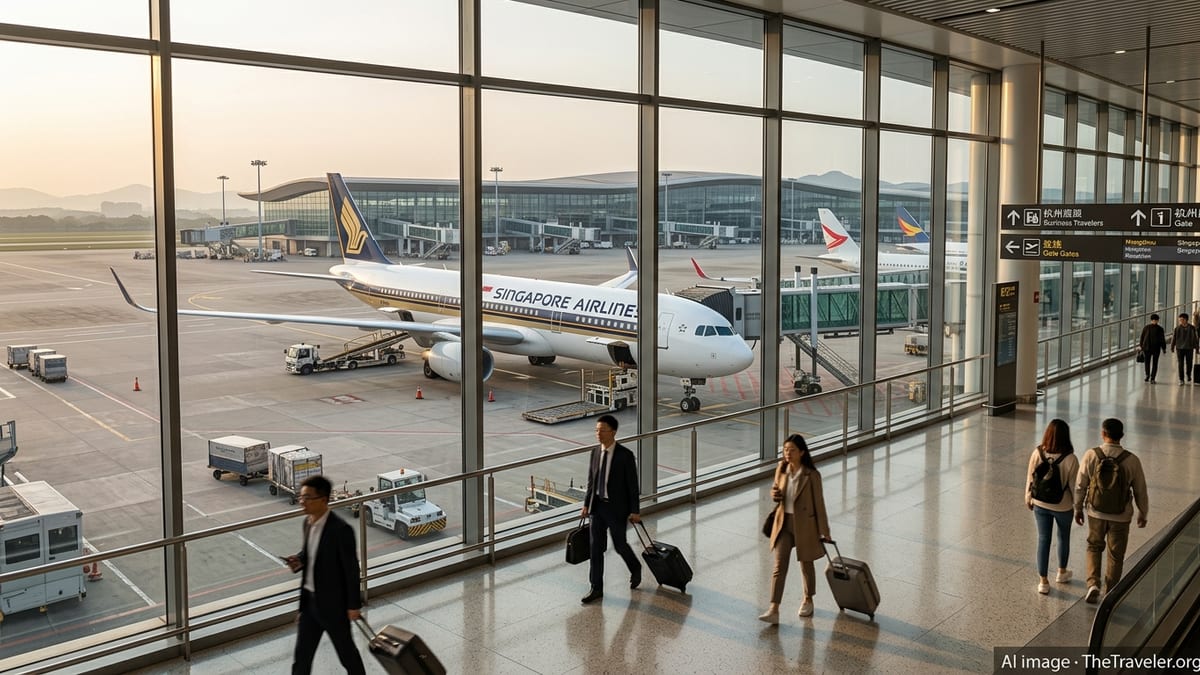
Daily Service Returns to a Fast-Growing Chinese Gateway
Publicly available scheduling information indicates that Singapore Airlines will resume services to Hangzhou Xiaoshan International Airport from June 2026, restoring a link that has been absent from the carrier’s network in recent years. Aviation enthusiasts tracking the airline’s timetable changes report that the route is set to operate on a daily basis, directly connecting Singapore Changi with the capital of Zhejiang province.
Industry observers note that Hangzhou’s return to the Singapore Airlines map aligns with a broader recalibration of capacity into mainland China, following several years of uneven recovery and changing travel patterns. The daily frequency is seen as a strong signal of confidence in underlying demand from both leisure and corporate segments, rather than a tentative seasonal or limited trial.
While operational details are still emerging, the flight is expected to plug directly into Singapore Airlines’ Southeast Asia and long haul bank at Changi, offering same-day onward connections from Hangzhou to destinations across Australia, South Asia, Europe and North America. Travel analysts say this could reposition Hangzhou as a more prominent Asian gateway for travellers who prefer to avoid larger and often more congested Chinese hubs.
The move also reflects Hangzhou’s rising profile within China’s aviation hierarchy. Once viewed primarily as a secondary airport behind Shanghai, Hangzhou Xiaoshan has expanded aggressively, benefiting from both strong local demand and spillover from the Yangtze River Delta’s wider economic growth.
Strategic Boost for Singapore as a North–South Connector
For Singapore, the return of daily Hangzhou flights underscores Changi Airport’s positioning as a north–south transfer hub linking China to Southeast Asia, Australia and beyond. Network planners emphasise that routes like Singapore–Hangzhou are not only about point-to-point traffic, but also about feeding wider connectivity across the airline’s long haul system.
Travellers from Hangzhou will gain one-stop access via Singapore to popular leisure destinations such as Bali, Phuket and the Maldives, as well as to major business centres including Jakarta, Kuala Lumpur and Sydney. Conversely, passengers originating in Southeast Asia and Oceania will have a new premium option for reaching eastern China, complementing existing Singapore Airlines and Scoot services into cities such as Shanghai, Shenzhen and Xiamen.
Travel trade publications suggest that the daily Hangzhou operation is timed to mesh with peak connection banks at Changi, allowing most itineraries to be completed with a single, relatively short layover. This is expected to appeal to premium leisure travellers and small and medium-sized business travellers who are sensitive to total journey time and schedule convenience.
The route also supports Singapore’s broader ambitions to retain and grow its role as a regional aviation crossroads, as competition intensifies from rival hubs in Hong Kong, Bangkok and the Gulf. Regular, reliable access to a diversified set of Chinese cities is viewed as a key differentiator in attracting both airlines and passengers to transit via Changi.
Hangzhou’s Cultural Appeal Meets Tech-Driven Growth
Hangzhou has long been celebrated within China for its cultural heritage and landscapes, particularly the UNESCO-listed West Lake, classical gardens and tea-growing hills that frame the city. Tourism boards often highlight Hangzhou as a softer, more intimate counterpoint to the bustle of megacities such as Shanghai or Beijing, making it an attractive first stop for visitors seeking a blend of history, nature and modern comforts.
In recent decades, the city has also emerged as a major technology and innovation hub, home to leading digital and e-commerce firms and a growing cluster of start-ups. This dual identity as both cultural showcase and digital powerhouse is drawing a new wave of visitors ranging from tech entrepreneurs to conference delegates and high-spending independent travellers.
Tourism and economic data from Chinese and international agencies show that Zhejiang province has been investing heavily in visitor infrastructure, including hotel capacity, cultural venues and transport links radiating from Hangzhou. A direct daily connection to Singapore is expected to complement these efforts by funnelling more international travellers into the region, particularly from markets where Singapore Airlines maintains a strong presence.
Industry commentators point out that Hangzhou is increasingly promoted on multi-city itineraries that combine traditional cultural highlights with newer design, food and tech districts. The resumed Singapore service is likely to support this positioning, enabling seamless open-jaw and circular routes that start or end in other Asian gateways but pivot through Hangzhou for a deeper dive into eastern China.
Opportunities for Business, Meetings and Premium Travel
The new Singapore–Hangzhou schedule is also expected to stimulate business travel and meetings, incentives, conferences and exhibitions activity. Hangzhou has invested in large-scale convention facilities, and Singapore remains one of Asia’s most established hubs for corporate events, banking and professional services, creating a natural corridor between the two cities.
Corporate travel managers in the region are watching for final aircraft and cabin details, as the choice of product could shape demand from higher-yield sectors. Singapore Airlines has historically deployed a mix of widebody aircraft into Chinese markets, with configurations that emphasise its premium cabins alongside substantial economy capacity. Observers expect a similar approach on Hangzhou, designed to serve both cost-conscious group travel and individual premium passengers.
Travel industry reports suggest that enhanced connectivity could strengthen cross-border links in sectors such as technology, manufacturing, logistics and creative industries, all of which have strong footholds in both Zhejiang and Singapore. Better flight options reduce friction for project teams, investors and executives who require frequent, short-notice travel between the two markets.
The route’s daily cadence is considered particularly important for business travellers, offering the flexibility to schedule short trips without the constraint of limited operating days. This tends to increase overall utilisation of the service, improving its long-term sustainability within the airline’s wider China portfolio.
Competitive Dynamics in Mainland China Connectivity
Singapore Airlines’ return to Hangzhou comes at a time of renewed competition among carriers vying for international traffic to and from mainland China. Chinese airlines have been rebuilding their overseas networks, while foreign carriers are selectively restoring or expanding capacity in cities beyond the traditional Beijing–Shanghai–Guangzhou triangle.
Market-watchers say a daily Singapore–Hangzhou link strengthens the airline’s ability to retain high-value traffic that might otherwise connect through hubs such as Hong Kong, Seoul or the Gulf. By offering a full-service product and a familiar transit experience at Changi, Singapore Airlines is positioning the route as a premium alternative to itineraries that involve multiple stops or mixed carriers.
At the same time, the Hangzhou move is seen as part of a portfolio strategy in China that balances established mega-hubs with emerging regional centres. Maintaining a diversified presence across the country allows the airline to respond more flexibly to shifts in demand, policy and competition, while giving travellers a broader choice of entry points into the Chinese market.
Travel analysts expect that as booking data flows in after the relaunch, capacity and scheduling may be fine-tuned to match seasonal patterns, public holidays and growing outbound tourism from Hangzhou. For now, the planned daily flights signal a strong vote of confidence in the city’s role as both a cultural draw and a gateway to eastern China, with Singapore positioned as its key link to the wider Asia-Pacific and global networks.