

More news on this day
Singapore is tightening its border controls with a new travel rule that will come into force on 30 January 2026, and it directly affects passengers, including large numbers of Indian travellers, even before they board a plane.
Airlines operating flights to Singapore will be required to deny boarding to passengers flagged by Singapore’s immigration authorities or found to be holding invalid or incomplete documentation. For Indians heading to the city state, this makes pre departure checks more critical than ever, with last minute fixes at the airport no longer a reliable safety net.
More News
- TSA Rolls Out $45 ConfirmID Fee for Travelers Without REAL ID at Security
- Flying Blue Launches February 25% Promo Rewards on Transatlantic and Regional Routes
- United Fast-Tracks Starlink Wi‑Fi Across Fleet, Free for MileagePlus Members
What Is Singapore’s New No Boarding Directive
The core of the new regime is a system of No Boarding Directives issued by Singapore’s Immigration and Checkpoints Authority, known as ICA. From 30 January 2026, ICA will send electronic instructions to airlines at Changi Airport and Seletar Airport directing them not to board specific travellers on flights bound for Singapore. These notices will be based on advance traveller information and will target those considered prohibited or undesirable immigrants, as well as passengers who do not meet entry requirements.
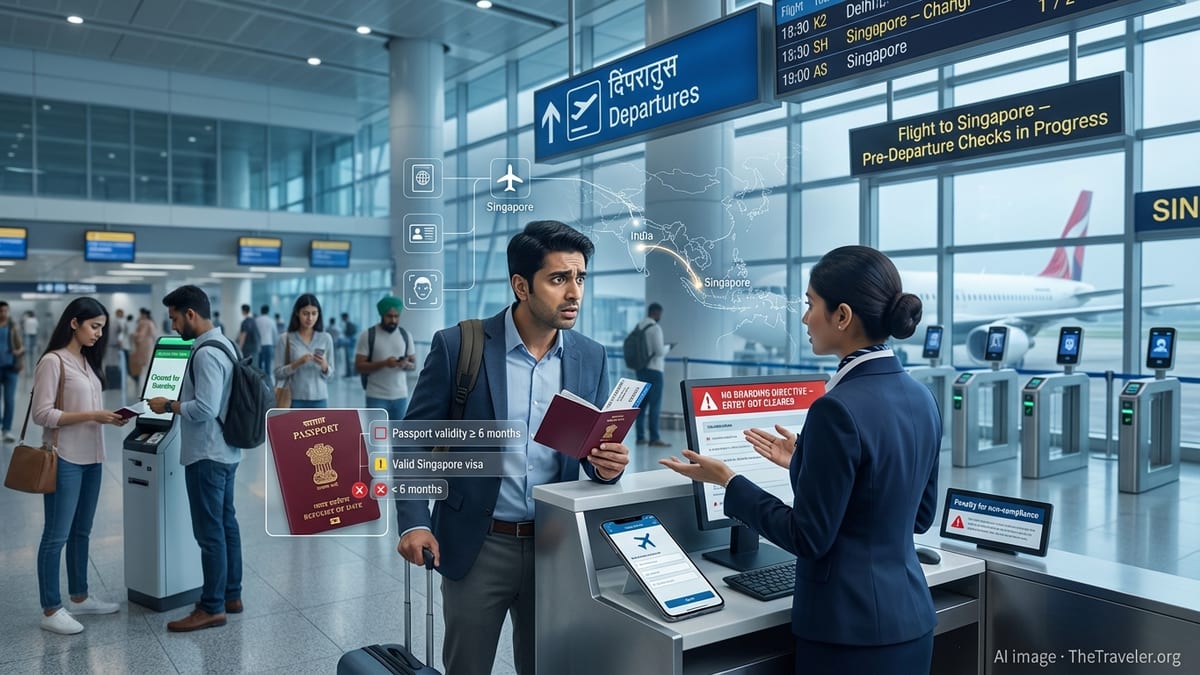
Under the rule, a No Boarding Directive can be triggered for issues as basic as not having a valid visa when one is required, or carrying a passport that has less than six months of validity remaining. Travellers identified under these criteria will be blocked from boarding before they ever reach Singapore’s immigration counters. The move is part of a broader shift to what authorities describe as “upstream” border security, focusing on screening and decision making long before an aircraft lands.
For Indian passengers, who form one of Singapore’s largest and fastest growing source markets, this means that compliance with documentation rules is no longer only checked at arrival. Instead, it becomes a pass or fail condition for boarding itself, handled jointly by ICA and the airline’s ground staff during check in and boarding gate procedures.
How Airlines Will Enforce Pre Departure Checks
Once the system is in place, airlines will transmit passenger data to ICA ahead of departure, including information taken from the passport and other travel records. ICA will then screen this information using its risk assessment systems. If any passenger is deemed ineligible for entry or is flagged as a security or immigration risk, ICA will issue a No Boarding Directive to the operating carrier for that specific flight.
Airlines receiving such a directive must deny boarding to the named passenger. In some cases, the directive may also require carriers to conduct supplementary checks beyond basic passport verification. These could include confirming that a Singapore visa has been issued and is valid for the intended dates of travel, verifying that the traveller has correctly submitted the mandatory SG Arrival Card details in advance, or checking that the passport has the required minimum validity for entry.
At the airport, the impact will be visible at check in counters and boarding gates. Airline agents will see system alerts identifying travellers who are not cleared to board. Even if the passenger has a confirmed ticket and appears on the manifest, staff will be obliged to refuse boarding if a No Boarding Directive remains in force. This shifts part of the frontline responsibility for immigration compliance onto airlines, turning pre departure checks into an integral part of the security chain rather than a courtesy reminder.
What Counts As “Invalid” Documents For Entry
For the purpose of Singapore’s new rule, “invalid” documentation is not limited to visibly expired passports or obviously fraudulent papers. It includes a range of common issues that have historically led to problems at immigration counters, but which will now be picked up before boarding. The most basic of these is a passport that does not have at least six months of validity remaining on the date of arrival in Singapore, a long standing entry condition that some travellers still overlook when planning last minute trips.
Visa issues are another major trigger. Indian passport holders generally require a prior approved visa to enter Singapore as tourists or short term visitors, and these visas must be valid for the exact period of stay. Applications submitted through authorised visa agents or online channels that remain pending, have been refused, or have lapsed will mean the traveller does not meet entry requirements. Under the new system, such cases are likely to attract a No Boarding Directive once the traveller is matched against Singapore’s records.
Incomplete mandatory declarations can also create problems. Singapore requires travellers to submit an SG Arrival Card with health and travel information before arrival. If a passenger has not completed this form, or if there are inconsistencies between the card and other data, authorities may require additional verification. In some situations, airlines may be instructed to check that the SG Arrival Card has been lodged correctly before passengers are allowed on board, raising the bar for pre flight documentation checks.
Penalties For Airlines And Implications For Travellers
The new regime carries significant financial and legal risks for carriers that fail to comply, underscoring why travellers should expect airlines to take the rules seriously. Under Singapore’s Immigration Act, an airline that allows a person subject to a No Boarding Directive to board a flight bound for Singapore can face a strict liability offence. Fines can go up to 10,000 Singapore dollars per incident, even if the carrier argues that the breach was unintentional or due to a system error.
It is not only the airline as a company that faces exposure. Individual pilots or airline employees who, by act or omission, enable a person under a No Boarding Directive to board can be held personally liable. They may face fines, possible imprisonment of up to six months, or both, if convicted. This legal framework is designed to ensure that adherence to ICA’s instructions is non negotiable, and it will inevitably lead to a more conservative approach by airlines when doubts arise about a traveller’s eligibility.
For passengers, especially those who fly frequently between India and Singapore, this means they are likely to see stricter document checks at the time of booking, during online check in and again at the airport. Staff will be less willing to “let it pass” in cases where paperwork appears incomplete or borderline, because doing so could expose their employer and themselves to penalties. As a result, travellers who arrive at the airport without having resolved visa issues or with passports close to expiry run a much higher risk of being turned away long before security checks.
What Indian Travellers Should Do Before Booking
With the start date of 30 January 2026 fixed by Singapore’s authorities, Indian travellers planning trips for late 2025 or early 2026 have a clear timeline to work with. The first step is to examine passport validity well in advance. Because Singapore typically requires at least six months of validity on arrival, travellers with passports expiring in mid or late 2026 should consider renewing early to avoid falling foul of the new pre departure checks. Relying on grace periods or hoping for discretion at immigration will no longer be a viable strategy once airlines are compelled to deny boarding.
Visa planning will need to become more structured. Tourists should only purchase non refundable tickets after securing a valid Singapore visa through approved channels or confirming eligibility under any applicable schemes. Business travellers accustomed to last minute trips should coordinate closely with corporate travel teams and visa agents to avoid situations where flights are booked before visa approvals are in place. Because airlines will be acting on data received directly from ICA, a visa that is pending or refused will likely translate into a pre boarding rejection, regardless of the passenger’s travel urgency.
Indian visitors should also get used to treating the SG Arrival Card as a critical part of their travel checklist. Filling in the form accurately, using the correct passport details and travel dates, reduces the scope for mismatches that might trigger extra scrutiny. As Singapore enhances its pre arrival risk assessment capabilities and links various databases, consistency across all submitted information becomes essential to avoid delays or denials before departure.
At The Airport: What Happens If You Are Denied Boarding
Under the new system, a denial of boarding in relation to Singapore’s entry rules will not be handled like a simple airline overbooking or schedule issue. If a passenger is stopped at check in or the boarding gate because of a No Boarding Directive, airline staff will have to inform them that Singapore’s authorities have found them ineligible to enter. The passenger will be unable to travel on that flight, even if they are willing to sign a waiver or assume the risk themselves. The decision has its origin in Singapore’s immigration systems, not in the airline’s commercial policies.
Travellers who believe they have been wrongly flagged or who wish to resolve their status do have a path to request reconsideration, but it will not be immediate. Singapore’s ICA expects such passengers to write in to seek approval for entry, using official feedback or contact channels, before arranging a new flight. That process can take time, depending on the complexity of the case and the need for additional checks. For travellers who had planned short holidays or brief business visits, it could mean their trip is effectively cancelled or must be rescheduled.
Financially, the situation is also complex. While some airlines may offer rebooking options or charge change fees, they are under no obligation to do so if the denial stems from the passenger’s failure to meet entry conditions. Travel insurance policies may treat the issue as a documentation failure, which is commonly excluded from cover. Indian travellers are therefore advised to carefully read fare rules and insurance terms to understand what protection, if any, they would have if they are denied boarding because of invalid or incomplete travel documents under Singapore’s new regime.
How The Rule Fits Into Singapore’s Wider Border Strategy
The No Boarding Directive is not an isolated measure, but part of a broader reconfiguration of how Singapore manages its borders. Authorities have been rolling out an ambitious New Clearance Concept that emphasises automation, biometric verification and the heavy use of data analytics. At Changi Airport and other checkpoints, hundreds of next generation automated gates are being installed, allowing most travellers to clear immigration through facial and iris recognition rather than manual passport scanning.
As these systems expand, Singapore has increasingly turned to pre arrival information to make decisions about travellers’ risk profiles before they set foot in the country. Passenger data from airlines, information from the SG Arrival Card and historical travel records are analysed together. Those seen as presenting a higher security or immigration risk can then be singled out for closer scrutiny on arrival, while low risk travellers pass quickly through automated lanes. The No Boarding Directive extends this model one step further by preventing ineligible or high risk individuals from even boarding the aircraft in the first place.
For Indian visitors, this means they will experience a mix of stricter documentation control before departure and smoother, faster processing on arrival, provided everything is in order. Automated immigration, combined with passport less clearance for many categories of travellers, is designed to shorten queues and reduce waiting times at Changi Airport. The trade off is that there will be less tolerance for missing paperwork, inconsistent information or borderline documentation before boarding, as authorities seek to keep potential issues away from the physical border.
FAQ
Q1. From what date will Singapore’s new No Boarding Directive apply to travellers, including those from India
It will apply from 30 January 2026 for flights bound for Singapore, meaning Indian travellers on or after that date can be denied boarding if they do not meet entry requirements.
Q2. Who decides whether a passenger is subject to a No Boarding Directive
Singapore’s Immigration and Checkpoints Authority makes that decision using advance traveller information, and then instructs the airline through an electronic No Boarding Directive.
Q3. What are the most common reasons an Indian traveller might be denied boarding under the new rule
The most likely reasons include an expiring passport with less than six months’ validity, an absent or invalid Singapore visa where one is required, or failure to meet other documented entry conditions.
Q4. Can airline staff override a No Boarding Directive if a passenger insists they will resolve issues on arrival
No, airline staff are legally required to comply with directives. Allowing a flagged passenger to board can expose the airline and individual employees to fines or other penalties.
Q5. What should I do if I am denied boarding because of a No Boarding Directive but believe my documents are in order
You will need to contact Singapore’s immigration authorities through official channels to request approval or clarification and only book a new ticket once that permission has been granted.
Q6. Will this new rule affect only Indian travellers, or passengers from all countries
The directive applies to all travellers on flights bound for Singapore, regardless of nationality; however, it is particularly relevant for Indian visitors because of visa requirements and high travel volumes.
Q7. Does completing the SG Arrival Card guarantee that I will not face a No Boarding Directive
No, while a correctly completed SG Arrival Card is important, it is only one part of the assessment. Authorities will also consider visa status, passport validity and other security or immigration information.
Q8. Will there be any change to arrival procedures at Changi Airport for compliant travellers
Travellers with proper documents can expect more automated and biometric based clearance at immigration, which is designed to reduce waiting times and streamline the arrival process.
Q9. How far in advance should Indian travellers check their passport and visa before a trip to Singapore in 2026
It is advisable to verify passport validity and secure a visa several weeks before travel, and certainly before purchasing non refundable tickets for trips scheduled after 30 January 2026.
Q10. Does travel insurance typically cover losses if I am denied boarding due to invalid documents under this rule
Many travel insurance policies treat documentation failures as exclusions, so coverage is not guaranteed. Travellers should read policy terms carefully and not rely on insurance to offset losses caused by invalid or incomplete travel documents.