

More news on this day
Thousands of cruise passengers remain stranded in the Arabian Gulf after at least six vessels were unable to leave regional ports, as escalating security risks, withdrawn war-risk insurance and rapidly changing operational rules brought cruise itineraries to an abrupt halt.
Get the latest news straight to your inbox!
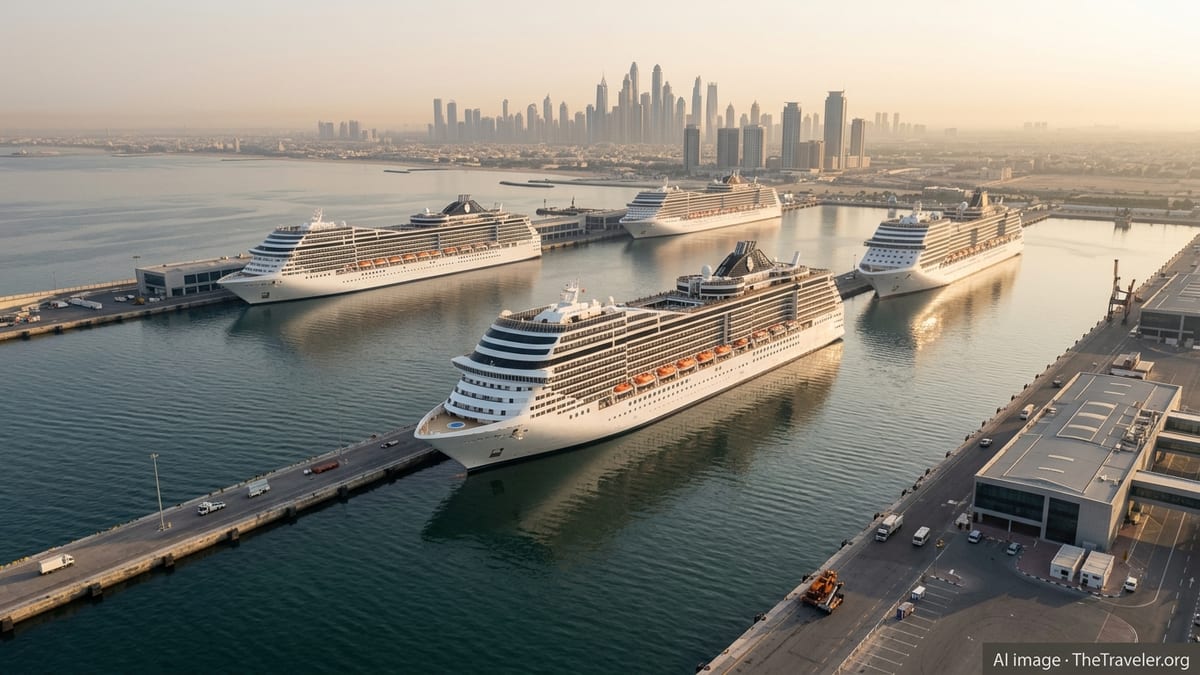
Cruise Vessels Caught in a Fast-Moving Security Crisis
Publicly available maritime tracking data and recent coverage of the Strait of Hormuz crisis indicate that six large cruise ships operating winter programs in the Arabian Gulf have been effectively stranded in port or confined to sheltered waters. The affected vessels include Saudi-based Aroya Cruises’ flagship Aroya, Celestyal Discovery and Celestyal Journey from Celestyal Cruises, MSC Cruises’ LNG-powered MSC Euribia, and TUI Cruises’ Mein Schiff 4 and Mein Schiff 5.
Reports describe these ships as unable to continue their advertised itineraries after Iran declared the Strait of Hormuz closed and regional tensions escalated, triggering a broader pullback from Gulf sailings. Cruise lines halted embarkations and disembarkations at key turnaround ports and began cancelling or truncating voyages, leaving an estimated 15,000 passengers waiting for alternative travel arrangements or extended hotel-style stays on board.
The disruption follows a surge in missile and drone activity across the region and targeted strikes on infrastructure in Gulf states, which have sharply increased perceived risk for high-profile passenger ships. While commercial cargo vessels have in some cases continued limited operations, cruise lines have adopted a more conservative approach, prioritising passenger safety and insurance compliance over schedule integrity.
Insurance, Airspace Closures and Operational Constraints
Maritime advisories issued in early March describe a cascading series of operational challenges that have overwhelmed normal planning for regional cruise deployments. Shipowners and insurers have broadly withdrawn war-risk coverage for transits through the Strait of Hormuz, transforming routine repositioning voyages into high-risk movements that many operators now consider commercially untenable.
At the same time, airspace closures and flight suspensions across multiple Gulf and neighbouring countries have complicated the usual safety valve for disrupted cruises, which is to fly guests home once a sailing is cancelled. Port circulars and carrier notices indicate that while many ports in Saudi Arabia and the wider Gulf remain technically open, passenger movements are constrained by suspended or heavily reduced flight schedules throughout the region.
Industry logistics updates highlight a sharp fall in overall vessel traffic in and out of the Arabian Gulf, driven partly by AIS disruptions and navigational warnings, but even more by the repricing and withdrawal of insurance coverage. For cruise operators, whose business model relies on predictable port calls and seamless air-sea connectivity, this combination of restricted sea lanes and constrained air travel has effectively frozen ships in place.
Passenger Experience: Extended Stays, Cancellations and Repatriation
Travellers caught on board the stranded ships describe an experience that is closer to an unplanned hotel stay than a conventional cruise holiday. Social media posts and forum discussions suggest that many passengers have been informed of itinerary cancellations while remaining aboard vessels safely berthed in ports such as Dubai or anchored in nearby sheltered waters, with onboard services maintained but port calls drastically curtailed.
Some reports indicate that cruise lines are offering full refunds, future cruise credits or a combination of both, along with assistance in arranging onward travel when flights are available. In cases where nearby airports remain accessible, guests have begun to disembark in stages, flying out via alternative hubs in less affected countries. Others are opting to remain on board until a clearer and more stable exit option emerges.
The disruption is also affecting would-be passengers whose voyages were scheduled to embark in the coming weeks. Many have received cancellation notices and refund offers, with operators suspending new bookings for Gulf itineraries while they reassess deployment plans. Travel agents and cruise specialists are steering clients toward Mediterranean, Northern Europe and Caribbean sailings that are less exposed to current Middle East security dynamics.
Wider Travel and Cruise Industry Repercussions
The stranding of six cruise ships in the Arabian Gulf is emerging as one of the most visible tourism-related consequences of the wider Strait of Hormuz crisis, which has already disrupted energy shipments and container traffic. Travel industry analysts point to the episode as evidence of how quickly a niche but fast-growing Gulf cruise market can be upended by geopolitical shocks, especially when those shocks intersect with critical maritime chokepoints.
Several lines had invested heavily in winter Arabian Gulf programs, positioning modern ships in Dubai, Doha and Saudi ports to capture rising demand for week-long itineraries combining sun, shopping and heritage sites. The current suspension of operations raises questions about the pace at which these deployments can resume, and whether travellers will remain confident about booking Gulf cruises for upcoming seasons.
Beyond cruise holidays, the disruption is spilling over into the broader travel ecosystem. Airline schedules, hotel occupancy patterns in key Gulf cities and tour operator programs throughout the region are all being adjusted in real time. Insurers, port authorities and global distribution networks are closely monitoring developments, as extended instability could reshape preferred routings and winter homeports for years to come.
Uncertain Timeline for Recovery in the Arabian Gulf
Forecasts for when the six stranded cruise ships will be able to reposition out of the Arabian Gulf remain highly uncertain. Analysts tracking naval deployments and diplomatic efforts suggest that any reopening of the Strait of Hormuz to routine passenger traffic is likely to lag behind the limited movements already being contemplated for essential cargo and energy shipments.
For cruise brands, the decision to redeploy vessels hinges on more than a simple lifting of navigational warnings. Operators are expected to wait for sustained reductions in military activity, restored war-risk coverage at commercially viable rates, and improved air connectivity to key source markets. Until those conditions are met, ships may remain in safe harbour, or be repositioned via lengthy alternate routes if an acceptable insurance solution can be found.
The immediate focus for the sector remains on caring for affected passengers, preserving brand trust and rebalancing global fleets to minimise further disruption. Yet the episode has already added a new chapter to the risk calculations that underpin modern cruising, underscoring how deeply the industry’s fortunes are tied to the stability of strategic sea lanes such as the Strait of Hormuz.